PROGRAMAS DE IMIGRAÇÃO
PGWP Ended: What Now? Your Real Options in Canada in 2026
In this article
PGWP: apply within 180 days of completion (open work permit up to 3 years). Expired? 4 ways out: recapture, LMIA, Francophone Mobility (CLB 5), BOWP.
IMIGRANDO COM FACULDADE: O QUE EU FARIA (com ou sem experiência)
Vai fazer college no Canadá? Veja isso antes! | EP 09
IMIGRANDO SEM FACULDADE: O QUE EU FARIA
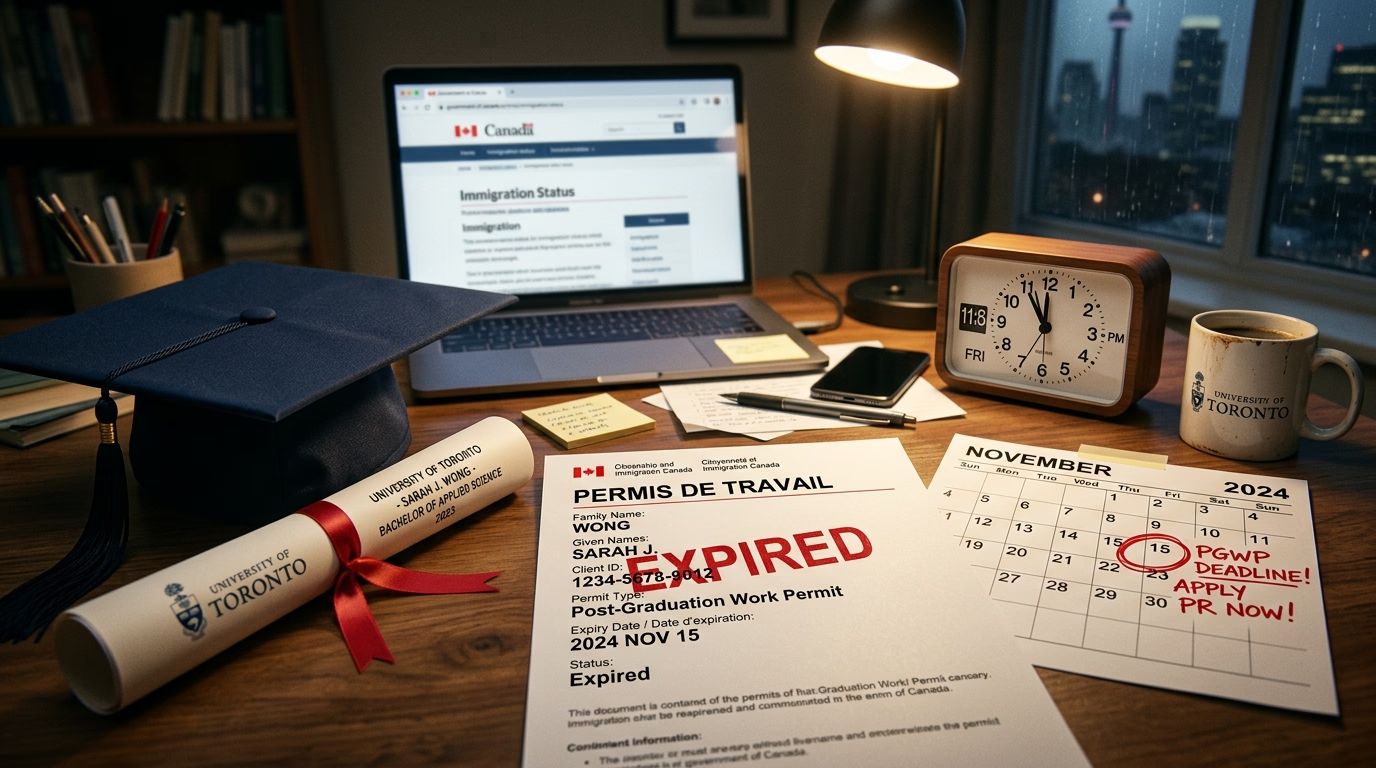
I remember the feeling exactly. You open your work permit, look at the expiry date, do the math in your head, and realize: only a few months left. And then comes that cold knot in your stomach. That thought that wakes you up at 3 a.m.: “what if I can’t sort this out in time?” I know how it feels, man. I know because I’ve been in that spot, staring at a document with an expiry date and feeling the floor disappear.
If your PGWP is running out, this article is for you. I won’t waste your time with motivational fluff. I’ll give you the facts, the real options, and an action plan. Because when the clock is ticking, what you need is clarity, not empty hope.
How do you get the PGWP in Canada after graduation?
The Post-Graduation Work Permit (PGWP) is an open work permit issued after you complete an eligible program, with no tie to a specific employer. To be eligible you must have:
- Completed a program of at least 8 months at an approved Designated Learning Institution (DLI)
- Been a full-time student throughout the program (there is an exception for the last 2 semesters in part-time)
- For programs starting after November 1, 2024: a field of study that is on the IRCC list of eligible NOCs
| Program length | PGWP granted |
|---|---|
| 8 months to less than 2 years | Equal to the program length |
| 2 years or more | Maximum 3 years |
| 2+ combined programs (if they total ≥2 years) | Can reach up to 3 years |
Application deadline: 180 days from the date of your letter of completion (not the convocation date). Apply online at canada.ca. Required documents: valid passport, transcripts, letter of completion, proof of your study permit.
If you’re already on the PGWP and not in the application process, read what’s below: what to do when the permit is about to expire.
The hard truth: there is NO PGWP extension
I’ll be direct because there’s a lot of misinformation going around: there is no PGWP extension. Full stop. There’s no hidden form, no new program that extends it, no workaround. The PGWP is issued once, for the length you’re entitled to, and when it’s over, it’s over.
I know that hurts to hear. I know you’re frantically searching “PGWP extension 2026” online. I’d do the same. But that’s the truth, and the sooner you accept it, the faster you can act on the options that actually exist.
Now, there’s one important exception, and that’s where we’ll start.
Option 1: Time recapture, getting back what’s yours by right
This is the one fewest people know about, and it can save your situation. If your PGWP was issued for a period shorter than you were entitled to, for example because your passport was close to expiring and the work permit could only run to the passport date, you can request to recapture that remaining time.
Here’s how it works: if you finished a 3-year program but received a PGWP of only 1 year and a half because your passport expired sooner, the other 1 year and a half are yours. You can ask for them back.
But heads up, this process has very specific rules:
- It’s a PAPER application. Yes, in 2026. It’s one of the only applications that still hasn’t been digitized. You have to print it, fill it out, and mail it.
- There’s no automatic confirmation of receipt. Unlike submitting an online application and getting a reference number on the spot, here the silence is deafening.
- Use courier or Canada Post with tracking and signature. This isn’t a suggestion, it’s a necessity. Because without proof of mailing, it’s your word against nothing.
- Your original work permit MUST carry a remark saying its validity was limited to the passport expiry (“valid till end of passport expiry”). If that remark isn’t there, recapture doesn’t apply.
- If the application is returned as incomplete: STOP WORKING IMMEDIATELY. This is serious, understand? If it comes back, your status may be compromised.
And here’s a detail that can help you: while the application is being processed, you can show your employer the tracking confirmation with signature, along with your maintained-status documentation, as proof that you’re in a legitimate process. Many employers accept that.
Option 2: Work permit via LMIA, the most common path (and the slowest)
If recapture doesn’t apply to you, the most direct path to a new work permit is through an LMIA. And here the lead role isn’t yours, it’s your employer’s.
The LMIA (Labour Market Impact Assessment) is the document the government issues authorizing a company to hire a foreign worker. Without it, in most cases, there’s no new work permit after the PGWP expires.
The numbers you need to know
- LMIA to support PR: processing takes roughly 1 year. A whole year, man.
- Regular high-wage LMIA: processing around 4 to 5 months.
- New high-wage LMIA timeline: the government announced processing in 60 business days. That’s a significant improvement, but still not fast.
- Low-wage LMIA: this stream has been effectively shut down. In regions where unemployment is above 6%, employers can’t even apply for LMIAs in certain sectors.
- Wage threshold: the minimum to qualify in the high-wage stream is roughly CAD 36/hour, and it varies by province. If your wage is below that, your options get much more limited.
The strategy if your PGWP is expiring
If your employer has already submitted a genuine LMIA, with a file number and everything, you can submit a work permit extension using the LMIA submission and the payment receipt as proof. That shows IRCC there’s a legitimate process underway.
But heads up: the employer must have actually started the process. Just promising to do it isn’t enough. You need the LMIA file number and proof the application was submitted and paid.
Talk to your employer as early as possible. Like, yesterday. Because if they need 4 to 5 months to process the LMIA and your PGWP expires in 3 months, every day that passes is a day less to fix it.
Option 3: Francophone Mobility, the French advantage
If you speak French, man, you’ve got an ace up your sleeve that most people don’t even know exists. The Francophone Mobility program allows work permit extensions for those with a level of CLB 5 or higher in French.
I’ve already written extensively about why French is the secret weapon of Canadian immigration, and this is one more proof. While everyone else is fighting over the same narrow path, French speakers have a side door open.
How it works in practice
- The employer has to submit an offer in the employer portal. It’s not you who does it, it’s the company.
- The submission generates an A number and an O number. These are the reference numbers you’ll use in your application.
- You fill out form 5710 online with all the supporting documentation.
- The employer compliance fee (CAD 230) does not expire once it’s been tied to the employee. So if the employer paid, it’s paid.
The CLB 5 requirement isn’t impossible. It’s an intermediate level of French, not fluency, just functionality. If you’re Brazilian, we have a natural advantage with French since it’s a Romance language. You can reach CLB 5 with 6 to 12 months of focused study.
If you haven’t yet considered French as an immigration strategy, now is the time. Seriously. You can’t ignore this path.
Option 4: Bridging Open Work Permit (BOWP), when PR is in the oven
If you already have a permanent residence application in the queue, the Bridging Open Work Permit can be your lifeline. The BOWP lets you keep working while you wait for your PR decision.
But there are details that can complicate things:
- For PR applications that aren’t through Express Entry, like certain provincial programs, the AOR (Acknowledgement of Receipt) can take a LONG time. And without the AOR, it’s hard to prove you have an active application.
- If your PNP is employer-driven, changing employers gets complicated. It depends on the specific program, whether the Expression of Interest was tied to the employer, and the province’s rules.
- You need proof of the AOR to apply for the BOWP. If the PR portal is taking months to issue the AOR, that becomes a real problem. It’s a bureaucratic pothole that catches a lot of people off guard.
The BOWP is a good option when it works, but it depends on timing. If your PGWP expires before you get the AOR for your PR, there’s a gap that needs to be resolved, and that’s the gap where the other options (LMIA, Francophone Mobility) come in as backup.
What NOBODY tells you: the full-time studies trap
This one’s a bomb I need to drop, because people are falling into this trap without knowing.
If you’re on the PGWP and decided to go back to studying full-time, pay maximum attention. Work experience gained while you’re studying full-time is NOT eligible for the CEC (Canadian Experience Class). That means the time you worked while you were a full-time student simply doesn’t count toward Express Entry via CEC.
In 2023, a policy came out allowing work permit holders to study without needing a separate study permit. A lot of people understood this as “I can study and work and it’s all fine.” But what happened was that people who started studying full-time while working stopped the clock on their CEC eligibility without knowing it.
The rule is clear: part-time students CAN count their work experience. Full-time students, CANNOT.
If you’re thinking about studying while your PGWP is active, do it part-time. Don’t kill your CEC eligibility over a detail nobody explained to you.
The bigger picture: why everything is so hard
Look, I understand the frustration. But to have perspective, you need to understand the size of the problem the government is trying to solve:
- 2.1 million temporary residents had their documents expire in 2025.
- 1.9 million are expected to expire in 2026.
- The government’s goal is to reduce the number of temporary residents to 5% of the population by 2027.
These are huge numbers. And what that means in practice is that the system is overloaded, the rules are getting stricter, and the competition for every PR spot is fiercer than ever.
I’m not saying this to discourage you. I’m saying it so you understand the urgency. The window of opportunity for anyone with an active PGWP is NOW. Every month that passes without action is a month lost in an environment that only gets tighter.
How do you run a week-by-week action plan if your PGWP is running out?
If your PGWP is running out in the next few months, here’s what I’d do, and what I recommend you do, starting today:
Week 1: Diagnosis
- Check the exact expiry date of your PGWP
- See if your work permit has the remark about validity until passport expiry (for recapture)
- Calculate your current CRS in Express Entry
- List all your immigration documents and what’s missing
Week 2: Talk to your employer
- Talk to your employer about an LMIA, be direct and honest about your situation
- Ask if the company has done an LMIA before and whether it’s willing to do one
- If the employer agrees, ask them to start the process IMMEDIATELY
- Explore whether Francophone Mobility applies (if you speak French)
Week 3: Documentation
- Start gathering all the documents for whichever pathway applies
- If it’s recapture: prepare the paper application with tracked courier
- If it’s LMIA: gather your employment records, pay stubs, letters
- If you have PR in the queue: organize the AOR proof for the BOWP
Week 4: Parallel action
- Submit ALL possible applications, don’t wait for one to respond before sending another
- Update your Express Entry profile if you don’t have one yet
- If you don’t speak French: start studying. CLB 5 in 6 to 12 months is realistic
- Keep a record of EVERYTHING, dates, reference numbers, mailing receipts
Ongoing
- Monitor the status of all applications weekly
- Keep copies of everything, digital AND physical
- If something is returned or refused, act the same day, don’t wait
You’re not alone
Man, I know reading all this is heavy. It’s a lot of information, a lot of bureaucracy, a lot of uncertainty. And when you’re in the middle of it, with your permit’s expiry date approaching, everything feels impossible.
But look: you have options. Four real, concrete options that I just showed you. Recapture, LMIA, Francophone Mobility, BOWP. None of them are easy, none of them are fast, but all of them are legitimate paths.
The worst thing you can do right now is stand still. The second worst is to panic and make a rushed decision. The middle path is this: understand your options, build a plan, and execute with discipline and urgency.
I’m on this journey too. I understand the weight of depending on a document with an expiry date just to keep building the life I chose to build here. It’s not easy. But it’s possible.
If you know someone whose PGWP is running out, send them this article. The right information at the right time can change a life.
I got your back. Let’s go.
Frequently asked questions
How do you get the PGWP in Canada after graduation?
Is it possible to extend the PGWP in Canada?
What is PGWP time recapture and when does it apply?
How long does an LMIA take for a work permit extension in 2026?
How does Francophone Mobility work for a work permit extension?
Why is studying full-time while on the PGWP a trap?
This article reflects the rules in force as of April 2026. Immigration policies change frequently, always confirm information directly with IRCC before making decisions.
The Vancouver Letter
You made it this far. That tells me something.
The Vancouver Letter is the letter I wish someone had sent me the third time I tried for Canada, when I had no idea what I was doing wrong. Once a week, straight to your inbox. No products, no courses, just what actually works. I got your back.
Get immigration updates
Practical tips straight to your inbox.
Related articles

LMIA and work permit: everything you need to know
LMIA in Canada in 2026: CAD 1,000 fee, 8-12 weeks, 50-200 CRS points. Tech via Global Talent Stream in 2 weeks. Cap dropped 367k to 230k.
Canada's New PR Program: Answers to the Most Common Questions
When does the new PR arrive? Is Express Entry still worth it? What to do now? Direct answers about the 2026 reform of Canada immigration system.

Canada study permit: what changed in 2026
Study permit in 2026: cap dropped 305k to 155k, GIC rose to CAD 20,635, PGWP needs an eligible field. Analysis from someone who landed in Vancouver in 2024.