BUROCRACIA
Reference Letters: The Most Important Document in Your Express Entry
In this article
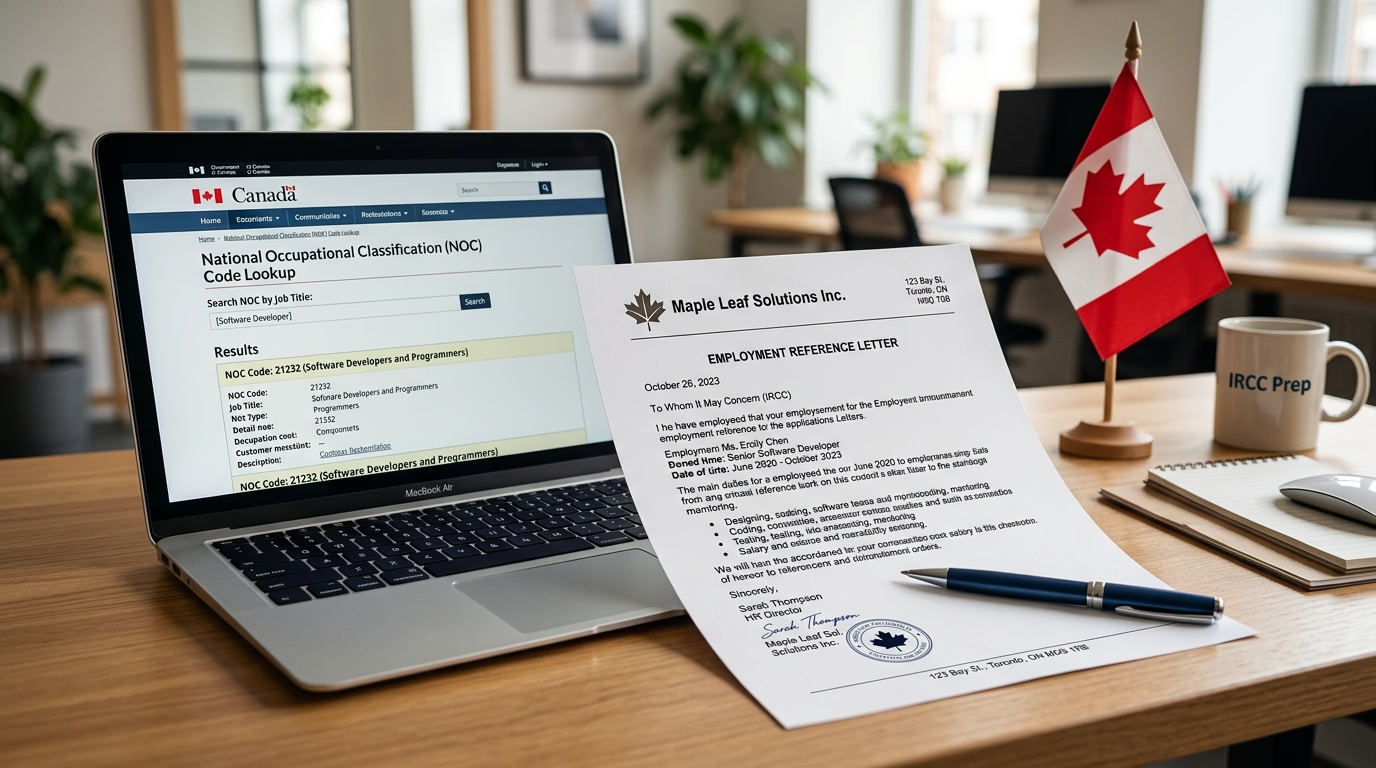
The reference letter is the most decisive document in your Express Entry. Without salary, an aligned NOC, and letterhead, they reject you even with a high CRS.
EXPRESS ENTRY 2025: DESCUBRA COMO CRIAR SEU PERFIL!
5 Segredos Para Aumentar Suas Chances No Express Entry!
I remember the exact feeling. I was in the middle of a retail shift, around 3 p.m. on some random Tuesday, and I needed to ask my manager to write a letter saying what I did at work. Sounds simple, right? But man, that conversation was one of the most awkward I’ve ever had. My manager looked at me confused, like “why do you need this?”, and there I was trying to explain that the Canadian government wants a letter with details he didn’t even know existed. Hourly wage, a job description aligned with an occupation code, weekly hours, benefits…
And you know what I found out later? That letter, the reference letter, is probably the single most important document in your entire Express Entry application. More important than your degree. More important than your IELTS or CELPIP result. Because if the reference letter is wrong, incomplete, or badly written, your application can be refused. Full stop.
Why the reference letter is so decisive
Express Entry works like this: you declare your work experience in your profile, you earn CRS points for it, you get the ITA, and then you have to prove everything you declared. The reference letter is the main proof of your work experience. It’s the document that confirms to IRCC that you really worked in that role, performed those duties, and earned that salary.
If you’re not getting how serious this is, let me be more direct: people with excellent profiles, high CRS, perfect English, validated degree, had their application refused because the reference letter didn’t have the right elements. All that investment of time and money thrown in the trash because of one letter.
And in the case of foreign experience (outside Canada), the situation is even more critical. The reference letter is the only mandatory document to prove your international experience. There’s no plan B that fully replaces it. The other documents, pay stubs, bank statements, tax returns, are only supplementary.
If you haven’t started worrying about this yet, now is the time. If you already have your Express Entry profile created, this letter needs to be at the top of your priority list.
What MUST be in the letter?
I’ll list every element IRCC requires. If any of these is missing, your letter is incomplete and you’re taking an unnecessary risk.
-
Company letterhead: the letter MUST be printed on paper with the company logo, name, and address. A letter written on generic white paper is asking to be questioned.
-
Exact job title: your job title, exactly as it was. Don’t make it up, don’t dress it up. If you were a “Retail Sales Associate”, that’s what goes on the letter.
-
Description of duties aligned with the NOC code: this is the most critical part. The duties described need to match a substantial number of the bullet points in your NOC code. And it needs to include the lead statement, that main sentence that summarizes the occupation in the NOC. That sentence is the most important one in the whole letter.
-
Start and end dates: the month and year you started and ended in that role. If you still work there, the end date is “present” or “to date”.
-
Hours of work per week: a minimum of 30 hours per week to count as full-time. If you worked less, it can count as part-time, but the math changes.
-
Salary/compensation: MANDATORY. This is not optional. Applications are refused for not including the salary. It can be hourly, monthly, or annual, but it has to be there.
-
Benefits: mention the benefits you received. At minimum, something like “the employee participates in the company’s benefits program”. Sounds like a detail, but it’s one of the items IRCC expects to see.
-
Direct contact information: name, title, phone, and email of the supervisor or HR person who can confirm the information. IRCC may call. And they do.
Every one of these items matters. It’s not a question of “ah, I’ll include most of them and it should be fine”. IRCC is meticulous. And when they ask for something, they expect to receive exactly that.
How to align duties with the NOC correctly?
This part is where most people slip up, and it’s where I had to sit down and study a lot when I did mine.
The NOC system (National Occupational Classification) is how Canada classifies all occupations. Each NOC code has a list of typical duties, the bullet points. Your reference letter needs to show that you performed a substantial number of those duties.
The most important thing of all: the lead statement. It’s the first sentence in each NOC description, like the summary of the occupation. That sentence needs to be reflected in your letter. If the NOC says “supervise and coordinate activities of workers” and your letter doesn’t even mention supervision, you’ve got a problem.
Now, one point that takes the pressure off: you don’t need to cover 100% of the bullet points. IRCC uses the phrase “substantial number of main duties”, which in practice means most, not all of them. And your job title at the company doesn’t need to be identical to the NOC title. What matters is the description of the duties, not the name of the role.
Practical tip: take the duties list from your NOC code, put it next to your letter, and align it point by point. Like a matching spreadsheet. That’s exactly what the IRCC officer will do when reviewing your application, so you’re making their job easier.
When the employer won’t (or can’t) help
This is the reality for a lot of people. When I worked at the startup, asking for the letter was relatively easy, small company, accessible management. But in retail? My manager had no idea what a NOC was, had never heard of Express Entry, and honestly wasn’t all that interested in stopping to write a detailed letter.
If your employer won’t cooperate, don’t panic. But know that the situation gets riskier.
What you can do:
Write a draft yourself and ask the employer to review and sign it. This is perfectly acceptable and, honestly, it’s what most people do. You know the requirements better than the company’s HR.
Gather supplementary documentation: if the letter comes out weak or incomplete, reinforce it with:
- Pay stubs showing your salary
- Employment contract with the terms of employment
- T4s (for Canadian experience) or income tax equivalents (for foreign experience)
- Bank statements showing employer deposits
But careful: none of these documents replaces the reference letter. They complement it. The risk of refusal is always higher when you don’t have exactly what IRCC asks for.
And an important warning: self-signed declarations (like a lawyer-notarized affidavit saying “I worked at X place”) are NOT accepted as standalone proof. They can help as a complement, but on their own, they don’t solve the problem.
How to declare multiple roles with the same employer?
This trap almost got me. If you worked at the same company but changed roles, say, you started as a salesperson and then became a supervisor, each position needs to be a separate entry in your work history in Express Entry.
A lot of people make the mistake of listing only the most recent role (the most senior one) to cover the entire period of employment. That’s inaccurate and can be interpreted as misrepresentation, which is serious business in the Canadian immigration context.
The good news: you can have a single reference letter covering all the positions. You just need to detail:
- The exact dates (month/year) of each role
- The salary in each position (including changes)
- The specific duties of each role
- Additional responsibilities that accumulated
If there was a NOC change from one role to another (for example, from salesperson to manager), this is especially important to separate. Each different NOC is a different entry in the system.
Which date traps should you avoid in Express Entry?
This one is something few people talk about and that can cause serious problems.
The Express Entry system asks only for month and year, it doesn’t ask for the specific day. That seems irrelevant, but it creates a dangerous situation: if you started working on April 30, the system gives you credit for the entire month of April. In practice, you worked 1 day, but the system counted it as the full month.
And here’s the problem: if the system over-calculated your points because of this, it’s YOUR responsibility to recognize and correct it. Not the system’s. Not IRCC’s. Yours. If they find out later that your points were inflated, even if it wasn’t intentional, you can face serious consequences.
For those in the Canadian Experience Class (CEC), the calculation is by hours: you need 1,560 hours of work. If you have an irregular schedule, night shift, part-time, variable hours, track your hours closely. Write everything down. Keep your pay stubs, keep a spreadsheet, keep whatever you can.
Another detail: the end date of the job is the last day you actually worked, not the last day you received pay. If you left the company on March 15 but were paid out vacation until the 30th, the end date is March 15.
What a good reference letter should contain (general structure)
I’m not going to give you a copy-and-paste template, because every situation is different and copying a generic model is one of the most common ways to get into trouble. But I’ll explain what each section should contain.
Header: company letterhead, date of issue, recipient (can be “To Whom It May Concern” or “Immigration, Refugees and Citizenship Canada”).
Identification paragraph: who the employee is (full name, date of birth can help), who is issuing the letter (name, title, relationship to the employee), and confirmation that the information is true.
Employment details: job title, period (start and end dates), type of employment (full-time/part-time), weekly hours, salary (with frequency, hourly, monthly, annual), and benefits.
Description of duties: here is the heart of the letter. List each duty performed, aligning it with the bullet points of the chosen NOC. Start with the lead statement. Be specific, “managing a team of 5 people” is better than “responsible for management”. The more concrete, the better.
Closing: the signatory’s contact information (direct phone and professional email), signature, and date.
The whole letter doesn’t need to be long, 1 to 2 pages is ideal. What matters is that it’s complete, not that it’s pretty.
What are the most common mistakes that cause refusal?
After a lot of research and conversations with people who’ve been through it, I compiled the mistakes that show up most:
-
Not including salary: this is the refusal champion. Seems absurd, but a lot of people forget. IRCC is categorical: no salary, no approval.
-
Duties that are too generic: “responsible for various tasks” says nothing. The officer needs to see specific duties that match the NOC.
-
Not including the NOC lead statement: if the main occupation description isn’t reflected in the letter, the officer may question whether the role really corresponds to the declared NOC.
-
Using a job posting instead of a reference letter: a job posting describes what the employer expected of the role, not what you actually did. IRCC wants the second one.
-
Listing only the most recent role in promotions: as I said above, each position is a separate entry. Listing only the senior role for the entire period is inaccurate.
-
Not including verifiable contact information: if the officer can’t confirm the information, the letter loses credibility.
-
Inconsistent dates: if the letter says “January 2020” but your pay stub shows you started in March 2020, you’ve got a problem. Check EVERYTHING before submitting.
-
Letter without letterhead: seems obvious, but it happens. A letter on white paper raises immediate suspicion.
-
Confusing an offer of employment with a reference letter: an offer letter is a document aimed at the future (“we’re offering you this role”). A reference letter is aimed at the past (“this person worked with us and performed these duties”). IRCC wants the second one, and the first carries much less weight.
-
Not separating experience by NOC when there was a change of role: if you performed duties for two different NOCs at the same company, you need to separate them. Mixing everything into a single entry distorts the information.
Final checklist: before you submit, check everything
Use this list to review your reference letter before including it in your application:
- Letter on company letterhead
- Employee’s full name and title
- Exact job title
- Start and end dates (month/year)
- Weekly hours of work (minimum 30h for full-time)
- Salary/compensation with frequency
- Benefits mentioned
- NOC lead statement reflected in the description
- Duties aligned with a substantial number of NOC bullet points
- Name, title, phone, and email of the signatory
- Signature of the supervisor or HR
- Dates consistent with pay stubs and T4s/tax returns
- Separate entries for each role (if there was a promotion or change of role)
- Foreign experience accompanied by supplementary documentation
Frequently asked questions
Why is the reference letter so decisive in Express Entry?
What must mandatorily be in the reference letter?
What if the employer will not or does not know how to write the letter?
How does the calculation of hours and dates work in Express Entry?
What are the most common mistakes that cause refusal?
Start now
I know asking for a reference letter is annoying, awkward, and a hassle. I know because I went through it, both in retail and at the startup. And neither time was a comfortable conversation.
But man, if there’s one thing I learned in this immigration process, it’s that temporary discomfort is infinitely better than permanent refusal. A well-made letter takes a week to sort out. A refused application can cost you months, money, and the entire opportunity.
If you’re in the middle of the Express Entry process, start gathering your letters now. Don’t wait for the ITA to arrive before chasing them down, you’ll only have 60 days to submit everything after the invitation, and believe me, 60 days flies by.
If you haven’t organized your complete documentation yet, that’s the next step. And if you’re at the start of the journey and want to understand the whole system, the complete Express Entry guide is where to begin.
I got your back on this one. One document at a time, we’ll get there.
The Vancouver Letter
You made it this far. That tells me something.
The Vancouver Letter is the letter I wish someone had sent me the third time I tried for Canada, when I had no idea what I was doing wrong. Once a week, straight to your inbox. No products, no courses, just what actually works. I got your back.
Get immigration updates
Practical tips straight to your inbox.
Related articles

Concurrent work experience in Express Entry: the loophole few people know about
Express Entry loophole confirmed by IRCC: simultaneous Canadian and foreign work can add 38 CRS points. But it might not last.
Canada's New PR Program: Answers to the Most Common Questions
When does the new PR arrive? Is Express Entry still worth it? What to do now? Direct answers about the 2026 reform of Canada immigration system.

Express Entry: The Complete Guide for Brazilians in 2026
Express Entry: CRS 480-520 in 2026 general draws, but French adds up to 50 points and opens category draws with cutoffs of 380-450. The full strategy.