NOTÍCIAS
Bill C-12: The Law That Changed Everything in Canadian Immigration in 2026
In this article
Bill C-12 passed and gave the government unprecedented powers over immigration. Here is what changes for refugees, PRs, and temporary residents.
Crise Imigratória no Canadá: A Renúncia de Trudeau Explicada
Sua imigração COMPROMETIDA e mais CATÁSTOFRES do governo CANADENSE | EP04
DESCUBRA O QUE O PRIMEIRO MINISTRO REALMENTE PENSA SOBRE IMIGRAÇÃO!
I saw the news that Bill C-12 had passed and, man, my first reaction was to open the full text of the law and try to understand what was happening. Because when you live in Canada on a temporary visa, working at a startup, building your life here in Vancouver, any change to immigration legislation hits you in the gut. Even when it is not directly about you.
And this law… this law changes a LOT. Not just for refugees, who are the most immediately affected, but for anyone with an immigration process underway in Canada. Including you, reading this.
I’ll walk you through everything I understood, with the real numbers, no fluff. Because wrong information at this moment can cost you dearly.
What is Bill C-12?
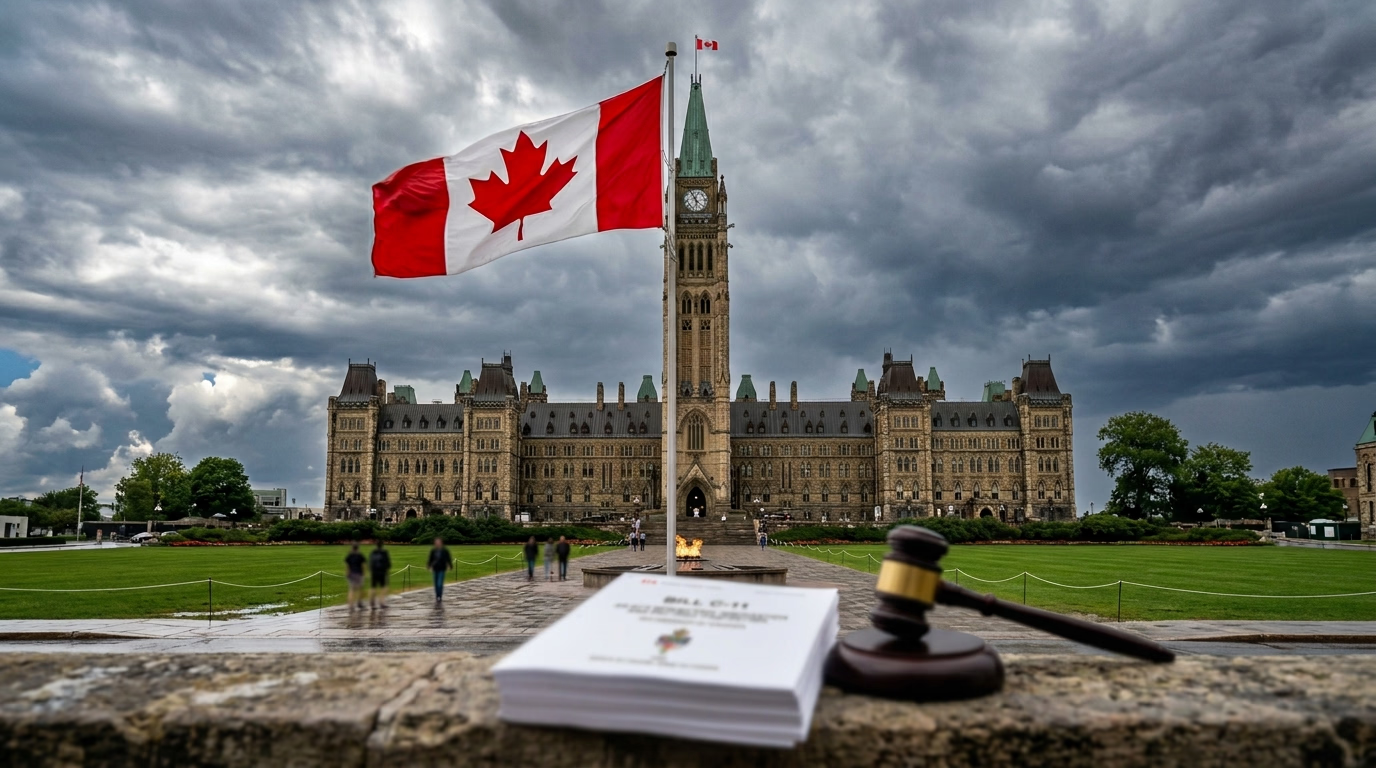
Bill C-12 is a federal law that passed in late March/early April 2026 and gave the Canadian government unprecedented powers over the immigration system. It is not a one-off change. It is a reshaping of how IRCC can deal with applications, refugees, and data sharing between government bodies.
The most striking part: the law passed with almost unanimous bipartisan support. There was no significant resistance from any party. The Senate even recommended privacy safeguards, but those recommendations were not accepted. The only amendment that passed was a mandatory review of the law in 5 years.
In other words: the government has a blank cheque. And it has already started using it.
IRCC began sending notifications to those affected immediately after the law came into force. This is not theory, not “it could happen”. It is already happening.
The most brutal change: the retroactive rules for refugees
This is the part that made me most uncomfortable, and I’ll explain why.
Bill C-12 created two rules that directly affect anyone who claimed asylum in Canada:
The 1-Year Rule
If your first entry into Canada was after June 24, 2020, your refugee claim is now ineligible to be referred to the Immigration and Refugee Board (IRB). Just like that. It does not matter how long you have been waiting, it does not matter your situation. If you entered after that date, you lost the right to have your case heard by the refugee tribunal.
The 14-Day Land Border Rule
If you entered Canada through the land border with the United States and more than 14 days have passed, your claim is also ineligible.
And here is the catch: these rules are retroactive. They do not apply only to new claims. They apply to people who were already waiting. People who left everything behind, crossed the border, and had been waiting months or years for a hearing woke up one day to a notification saying their case would no longer be heard.
The only recourse left is the Pre-Removal Risk Assessment (PRRA), which is a much harder standard. You have to prove a risk of persecution or torture in your country of origin. It is no longer “I’m afraid to go back”. It is “I will be tortured if I go back”. The bar rose dramatically.
The backlog numbers
To give you a sense of the scale: there are roughly 100,800 refugee claims waiting to be processed, with some reports pointing to more than 300,000 in total when you include all stages. The posted average processing time is 16 months.
I know what you might be thinking: “Caio, but this does not affect me, I’m not a refugee.” And that may be true. But the issue is bigger than that, and I’ll explain why in a moment.
How does Bill C-12 expand IRCC’s cancellation powers?
This is where the law gets scary for EVERYONE with a process at IRCC.
Bill C-12 did not just give the government powers over refugees. It created authority to cancel or discontinue immigration applications broadly. The grounds include:
- Fraud
- Administrative errors
- Public health
- Public safety
- National security
And here is the detail that made me stop and re-read it three times: the law uses the word “include”, which means this list is not exhaustive. The government can define additional grounds without needing to change the law.
I work with data, right? And when you read legislation that says “the grounds include X, Y and Z”, you know the door is open to anything. It is an open list by design.
In practice, this means this cancellation authority could theoretically be used in programs like:
| Program | Current queue | Processing |
|---|---|---|
| Startup Visa | 45,600 in queue | ~500/year (paused since Jan 2026) |
| Self-Employed | 8,100 in queue | Slow |
| Humanitarian and Compassionate (H&C) | 50,000+ in queue | ~1,000/year |
Look at those H&C numbers: 50,000 applications waiting, with 1,000 processed per year. Do the math with me: that is more than 50 years of backlog. Fifty years. That is not an immigration system, it is a lifelong queue.
And the Startup Visa? 45,600 people waiting, program paused since January 2026, processing about 500 per year. That is 91 years of queue. The government literally stopped processing.
I’m not saying the government WILL use Bill C-12 to cancel all those applications. But the law allows it. And when a government has power, historically, it uses it.
Data sharing: the Big Brother of immigration
This is the part fewest people are talking about, but the one I find most impactful for the daily life of anyone living in Canada.
Bill C-12 authorizes domestic data sharing between:
- CRA (Canada Revenue Agency, the tax authority here)
- ESDC (Employment and Social Development Canada)
- IRCC (Immigration, Refugees and Citizenship Canada)
- CBSA (Canada Border Services Agency)
- Provincial governments
What does that mean in practice? IRCC can now cross-reference employment data, T4 slips (tax pay statements), records of employment, and provincial records. All connected.
Let me give you a concrete example: if you drove for Uber, did a delivery gig, or held any undeclared job while on a study permit that only allowed 20 hours per week, IRCC can now pull your CRA data and see that you received income from a source you did not declare on your application.
Changed provinces and did not update your records? Now they cross-reference information between provinces too.
And man, I have to be honest here: when I arrived in Canada, I spent more than a year in retail earning minimum wage, after an initial month in demolition at CAD 23/hour. I know what it is like to feel the pressure of paying rent in Vancouver, of making the numbers work. I understand why people take undeclared jobs, why they do side gigs. I’m not judging anyone.
But the reality now is that the risk of getting caught for undeclared work has increased exponentially. What used to be hard to trace is now automatic database cross-referencing. And the penalty for misrepresentation, the omission of information, is a 5-year ban.
How does Bill C-12 connect with misrepresentation?
This connects with something that was already happening before Bill C-12 but has now become much more dangerous.
IRCC was already using artificial intelligence to cross-reference all of an applicant’s previous applications. If you did a study permit in 2019 and are now applying for Express Entry in 2026, the system automatically compares all the information you provided in both applications.
Any inconsistency, even a small one, is flagged. A different address, a work experience that appears in one application and not the other, a trip you forgot to list.
With Bill C-12, that cross-referencing now includes CRA, ESDC and provincial data. The history of the last 10 years must be disclosed completely. Everything.
I’ll admit that when I found this out, I went back and reviewed every document I had ever submitted to IRCC. Every form, every declaration. Because an honest mistake from 2024 can turn into a misrepresentation accusation in 2026, you understand?
What this means for YOU
Let’s be practical. Depending on your situation, Bill C-12 affects you in different ways:
If you are a refugee or asylum seeker
The situation is the most urgent. If you entered Canada after June 24, 2020, your case was reclassified. You need to understand your options immediately. The PRRA is far more restrictive, and the standard of proof is different. Do not wait for the notification to arrive; research your options now.
If you are a temporary resident (study permit, work permit)
Review EVERYTHING you have declared. Any unauthorized work, any undeclared income, any inconsistency between previous applications, now is the time to resolve it. Data sharing between CRA and IRCC completely changes the level of risk.
If you have an application underway at IRCC
Whether it is Express Entry, PNP, Startup Visa, H&C, pay attention to any communication from IRCC. The new cancellation powers are broad and the list of grounds is open. Make sure your application is impeccable.
If you are planning to immigrate
Understand that the regulatory environment has changed. Canada wants immigrants, but it wants immigrants who follow the rules to the letter. The margin for error has shrunk drastically.
The elephant in the room: the backlogs that could be eliminated
I’ll put on my data analyst hat for a minute, because the numbers tell a story nobody wants to hear.
The Canadian government has a target to reduce temporary residents to 5% of the population by 2027, with a net reduction of 1 million people. At the same time, it has gigantic backlogs in programs like H&C (50,000+), Startup Visa (45,600), and refugees (100,800+).
Now there is a law that allows applications to be cancelled on broad grounds, including grounds that have not yet been defined.
I’m not one for conspiracy theories. But when you have a reduction target, a backlog impossible to process within normal timelines, and a legal tool that allows queues to be cleared, you do not need to be a data analyst to connect the dots.
This does not mean it WILL happen exactly that way. But it means the possibility exists, and it did not exist before Bill C-12.
What to do NOW
If you take nothing else from this article, take this:
1. Review ALL your previous applications. Pull every form you have submitted to IRCC and compare them. Addresses, work experiences, trips, employment periods. Everything has to match.
2. Declare everything. If you have undeclared income, unauthorized work, or any irregular situation, now is the time to resolve it. CRA and IRCC now talk to each other. What used to be “probably nobody will find out” has become “they will probably cross-reference this information automatically”.
3. Fix errors proactively. If you notice an inconsistency in a previous application, it is better to correct it than to wait for IRCC to find it. A voluntary correction is treated very differently from an omission uncovered by investigation. The difference can be between a request for clarification and a misrepresentation accusation with a 5-year ban.
4. Monitor IRCC communications. Check your MyCIC portal regularly. IRCC is already sending notifications to people affected by the new rules. Do not let a notification slip by unnoticed.
5. Keep your documents organized. T4 slips, records of employment, address history, travel records, everything needs to be accessible and consistent. With data sharing between bodies, any discrepancy can be flagged.
6. Understand your rights. Bill C-12 gave powers to the government, but you still have rights. The PRRA exists as a recourse for affected refugees. There are appeal processes. Do not panic, but do not ignore it either.
My personal take
I believe in the rule of law. I believe a country has the right to control its borders and define who enters and who stays. As a Christian conservative, I believe rules exist for a reason and that respecting them is fundamental.
But I also believe in compassion. And when I see retroactive rules affecting people who had been waiting years for a hearing, who left everything behind to seek safety, who trusted the system, my heart aches. Retroactivity is hard. Changing the rules mid-game for people who were already playing is hard.
The Senate tried to include privacy safeguards and they were not accepted. The only concession was a review in 5 years. That worries me, because unchecked power tends to expand, not contract.
I do not have all the answers. There is a lot in this law whose real impact we will only understand over time, as IRCC starts using these new powers. What I do know is that information is the best defense you have. Understand the law, understand your rights, and protect your process.
And look, I know this article is heavy. It is not the kind of content that is a pleasure to write, and it is probably not the kind that is a pleasure to read. But I would rather give you the raw reality than paint a pretty picture that does not exist.
Canada is still an incredible country to live in. I’m here, building my life, chasing my PR, and I do not regret a single decision. But the environment has changed, and those who do not adapt fall behind.
If you have nothing else to do today, go and review your applications. Seriously. Open MyCIC, pull your forms, and check that everything matches. That is the most concrete thing you can do to protect yourself right now.
I got your back on this journey. And a hard journey is not one we cross alone.
Frequently asked questions
What is Bill C-12 and when did it come into force?
Is Bill C-12 retroactive? Does it affect people already waiting for a refugee hearing?
Does Bill C-12 only affect refugees or temporary residents too?
What changes in data sharing between CRA and IRCC?
What should you do now to protect yourself from Bill C-12?
Immigration rules are changing fast. Follow MorarFora for up-to-date analysis on what is happening and how to protect yourself.
The Vancouver Letter
You made it this far. That tells me something.
The Vancouver Letter is the letter I wish someone had sent me the third time I tried for Canada, when I had no idea what I was doing wrong. Once a week, straight to your inbox. No products, no courses, just what actually works. I got your back.
Get immigration updates
Practical tips straight to your inbox.
Related articles

Canada's Immigration Backlogs by the Numbers: The Analysis Nobody Does
Canada's backlogs: Startup Visa 91 years, H&C 50 years with <1% odds, citizenship 25 real months. Only Express Entry works: 7 months.
Does IRCC make mistakes? Yes: error types and how to challenge [Canadian Immigration Institute]
Canadian Immigration Institute logged 5 IRCC errors in one week. I cover the types, how to spot them, and the 3 ways to challenge, a Brazilian lens.
Canadian PR fees went up on April 30, 2026: what changed in the math
PR through Express Entry in 2026: CAD $1,590 per adult ($990 application + $600 RPRF). A family of 3 pays $3,450. Full table and rules if you already applied.