NOTÍCIAS
Does IRCC make mistakes? Yes: error types and how to challenge [Canadian Immigration Institute]
In this article
Canadian Immigration Institute logged 5 IRCC errors in one week. I cover the types, how to spot them, and the 3 ways to challenge, a Brazilian lens.
Look, I was in Vancouver on Friday (May 1, 2026) having coffee before I opened my laptop when I saw the title of the livestream on the Canadian Immigration Institute channel: “Does IRCC make mistakes?”. The channel has covered Canadian immigration practice in Calgary for over a decade, and the team decided to turn 30 minutes of livestream into a professional venting session about 5 cases of gross IRCC error they got that very week, all paying clients, all with lives upended. And I, 7 years into Canada and still tracking my own Express Entry, dropped everything to listen.
I’m not a lawyer. I’m a data analyst in Vancouver. But what the channel described in that livestream is exactly the kind of thing that keeps me up at night, because I know that for a Brazilian applying from Brazil, with application-level English and no lawyer, a poorly challenged IRCC error turns into a 5-year ban from Canada. Yes, 5 years. It happens.
This post is the honest Brazilian version of the channel’s livestream. What counts as an IRCC error, how you find out you were a victim, what the 3 paths to challenge a decision are under Canadian law, and what changes when the applicant is Brazilian, things the channel, being Canadian, had no reason to cover. No verbatim quotes, no selling a lawyer’s course, no promising approval. The real deal, through the lens of someone on this side trying for PR.
What counts as an “IRCC error”?
The channel opened the livestream with an absurd example from the Calgary office. They were processing a request for a Canadian citizenship certificate for a client living in Singapore. On the official Use of Representative form, the firm entered the Canadian address (Calgary) as the delivery point for the certificate, and the client’s Singapore address as the client. Simple stuff, standard form, two clearly separate addresses in different fields.
When IRCC sent the “acknowledgement of receipt”, the letter confirming the request was received, the address printed on the letter read like this: Singapore street name, city Singapore, state Louisiana, a US postal code, country United States. Where did IRCC get Louisiana? The channel doesn’t know. Nobody knows. The client doesn’t either, and blames the firm.
This is Type 1: transcription/processing error. It could be poorly supervised AI, it could be a bad scan, it could be a new agent who hit tab on the wrong cell. The important point: IRCC treats an applicant’s error (you forgot to declare a trip, mistyped a passport number) as possible misrepresentation with a risk of a 5-year ban. IRCC handling IRCC’s own error? “Just call and we’ll fix it, maybe.” The channel calls this an asymmetry of standards, and they’re right.
The other types that came up in the livestream, categorized:
Type 2: Decision issued without processing a document update
The channel described a client who waited 40 months on an application that should take 12. Stuck in “security screening” with no communication. They filed a mandamus (forcing the federal court to compel IRCC to decide). Six months later, the client gets an email from the portal: they issued the COPR. Victory? No. The COPR came with an expiry in 2 days, because it was issued tied to the children’s passport, and that passport was expiring. The client had already renewed the children’s passport, sent a web form to IRCC, received official confirmation of receipt. The officer who issued the COPR ignored the web form. There was nothing in the internal notes (GCMS notes) about the renewal. It took another 2 to 3 months to cancel and reissue the COPR.
Type 3: Inadmissibility finding without due process
This is the worst one. The channel told of a client whose first spousal open work permit application was refused because “the officer didn’t believe the relationship was genuine”. OK, refusal out of disbelief, nothing more. The client filed a second application. The second refusal says: “refusing because you are inadmissible”. Inadmissible on what basis? Misrepresentation, according to the officer. When? Where? They requested the GCMS notes (IRCC’s internal notes). There wasn’t a single mention of misrepresentation anywhere. No PFL was sent, the Procedural Fairness Letter, the letter the law REQUIRES IRCC to send before declaring someone inadmissible, giving the person a chance to respond. The firm is going to file for judicial review. It’s going to cost the client dearly. It’s going to take over a year. And all because an officer decided the client was misrep with no record at all.
Type 4: Misrepresentation from a bank error
This case is small and brutal: the client sent a bank statement for a study permit. The statement had a bug: the date column showed 2023 instead of 2025, the bank had a known system glitch, fixed later. The top of the statement showed 2025; only the transaction column got the year wrong. The client received a PFL accusing them of fraud. The client went to the bank, got an official letter on letterhead, notarized, from the bank confirming it was their system error, that the transactions were correct, that only the column’s year was wrong. Submitted everything. The IRCC officer responded: “I acknowledge the bank’s explanation, but the transactions were repurposed from another statement”. Misrepresentation confirmed. 5-year ban. Federal court is the only path.
Type 5: Refusal from country bias
This is the one that bothers me most as a Brazilian. The channel said it explicitly, and these are Canadian immigration professionals, so that statement carries weight: the probability of study permit approval doesn’t depend only on the strength of the application. It depends on where you apply from. The team said, with their careers on the line, that they see consistent refusal for applicants from the Middle East and Asia even with applications identical to applicants from Western Europe or the US who got approved. They suspect an internal cap, a quota for how much to refuse. This isn’t a conspiracy theory, it’s the direct observation of people who process hundreds of applications a year.
And yes, Brazil sits in that grey zone. Not as targeted as the Middle East, but not as “trustworthy” as Western Europe or the US in the eyes of poorly trained visa officers.
How do you find out if you were the victim of an error?
This is where most Brazilians waste time. You won’t find out by reading the refusal letter. The letter is boilerplate, template text, usually saying something generic like “you have not satisfied me that you would leave Canada” or “I am not satisfied as to the genuineness of your relationship”. It doesn’t say WHAT failed to satisfy them, doesn’t say WHICH evidence was ignored, doesn’t say WHY the officer didn’t believe you.
To find out what really happened, you need to request the GCMS notes, the internal notes the officer writes while processing the case. That’s what shows: “applicant claims X, but officer notes Y; applicant did not provide Z; transaction inconsistent with W”. Everything in the head of the officer who refused you. Without GCMS notes, you’re fighting in the dark.
How to request the GCMS notes:
- You can request directly via ATIP (Access to Information and Privacy Act), it’s free, but it takes about 30 to 90 days, sometimes more. The channel mentioned that GCMS notes via ATIP “can take forever, months, maybe half a year”.
- If you’re going to file for judicial review, the court forces IRCC to hand over the Rule 9 Reasons, which is basically an excerpt of the GCMS notes. This path is faster (2 to 10 weeks depending on the case) BUT requires you to have already filed the judicial review request. In other words: you commit to the legal path before seeing the evidence. An uncomfortable trade-off.
For those applying from Brazil, do this before you apply:
- Save an exact copy of everything you submitted. The channel recommended a folder labelled by first name, last name, application number. In order. Untouched afterward. I’ve followed this rule since 2018: I have a folder on my Drive called
imigracao_canada_submetidosthat I treat as concrete. Nothing goes in, nothing comes out after I submit. - Write down the UCI numbers (Unique Client Identifier) that IRCC gives you. Every application you make in the future will pull that UCI and show EVERYTHING you’ve submitted before. If you forgot to declare a trip in 2018 and declare it in 2026, IRCC can use that against you. The channel has seen it happen.
- Take a screenshot of every portal screen. The IRCC portal can change status without notifying you, the channel gave the example of the client who discovered a COPR was issued only because they logged into the portal out of curiosity.
What are the paths to challenge a decision?
The channel went through this in detail in the livestream. There are 3 legal paths when IRCC refuses, and the choice between them depends heavily on the deadline and the type of error.
Path 1: Reapply
It’s the simplest and most used. You reapply, fixing what was missing on the first attempt. It’s cheap (just the application fee), fast (you can submit within days), and doesn’t require a lawyer.
When it works: if the refusal was for insufficient documentation that you can improve. Example: missing a letter of explanation explaining proof of temporary intent on a study permit.
When it does NOT work: if the refusal was for misrepresentation with a 5-year ban (you stay outside Canada those 5 years, no reapplying). Or if you already have 2 to 3 prior refusals, the team said that from the 3rd refusal on, the probability the next one gets refused too is “very high”, because the officer sees the refusal history attached to your UCI and starts from a negative presumption.
Gotcha for Brazilians: you MUST declare all prior refusals on any new application. Forgetting to declare a refusal, even the most recent one, can turn into misrepresentation by omission. The channel has seen this happen and cost a 5-year ban.
Path 2: Reconsideration Request
You ask the same officer (or a colleague) to reconsider the decision. It’s a formal written request, no extra cost.
Problem 1: the officer IS NOT REQUIRED to reconsider. They can look, think “I’m not reopening this”, and send you a one-sentence denial. Or worse, respond with nothing, letting the request fall into limbo for weeks or months.
Problem 2 (this one is critical): if you’re INSIDE Canada, you have only 15 days to file for judicial review after a refusal. If you send a reconsideration request and the officer takes 14 days to answer “no” (or doesn’t answer at all), you lose the judicial review window. The channel said this is one of the ways IRCC effectively blocks challenges, a slow denial eats up your deadline.
For applicants outside Canada (including Brazilians applying from Brazil), the deadline is 60 days, so you can do a reconsideration request and judicial review in parallel without burning the deadline. The channel recommends exactly this when the client has a strong case.
Path 3: Judicial Review (federal judicial review)
This is the hard path. You sue IRCC in the Federal Court of Canada, arguing that the decision was “unreasonable” or that it lacked procedural fairness (due process). The federal court doesn’t decide whether you deserve the visa, it decides whether the officer’s decision followed the law. If the court finds it didn’t, it sends it back to IRCC with instructions to reprocess (usually with a different officer).
Deadlines:
- 15 days if you’re inside Canada when you received the refusal.
- 60 days if you’re outside Canada (most Brazilians applying for a study permit or PR are in this category).
Cost: the channel didn’t give an exact number, but judicial reviews “cost a good chunk” and take “over a year” to reach a final decision. The typical range I’ve seen mentioned in Canadian immigration forums: CAD 5,000 to 15,000 in legal fees for a typical case, depending on complexity.
How the calendar works:
- Day 0: you receive the refusal.
- Day 1 to 15 (or 1 to 60): you file the JR in Federal Court.
- A few weeks later: you receive the Rule 9 Reasons (the version of the GCMS notes the court forces IRCC to hand over).
- You have 75 days after the Rule 9 Reasons to file the “application record”, arguing why the decision was unreasonable.
- IRCC has 30 days to respond with the “respondent memorandum”.
- The court decides whether to grant “leave” (authorization) to proceed. If it doesn’t grant it, that’s the end. If it does, it schedules a hearing. The hearing can be months later.
The channel gave a scary practical example: a client refused on June 5 with the semester starting September 5. Even with everything going right in the JR, there isn’t a single chance you’ll have a decision before September. You miss the intake. A program with only one intake a year? You’re delayed 12 months. A scholarship? It can evaporate.
The settlement path: sometimes, seeing that the case is strong and the officer’s error is clear, the Department of Justice (which defends IRCC in court) offers a settlement, agreeing to reopen the application without having to go to trial. The channel said this settlement used to be common in cases of obvious officer error. Recently, they’re seeing IRCC deny more settlements and force the client to go all the way through the JR. Suspicion: a new internal policy of not settling early. No official confirmation from IRCC.
How long does each path take?
I’ll consolidate what the channel said plus my understanding of the Federal Court deadlines in a useful format:
| Path | Deadline to file | How long to a decision | Cost |
|---|---|---|---|
| Reapply | Immediate (if there’s no ban) | Same timeline as a new application (weeks to months) | Just the official fee |
| Reconsideration | ”No formal deadline”, but do it within days | May never respond, or respond within weeks | Zero |
| Judicial Review (inside CA) | 15 days after refusal | 12+ months to final decision | Fees ~CAD 5K to 15K + court fees |
| Judicial Review (outside CA) | 60 days after refusal | 12+ months | Fees ~CAD 5K to 15K + court fees |
And here’s a detail that hit me in my own Express Entry: even if you win the JR and the court orders IRCC to reprocess, the reopened application goes back to the regular queue. The channel said they’ve seen cases where IRCC puts the application back in the queue and it “sits for months” before reaching a new officer. Winning the JR doesn’t get you a fast-track. You win the battle of principle and lose the time anyway.
What the channel, being Canadian, couldn’t cover: the Brazilian part
This is where the post stops citing the channel and starts being me, a Brazilian in Vancouver, translating it all into the reality of Brazil. The Canadian Immigration Institute is a Canadian firm in Calgary; it serves clients worldwide but their lens is the Canadian system working against the client. There are things that only hit hard for a Brazilian applying from Brazil that they didn’t cover.
A) Sworn translation and the error window
Brazilian documents (birth certificate, marriage certificate, Federal Police background check, diploma) need a sworn English or French translation for IRCC to accept them. Every translation is a point of failure. A sworn translator misspells a name, swaps a date, omits a line, and the one who signs the application is you. If IRCC compares the original with the translation and finds a discrepancy, you are responsible, not the translator.
What I did in my own process: I took each sworn translation, sat down side by side with the original, and read it line by line. I found 3 errors. I went back to the translator asking for corrections. It took me 2 extra weeks because of this. It was worth every minute. If I had submitted it as it came, IRCC could have called it an inconsistency.
B) The portal’s time zone and the vanishing letter
The IRCC portal runs on Ottawa time (usually UTC-5 or UTC-4). Brazil is on UTC-3. When IRCC sends a PFL (procedural fairness letter) or a request for an additional document, the deadline counts from the day it appears in the portal, Ottawa time. It’s not rare for the notification to arrive on Sunday night in Brazil (Saturday afternoon in Ottawa) and the 7-day deadline to start counting from there. You wake up Monday thinking you have a week. You have 5 days.
I checked the portal every Friday before bed during my Express Entry. It’s not an exaggeration. It’s the difference between getting the communication and missing the window.
C) Proof of funds
IRCC wants to see “settlement funds”, money proving you can support yourself in Canada for the first few months. For Express Entry without a job offer, it’s about CAD 14,690 for one person in 2026 (it keeps changing). A Brazilian typically proves it with a bank statement from Brazil in reais. This is where the channel’s case 4 hits: if your statement has a glitch, a wrong date, a duplicated transaction, a non-standard format, IRCC can call it fraud. Get a bank letter on letterhead, notarized, in English, confirming the balance is yours, isn’t pledged as collateral, comes from legitimate sources. Don’t pay for the cheap service; pay for the complete one. A Brazilian bank used to this (Itaú, Bradesco, Santander Premium) knows what IRCC wants to see. A smaller bank might hand you the equivalent of the “statement with 2023 instead of 2025”, and guess who loses the 5 years.
D) Travel history and the short memory
Express Entry and PR require you to list all international trips from the last 10 years, exact dates. A Brazilian who travelled a lot in the early 2010s to Argentina, Uruguay, the United States might not remember. But IRCC can cross-reference the data, Five Eyes. The channel mentioned in the livestream that IRCC can go 5 applications back and use a trip you forgot to declare against you years later. I made a spreadsheet with every passport stamp, cross-referenced it with every historical visa, and I keep it updated. Boring work. But it’s what separates “application approved” from “misrep by omission”.
E) A representative in Canada vs. doing it yourself
The channel, obviously, sells lawyer services. But they said something important: what a lawyer/consultant does is try to predict who would be “the most unreasonable IRCC officer” and address that concern preemptively. In other words, anticipate a future IRCC error. You can do this yourself by reading the official manual carefully (the IRCC Operational Manuals are public), participating in serious forums (not Instagram, real technical-topic forums), and reviewing 3, 4, 5 times before submitting. But if you have the money to pay for a licensed Canadian lawyer (CAD 300 to 600 for an initial consultation), consider it, not for the optimism, for the insurance. The cost of a 5-year ban is incomparably greater than the cost of a professional review.
How I prepared (and keep preparing): a checklist of what I do in Vancouver today
I arrived here on September 3, 2024. I’ve been thinking about Canadian immigration for 7 years (including the time researching in Brazil) and living in Vancouver for almost 2 years. My Express Entry is still in progress, my CRS score is at a cutoff that still demands patience. Every document, every interaction with IRCC, I treat as future evidence.
What I do, in chronological order of when it shows up:
- An
imigracao_canadafolder on Drive, subdivided into:originais_brasil,traducao_juramentada,submetidos_canada,comunicacoes_ircc,screenshots_portal. Quarterly backup to an external hard drive. - Every PDF I send to IRCC goes into
submetidos_canada, IMMUTABLE. I rename it with the date, application number, description. I don’t touch it afterward. If IRCC asks me 3 years from now “what did you submit on line 47 of form W-X”, I open the original PDF. - A calendar with reminders of the deadlines: submission date, expiry date of each document (passport, medical exam, language test), next status renewal.
- Portal screenshot every Monday, Thursday, and Friday. A religious rhythm. It protects me against a silent status change.
- An international travel spreadsheet with every entry/exit since 2014. Cross-referenced with passport stamps. Updated with each new trip.
- A digital copy plus a paper copy of the critical documents (birth certificate, background check, diplomas). I keep the paper in a physical folder in my drawer. If one day the cloud goes down, or I get hacked, or Drive bans me by mistake (I’ve seen it happen), I have paper.
- A list of all the UCIs (mine, Clara’s, my parents’ when they applied for a tourist visa). Each UCI generates a permanent history at IRCC. The government’s memory is better than yours.
If I get a refusal tomorrow, I already have an organized folder to show the lawyer. The difference between “I’ll challenge it” and “I’ll accept it” is months of preventive organization. The channel, without saying it in these words, described several cases where the client lost the JR not because IRCC’s error wasn’t an error, but because the client had no way to prove their version was the true one.
I got your back
I’m not going to tell you that IRCC errs on every 2 applications, because it’s not true. Most applications go through without much drama. But the probability of error is NOT zero, and the cost of a poorly challenged error is far too high for you not to be prepared.
The Canadian Immigration Institute channel opened the livestream saying they had 5 critical cases in one week. This is a Canadian firm, with qualified clientele, all paying for professional representation. Imagine the Brazilian who applies alone from the interior of Brazil, with borrowed English, no lawyer, no time to monitor the portal, how many IRCC errors does that profile suffer, without even noticing, and accepts as “ah, it really got refused, I’ll apply again”?
The question I leave you with: if 3 months from now IRCC sends you a denial that makes no sense, will you be able to prove it wasn’t you who made the mistake? If the answer is “I don’t have a copy of what I sent” or “I didn’t write down my UCI” or “I don’t know the exact date of my last trip to the US in 2019”, start tomorrow. Preventive organization is the only asymmetric weapon you have against a system that errs against you and punishes as if it were you.
I’m here in Vancouver doing the same. I got your back.
Frequently asked questions: IRCC errors
How long does IRCC take to fix an acknowledged typo (like the Louisiana address case)?
If I'm a Brazilian applying from Brazil and I get a refusal, which judicial review deadline applies to me, 15 or 60 days?
Can I request reconsideration and judicial review at the same time?
What are GCMS notes and how do I request them as a Brazilian living in Brazil?
How do I keep a sworn translation error from hurting me?
The Vancouver Letter
You made it this far. That tells me something.
The Vancouver Letter is the letter I wish someone had sent me the third time I tried for Canada, when I had no idea what I was doing wrong. Once a week, straight to your inbox. No products, no courses, just what actually works. I got your back.
Get immigration updates
Practical tips straight to your inbox.
Related articles
Bill C-12: The Law That Changed Everything in Canadian Immigration in 2026
Bill C-12 passed and gave the government unprecedented powers over immigration. Here is what changes for refugees, PRs, and temporary residents.
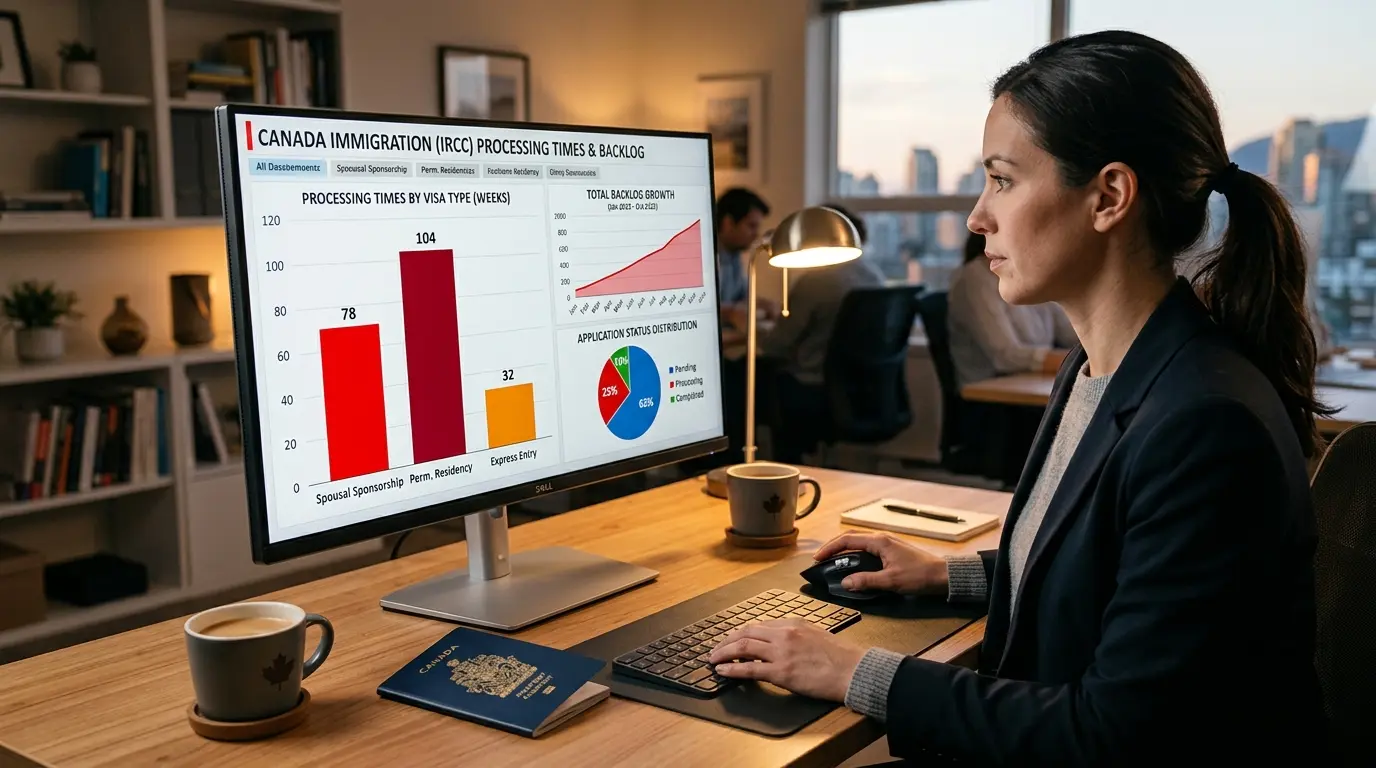
Canada's Immigration Backlogs by the Numbers: The Analysis Nobody Does
Canada's backlogs: Startup Visa 91 years, H&C 50 years with <1% odds, citizenship 25 real months. Only Express Entry works: 7 months.
Canadian PR fees went up on April 30, 2026: what changed in the math
PR through Express Entry in 2026: CAD $1,590 per adult ($990 application + $600 RPRF). A family of 3 pays $3,450. Full table and rules if you already applied.