DADOS DO CANADÁ
Canada's Housing Crisis: The Numbers from 2019 to Today
In this article
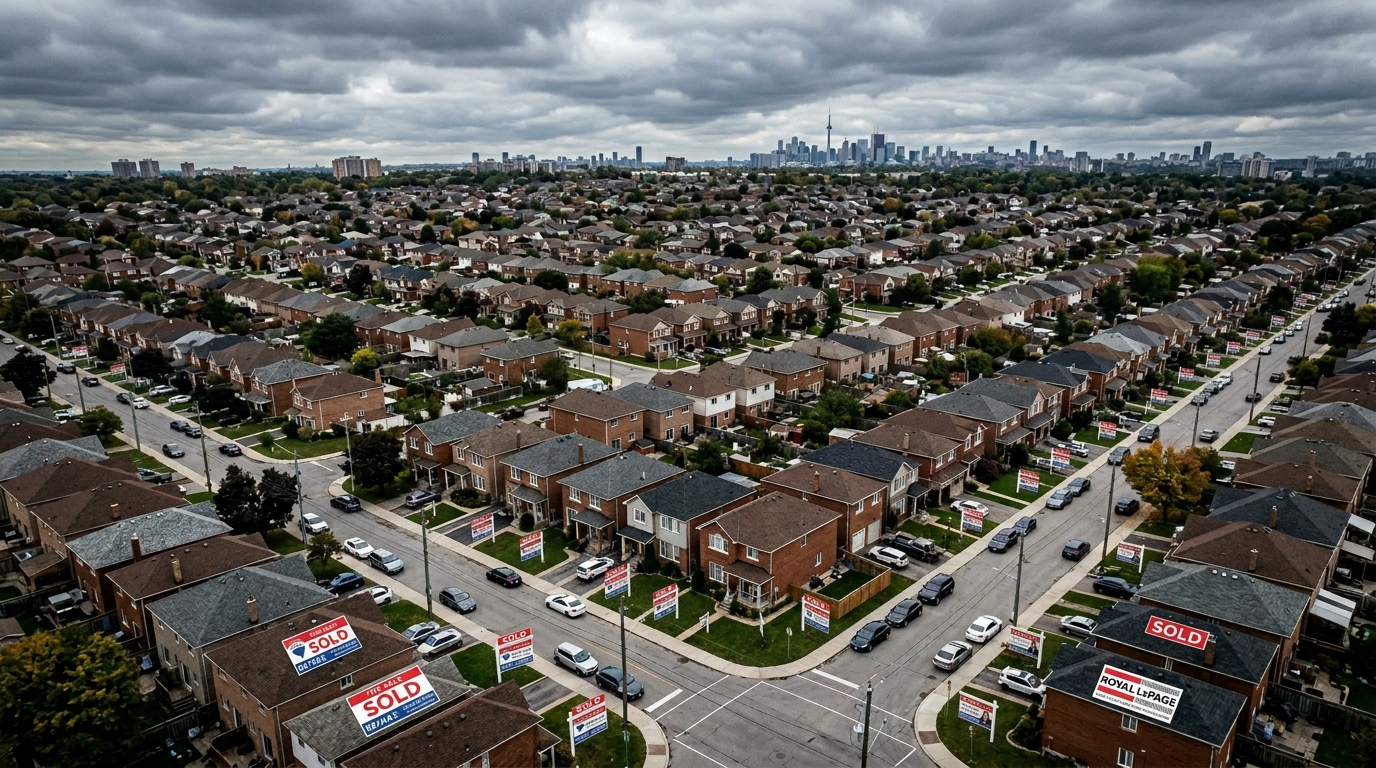
Canada's housing crisis: NHPI rose 9.8% in 2021, CREA hit CAD 800,000 (Feb 2022). Vancouver: 2-bedroom rent CAD 3,300/month.
ALUGUEL E SEGUROS NO CANADÁ: NÚMEROS QUE VÃO TE IMPRESSIONAR!
DESCUBRA NOSSOS GASTOS DO MÊS | MARÇO DE 2025 REVELADO
When I first arrived in Canada, one of the first conversations I had with a Brazilian friend who already lived here was about housing. He was looking for an apartment in Vancouver and told me, with that mix of anger and resignation only someone who has been through it understands: “Caio, I pay more than two thousand dollars for one room, and even so there’s a line of ten people for every place.”
I thought he was exaggerating. He wasn’t.
That conversation stuck with me because it captures something no single number can convey: the housing crisis in Canada is not an economic abstraction. It’s the cold sweat when you open the email with the landlord’s rejection. It’s the impossible math of salary versus rent that most immigrants face in their first years. It’s the question that comes back every night: did I really do the math right when I decided to come here?
In this post, I’m going to put the data on the table. Real numbers, official sources, and the context that makes the difference between understanding the Canada that made the headlines and the Canada you’ll actually find.
What were prices in 2019?
To understand the crisis, you need to understand where it came from.
In 2019, the Canadian real estate market was already expensive by international standards, but it was an expensive that, with effort, still had some logic. The average price of a home in Canada hovered around CAD 488,000 according to the CREA (Canadian Real Estate Association) composite index. In Vancouver and Toronto prices were significantly higher, but in the rest of the country you could still find properties at levels that, for someone coming from Brazil, seemed almost reasonable.
The Bank of Canada interest rate was at 1.75%, a favourable credit environment, but not the extreme of nearly free money that would come. Housing starts (the indicator that measures the beginning of new construction) sat around 209,000 units in seasonally adjusted annual rate (SAAR), a solid number that signalled the construction sector was keeping up with demand.
The rental vacancy rate in 2019 came in at 2.4% in the major cities, according to the CMHC (Canada Mortgage and Housing Corporation). Any rate below 3% already signals a market unfavourable to the tenant, and 2.4% was already a sign of pressure.
It was tense, but manageable. At least for those who were already here.
Then came 2020.
Why did the pandemic heat up the real estate market?
The initial logic seemed simple: pandemic = unemployment = falling real estate prices. That’s what happened in early 2020, there was a momentary freeze in the market. But what came next defied every expectation.
The Bank of Canada cut the interest rate to 0.25% in March 2020, in one of the fastest reductions in history. The goal was to protect the economy. The side effect was a flood of cheap credit.
At the same time, remote work became reality for millions of Canadians. And suddenly, the logic of living right next to the downtown office, paying a lot for it, vanished. Families who had been stuck in small apartments because of proximity to work started looking at smaller cities, at houses with backyards, at places two hundred kilometres from the major centres.
What happened with housing starts? In 2020, they reached 218,700 units SAAR, an increase over 2019. Construction didn’t stop; it accelerated.
And the price? Instead of falling, it started to rise. Because on the demand side, there was a rush for space. On the supply side, the construction supply chain struggled with shortages of materials and labour. The imbalance was set.
This was the paradox of Canadian real estate during COVID: a pandemic that, instead of cooling the market, threw gasoline on the fire.
The 2021–2022 explosion: when the numbers got out of control
New Housing Price Index (NHPI), Annual Change (%)
Source: Statistics Canada, Table 18-10-0205-01, New Housing Price Index. Open Government Licence.
| Período | NHPI variação anual (%) |
|---|---|
| 2019 | 0,3 |
| 2020 | 1,4 |
| 2021 | 9,8 |
| 2022 | 8,2 |
| 2023 | -3,5 |
| 2024 | -1,2 |
Ver dados em formato de tabela
If 2020 was the ignition, 2021 was the explosion.
The Statistics Canada New Housing Price Index (NHPI) recorded a change of nearly 9.8% in 2021, the biggest jump in decades. But the cold numbers of the index don’t tell the whole story. In the hottest cities, prices rose 20%, 30%, 40% in a matter of months. I know Brazilians who bought properties in early 2021 and six months later the value had risen so much that they literally made more from the property’s appreciation than from a full year’s salary.
Sounds good if you already owned the property. But for those trying to get into the market, especially recent immigrants, it was devastating.
The phenomenon is called FOMO: Fear Of Missing Out. Panicked buyers closed deals without a viewing, without an inspection, without financing conditions. In Toronto and Vancouver, bidding wars, where multiple buyers make simultaneous offers above the asking price, became routine. A house listed at CAD 800,000 closed at CAD 950,000 or more.
The CREA MLS HPI composite index, which represents the benchmark price of homes across Canada, reached close to CAD 800,000 at the February 2022 peak.
Housing starts also broke records: 271,800 units SAAR in 2021, the highest number since the series began. The construction sector was working at the limit of its capacity, but still couldn’t keep up with the pace of demand created by the combination of a zero interest rate and the internal migration of desperate buyers.
I remember talking with a friend who worked in construction in Hamilton, Ontario, at that time. He told me: “Caio, the problem isn’t a lack of willingness to build. It’s that there’s no lumber. There’s no concrete on schedule. And there’s nobody to work, because everyone is receiving CERB (the COVID emergency benefit) and the wages we pay can’t compete.”
It was a perfect storm of lack of supply and excess demand.
The table of facts: housing indicators 2019–2024
| Year | NHPI change (%) | Housing Starts (SAAR, thousands) | CREA composite price (CAD) | BoC Policy Rate (%) |
|---|---|---|---|---|
| 2019 | +0.3% | 209.4 | ~488,000 | 1.75% |
| 2020 | +1.4% | 218.7 | ~530,000 | 0.25% |
| 2021 | +9.8% | 271.8 | ~720,000 | 0.25% |
| 2022 | +8.2% | 259.7 | ~740,000 (Feb peak) | 0.25% → 4.25% |
| 2023 | -3.5% | 240.3 | ~670,000 | 4.25% → 5.00% |
| 2024 | -1.2% | ~244.0 | ~690,000 | 5.00% → 3.25% |
Sources: Statistics Canada NHPI Table 18-10-0205-01, CMHC Housing Starts, CREA MLS HPI. CREA values are market estimates based on industry data.
The 2022 interest rate shock: the market slammed on the brakes
In March 2022, the Bank of Canada raised the interest rate for the first time in years. It was a timid increase: from 0.25% to 0.50%. But what came next was brutal.
In seven months, between March and October 2022, the rate went from 0.25% to 4.25%. In July 2022, there was a 1 percentage point increase all at once, the biggest jump in decades. The effect on the real estate market was immediate and severe.
Those who had a variable-rate mortgage saw their payment rise hundreds of dollars overnight. Buyers who had calculated they could afford CAD 800,000 at 2% interest suddenly found that the same CAD 800,000 cost much more on credit.
Housing starts, which had reached nearly 272,000 in 2021, fell back to 260,000 SAAR in 2022 and to 240,000 in 2023. Prices gave way: the CREA composite index fell about 15% from the February 2022 peak to the bottom of 2023.
For those waiting to buy, it looked like an opportunity. But there was a problem: the higher interest rates made the cost of financing so high that even with nominally lower prices, the monthly payment increased. The “discount” on the price was more than offset by the more expensive credit.
This phenomenon, a drop in the nominal price but a rise in the effective cost of buying, is one of the most counterintuitive things about the Canadian housing crisis. And it’s something many Brazilians, used to the logic of “the price dropped, buy now,” don’t notice at first glance.
What happened with rents?
If you can’t buy, you rent. But the pressure from the purchase market migrated straight into the rental market, and the result was an explosion of prices.
The rental vacancy rate in the major cities, already low in 2019 (2.4%), fell even further during the pandemic in some cities as more people needed housing. In 2023, the national average vacancy rate sat at just 1.5% according to the CMHC, a number that represents critical scarcity.
The average rent for a two-bedroom unit in Vancouver reached CAD 3,300/month in 2023. In Toronto, CAD 2,900/month. Even in smaller cities like Calgary and Edmonton, rents rose 20% to 30% in two years.
For newly arrived immigrants, who are still building Canadian credit and often don’t have local references, the situation is even harder. Landlords have the option of choosing among dozens of candidates and tend to prefer those with established credit history, permanent employment, and robust proof of income, exactly what an immigrant in the first or second year is still building.
I know this because I went through it.
In my first months in Canada, I heard “no” more than “yes” in that search for housing. I learned that the process of finding a place to live here is a test of patience, of networking, and of knowing exactly what the market wants to see in an application. It’s not easy. But it’s navigable, if you know how.
Why is there a shortage of housing supply in Canada?
There’s something that needs to be said clearly about the Canadian housing crisis: it’s not just a problem of demand or interest rates. It’s a structural supply problem that has been neglected for decades.
Canada has one of the lowest rates of housing units per inhabitant among the G7 countries. That means that even before the recent demographic explosion, driven by record immigration, there was already a structural housing deficit.
The problem has several layers:
Restrictive zoning: In many Canadian cities, much of the residential land is zoned exclusively for single-family homes (single-family zoning). That means you can’t build an apartment building where there are houses, even if there’s enormous demand. Cities like Vancouver and Toronto have made progress on zoning reforms, but the process is slow.
Approval bureaucracy: A housing project in Canada can take two to five years to obtain all the necessary approvals before the first brick is laid. In hot markets, that means supply can never respond quickly to demand.
Construction cost: The rise in materials and labour costs, accelerated by the pandemic, made many projects less financially viable, especially more affordable units.
The 2026 housing starts, which the government pipeline confirms at 250,900 units SAAR for February, show that the sector is working, but still short of what experts estimate is needed (between 400,000 and 500,000 units per year to resolve the accumulated deficit).
What is happening now?
Housing Starts in Canada, Annualized Units (SAAR, thousands)
Source: Statistics Canada via CMHC. The 2026 data is the most recent available in the federal government's data pipeline (February 2026). Open Government Licence.
| Período | Housing Starts (mil unidades SAAR) |
|---|---|
| 2019 | 209,4 |
| 2020 | 218,7 |
| 2021 | 271,8 |
| 2022 | 259,7 |
| 2023 | 240,3 |
| 2024 | 244 |
| 2026 (fev) | 250,9 |
Ver dados em formato de tabela
With the gradual reduction in the Bank of Canada rate, which went from 5.00% in July 2023 to 2.25% in April 2026, the Canadian real estate market is going through a careful recovery.
Prices stopped falling and in some regions started to rise slightly. Affordability is still far from ideal, but the more favourable credit environment has begun to reactivate buyers who were on the sidelines.
For those arriving now or planning to arrive in the coming months, the picture is complex:
- Rents remain elevated, but the pressure from new entrants eased a bit with the reduction in immigration targets announced by the federal government in 2024/2025
- Buying is still difficult, but the math improved with lower interest rates
- The supply of new housing is growing, but slowly relative to the accumulated historical demand
The construction market is responding, building permits in February 2026 were CAD 12.09 billion, a number that indicates a strong intention to invest. But from permit to finished home is at least two years.
What does this mean for you, Brazilian immigrant?
I’m going to be direct here, because you deserve honesty and not marketing.
If you’re coming to Canada expecting an easy, affordable housing market, you’re going to be disappointed. That’s not the Canada of today.
But if you come prepared, with realistic expectations, a thought-out financial strategy, and a willingness to start with what’s possible before reaching what’s ideal, you’ll navigate this market.
A few practical things I learned that make a difference:
1. Building credit quickly is a priority. Open a bank account, get a secured credit card in your first days (even with a low limit), and use it with discipline. Credit history will open doors in the rental market.
2. The rental market demands patience and preparation. Put together a polished application “dossier”: cover letter, proof of income (even if from a job offer), references. In the competition, the details matter.
3. Living with Brazilians at the start isn’t a defeat, it’s strategy. Beyond splitting costs, you inherit a network of contacts and learn how the market works from those who have been through it.
4. Smaller cities have more affordable markets. If you have remote work flexibility or aren’t tied to a specific city, Calgary, Edmonton, and mid-sized cities in the interior of Ontario and Quebec offer a better cost-benefit ratio than Vancouver and Toronto.
5. The market is normalizing. The years 2021 and 2022 were aberrations. The Canada of today has a market that is still expensive, but with more logic than it had in those crazy years.
You’ll make it. It will be hard at the start. But you’ll make it.
How do you find an apartment as a recent immigrant?
I’ll be honest: finding an apartment in Canada as a recent immigrant is one of the most draining parts of the settlement process. Not because it’s impossible, but because you’re competing with people who have what you don’t yet have: credit history, local references, confirmed full-time employment in Canada.
Here’s what the process really involves:
1. The informal pre-qualification. Before you even show up for a viewing, many landlords ask for a pre-qualification via email: proof of income, credit score, and previous landlord references. As a recent immigrant, you may not have any of the three at the start.
2. The competition. For a reasonable apartment in a reasonable neighbourhood in Vancouver or Toronto, it’s common to have 10 to 30 simultaneous applications. Landlords choose who they want, and they can do that based on criteria you don’t control.
3. What helps your application:
- A personal cover letter (it’s not a joke, many landlords want to know who you are)
- References from your employer in Canada or from previous employers (even international ones)
- An offer to pay 2 to 3 months in advance (shows financial capacity when credit history is missing)
- Being transparent about your situation: “I just arrived in Canada, I have work confirmed on [date], and these are my resources.” Honesty with documentation is better than unexplained gaps
4. Where to look:
- Kijiji.ca: The largest rental classifieds in Canada. Especially for renting directly from the owner.
- Padmapper and Zumper: Aggregators that consolidate listings from multiple sources.
- Facebook Marketplace: Many smaller landlords prefer this channel. Also city-specific Brazilian groups.
- Brazilian groups in Canada: WhatsApp and Facebook communities where established Brazilians frequently point to available apartments or become the landlord of a new immigrant themselves.
5. Understand your rights. Each province has its own tenancy legislation. In Ontario, the Residential Tenancies Act strongly protects tenants, including rent increase guidelines, eviction rules, and the landlord’s maintenance obligations. Before signing any contract, read what your province’s law says. The provincial government has accessible summaries online.
How much does it cost to live in each city? Compare rent, groceries, transit, and total cost in Vancouver, Toronto, Calgary, and 20 more Canadian cities, side by side, for free. Compare now →
Vancouver vs. Toronto vs. the other cities: where should you live?
One of the most common questions I get is: “Which city should I choose?”
There’s no right answer, but there’s an analysis worth doing with data in hand.
Vancouver (BC):
- Strong job market in tech, games, film/VFX, healthcare
- Climate: the mildest in Canada. Winter without snow in the city, beautiful summers
- Housing: the most expensive market in Canada. An average 1-bedroom apartment: CAD 2,200–3,000/month
- Overall cost of living: very high
- Cultural diversity: very high. Vancouver has the largest Asian community in Canada
Toronto (ON):
- Job market: the most diversified in Canada. Finance, tech, healthcare, government, media, retail
- Climate: cold winters (-10 to -20°C), hot and humid summers
- Housing: similar to or slightly below Vancouver, but varies a lot by neighbourhood
- Public transit: the best in Canada (even if imperfect)
- Brazilian community: the largest and most organized in the country
Calgary (AB):
- Job market: energy (oil and gas), construction, healthcare, growing tech
- Climate: cold winters but many sunny days. Chinooks (warm winds) are unique to this region
- Housing: notably cheaper. 1-bedroom apartment: CAD 1,500–2,000/month
- Income tax: Alberta has no provincial income tax, you take more of your salary home
- Less diversity, but a Brazilian community growing fast
Ottawa (ON):
- Job market: federal government, tech, defence, healthcare
- Housing: more affordable than Toronto. High quality of life with access to nearby nature
- Bilingualism: many government positions require English and French
Montreal (QC):
- Job market: tech (a strong AI ecosystem), aerospace, healthcare, creative
- Cost of living: the lowest among major Canadian cities. Historically more affordable rents
- Requirement: French. For real integration into the local job market, French is essential
- Culture: the most European of Canadian cities. Excellent food, rich cultural life
My personal assessment: for those with a tech or business profile who don’t speak French, Toronto or Vancouver are the best bets, with awareness of the high costs. For those who speak or want to learn French, Montreal is unbeatable on cost-benefit. For families with children who prefer space and lower cost, Calgary with the bonus of zero provincial tax is far more attractive than it seems at first glance.
Government housing programs: what exists for you
The Canadian government created several programs to help with access to housing, some specific to first-time buyers, others for everyone.
First Home Savings Account (FHSA): Created in 2023. It allows first-time buyers to save up to CAD 40,000 (CAD 8,000 per year) in an account with a double tax benefit: contributions are deductible from income tax (like the RRSP) and withdrawals for the purchase of a first home are tax-free (like the TFSA). It is literally the best housing savings vehicle Canada has ever created.
First-Time Home Buyer Incentive: An equity-sharing program where the federal government co-invests up to 5–10% of the home’s value in exchange for a share in future appreciation (or depreciation). Created to reduce the mortgage amount, but with maximum income rules that exclude residents of Vancouver and Toronto.
Home Buyers’ Plan (HBP): Allows you to withdraw up to CAD 35,000 from the RRSP for the purchase of a first home, with no immediate tax, as long as it’s returned to the RRSP within the following 15 years.
Land Transfer Tax Rebate: Some provinces (like Ontario) offer a land transfer tax rebate for first-time buyers, which can reach CAD 4,000.
For newly arrived immigrants, the most relevant is the FHSA, because you can start contributing as soon as you have permanent residence or worker status, even if the home purchase is 5 to 10 years away. Every year of lost contribution is money you won’t recover.
How does sharing housing in Canada work?
One of the first decisions a Brazilian immigrant makes upon arriving in Canada is: will I live alone, with a spouse/partner, or will I have roommates?
For those who arrive alone or as a couple without children, the math of roommates is almost always smarter than it seems at the start.
The real calculation:
A 2-bedroom apartment in Vancouver costs on average CAD 3,200-4,000/month. Divided by two people: CAD 1,600-2,000 each. A studio or 1-bedroom costs CAD 2,200-2,800, and you’re on your own.
The savings are real: CAD 600-800/month, that is, CAD 7,200-9,600/year. Those are resources you can use to build a reserve, for travel, to invest in your own professional development.
Beyond the savings, Canadian roommates (especially other immigrants) are frequently your first social network here. You learn how the country works from those who have been here longer. You’re not alone in your first winter.
How to find respectable roommates:
- Kijiji.ca: Room-for-rent ads are abundant. Read the descriptions carefully and be clear about what’s included in the rent (utilities, internet, furniture).
- Facebook Groups: “Brazilians in Vancouver/Toronto/Calgary” constantly have room ads. Living with other Brazilians has the obvious advantage of shared language and culture.
- SpareRoom.ca and PadMapper: Aggregators specific to roommates.
What to check before signing:
- Does the rent include utilities (gas, electricity, water)? Or are they split separately?
- Is internet included?
- What’s the policy on guests?
- How are the common areas divided?
- Whose name is on the rental contract? (Watch out for unauthorized sublets)
The contract question:
In Canada, any roommate agreement can be formal or informal. For your protection, it’s better to have something in writing, even if it’s a simple email confirming the terms. Provincial tenancy legislation protects the primary tenant, but the relationship between roommates has less formal protection.
Buying property as an immigrant in Canada: does it make sense?
It’s one of the questions that most divides opinion in the Brazilian community here: is it worth buying property in Canada as an immigrant?
There’s no single answer, but there’s an analysis that needs to be done honestly.
Why some people say it’s worth it:
- Building equity instead of “throwing money away” on rent
- Protection against rent increases (once you’ve bought, your payment doesn’t rise with the market)
- Over the long term, properties in Canada have historically appreciated well, especially in Vancouver and Toronto
- Tax benefits for first-time buyers (FHSA, HBP)
Why others say it’s not worth it for recent immigrants:
- Committing to a 25-year mortgage requires a stability the first years rarely have
- Property transaction costs in Canada are high: land transfer tax, lawyer fees, inspection, closing costs, about 3-5% of the property value
- If you need to move cities for a better job in 2-3 years, selling soon after buying frequently results in a loss
- With interest still at 4%+ for a mortgage, the interest cost in the first years is high and little equity is built
The rule housing economists frequently cite:
If you’re not sure you’ll stay in the same city for at least 5 years, renting is financially smarter than buying. The fixed transaction costs of buying and selling property take on average 4-5 years to be recovered through appreciation.
For immigrants in the first years, this uncertainty about staying in the same city is especially high. You may find that Vancouver has the job you wanted in Toronto, or that Edmonton has the quality of life you expected from Toronto.
The exception:
If you already have stable income in your field of training, clarity about the city where you want to put down long-term roots, and access to a sufficient down payment so as not to commit your entire financial reserve, then the analysis changes. The FHSA and HBP create real tax advantages for first-time buyers that make a difference in the calculation.
For the vast majority of Brazilian immigrants in the first two to three years, renting and accumulating is more prudent than buying. This isn’t giving up, it’s planning.
What extra costs are there beyond rent?
The most common financial planning mistake Brazilian immigrants make is budgeting only for rent and then discovering that living in Canada costs much more than that number.
There’s a list of costs that come with any housing here:
Utilities:
- Electricity: CAD 50-120/month depending on the city and the type of heating
- Natural gas: CAD 30-100/month (more expensive in winter for heating)
- Water: often included in the rent, but not always
- Internet: CAD 50-100/month
Home insurance (Tenant Insurance or Home Insurance): Unlike Brazil, where tenant insurance is rare, in Canada almost all landlords require the tenant to have “tenant insurance,” coverage for your personal belongings and liability. It costs on average CAD 20-40/month. Don’t skip this cost: without it, a theft or fire leaves you with nothing.
Parking: If you have a car, apartment parking can be an extra CAD 50-200/month, not included in the base rent.
Laundry: Many older apartments have shared laundry with coin-operated washers (CAD 2-3 per cycle). Modern apartments have in-suite laundry, which is a significant quality-of-life differentiator and should be checked before signing the contract.
Maintenance: In a rented property, major maintenance is the landlord’s responsibility. But smaller items (light bulbs, small repairs) are frequently your cost. In an owned property, the rule of thumb is to budget 1% to 2% of the property value per year for maintenance.
Real total monthly cost:
For a 1-bedroom apartment rented in a major Canadian city:
- Rent: CAD 2,200-3,000
- Utilities + internet: CAD 150-220
- Tenant insurance: CAD 25-35
- Real total: CAD 2,375-3,255/month
That’s the number you need to keep in mind when you’re assessing whether a specific salary is enough for a given city.
The macro context: immigration and housing are inseparable
There’s a real political tension in Canada over immigration and housing that you need to know about.
Part of the Canadian public debate blames the volume of immigration for the housing crisis. That view is simplistic, the housing deficit predates the acceleration of immigration and has much older structural roots, but it exists and influences policy.
In response to that pressure, the federal government announced in 2024 a reduction in permanent resident admission targets: from about 485,000 to roughly 395,000 per year starting in 2025. The stated goal is to give time for housing supply to adjust to demand.
For those in the immigration process or planning to come, this means the environment has become more selective. But not closed. Canada needs immigrants, for demographics (an aging population) and for the economy. The debate isn’t “whether” Canada will receive immigrants, but “how many” and “in what way.”
This topic connects directly to the immigration data you’ll find in Post 3 of the series, on the immigration numbers in Canada.
Rent control in Canada: when and how much can the landlord charge
One of the most important protections for tenants in Canada, and one of the least known among immigrants who arrive here, is the existence of rules on rent increases. These rules vary significantly by province, so I’m going to cover the main ones.
Ontario:
In Ontario, the rent increase for units occupied before November 2018 is capped by the annual Rent Increase Guideline, a percentage published by the provincial government every year. In 2024, it was 2.5%. In 2025, 2.5%.
Important: the landlord must give 90 days’ notice before any increase. And can raise the rent at most once every 12 months for the same tenant.
The important exception: units first occupied after November 15, 2018, are exempt from rent control, the owner can charge whatever they want when renewing or starting a new contract. This created a significant price difference between older properties (with rent control) and new properties (without).
British Columbia:
BC has rent control similar to Ontario but with some differences. The maximum increase is indexed to inflation. For 2024, it was 3.5%. For 2025, 3.0%. The same 90-day notice rule applies. BC does not have the same exception for new properties that Ontario has.
Alberta:
Alberta has no rent control. The landlord can raise the rent to any amount, as long as they give 3 months’ notice. In Calgary and Edmonton, with the hot market of 2023-2024, this led to significant increases that wouldn’t happen in provinces with control.
Quebec:
Quebec has the Tribunal administratif du logement (TAL) that regulates rent increases. The system is more protective of the tenant than any other province, which contributes to Montreal’s historically lower rents.
What this means in practice:
If you’re renting in Ontario or BC, know that a landlord can’t raise your rent by 20% from one year to the next while you’re living there (for properties with rent control). But when you leave and a new tenant moves in, the landlord can charge whatever they want.
This creates the phenomenon of “tenant lock-in,” people who are paying rent well below market because they stayed in the same apartment for many years. And it explains why moving apartments frequently means paying much more than neighbours who have been there longer.
Does the housing crisis have a solution?
Honestly? Yes. But it’s going to take time.
Canada has resources, growing political will, and a construction sector that is already responding. Zoning reforms are advancing. The federal government announced billions in investment for affordable housing. The provinces are speeding up approval processes.
The problem is that housing has a long cycle. An apartment building that receives approval today will be finished in 2028 or 2029. There’s no quick fix for deficits that took decades to accumulate.
What this means in practice is that the next two to three years will remain challenging. After that, there’s reason for optimism.
And the interest rate cycle plays a central role in this equation, the reduction in the cost of credit is already reactivating projects that were frozen by the high-rate environment of 2022-2023.
See the current data in real time
The numbers I presented here cover the historical period from 2019 to 2024/2025. For the most recent housing data, housing starts, building permits, and other indicators updated monthly by the federal government, visit the Canada Data in Real Time page.
There you’ll find the latest update on construction indicators, plus other economic data that complements the analysis you read here.
Conclusion: the crisis that shaped the Canada of today
The Canadian housing crisis is, at the same time, a planning failure of decades and a consequence of the extraordinary forces of the pandemic.
It made Canada less affordable than it should be. It created real suffering for families, for immigrants, for young people trying to build their own lives. And it’s not over yet.
But the Canada you’ll find is not the Canada of the 2022 peak. It’s a country slowly adjusting, with falling interest rates, growing supply (even if slowly), and a public recognition, which didn’t exist before, that housing is a crisis that needs to be confronted.
You’ll pay more for housing here than in Brazil, proportionally. But you’ll have legal security, infrastructure, and a job market that, on average, pays well enough to make the math work.
It’s not easy. But it’s possible. And you’re not making this journey alone.
I got your back.
Sources
The data presented in this article was collected from the following official sources:
-
Statistics Canada, New Housing Price Index (NHPI), Table 18-10-0205-01. Available at: https://www150.statcan.gc.ca/t1/tbl1/en/dtbl!/18/18-10-0205-01. Data used under the Open Government Licence, Canada 2.0.
-
Statistics Canada / CMHC, Housing Starts, Completions and Under Construction. Housing starts (SAAR) data available through the CMHC at: https://www.cmhc-schl.gc.ca/housing-observer-online/housing-starts. Open Government Licence.
-
Statistics Canada, Building Permits, Table 34-10-0066-01. Building permit data used under the Open Government Licence, Canada 2.0.
-
CMHC (Canada Mortgage and Housing Corporation), Rental Market Reports (vacancy rates, average rents). Available at: https://www.cmhc-schl.gc.ca/housing-observer-online/rental-market-reports.
-
CREA (Canadian Real Estate Association), MLS® HPI (House Price Index). Industry data, used as a complementary reference to the Statistics Canada NHPI. Available at: https://www.crea.ca/housing-market-stats/mls-home-price-index/. Note: CREA is a real estate industry association, not a government source. CREA prices are the most cited benchmark in the Canadian market.
-
Bank of Canada, Overnight Rate Target (for interest rate context). Available at: https://www.bankofcanada.ca/core-functions/monetary-policy/key-interest-rate/.
Frequently asked questions
Why did real estate prices explode in Canada in 2021?
How much is the average rent in Vancouver and Toronto in 2023?
Is there rent control in Canada?
Is it worth buying property as a recent immigrant?
What is the FHSA?
The Vancouver Letter
You made it this far. That tells me something.
The Vancouver Letter is the letter I wish someone had sent me the third time I tried for Canada, when I had no idea what I was doing wrong. Once a week, straight to your inbox. No products, no courses, just what actually works. I got your back.
Get immigration updates
Practical tips straight to your inbox.
Related articles

BRL/CAD exchange rate: the real's purchasing power in Canada (2019–2026)
BRL/CAD exchange rate: R$2.90 (2019) → R$3.63 (April 2026). Brazil's 38% cumulative inflation erodes the purchasing power of remittances. Full analysis.

Economy and Inflation in Canada: How the Country Weathered the Storm (2019-2024)
Canadian inflation: peak 8.1% in June 2022 (highest in 40 years) to 1.8% in February 2026. What changed in the budgets of Brazilians here.

Canada's job market: wages, unemployment and opportunities (2019-2024)
Canadian job market 2019-2024: unemployment from 5.7% to 13.7% at the COVID peak, now 6.7% (Mar 2026). Average wage CAD 32.50/h.