CUSTO DE VIDA
Canada building permits rise 10.3% in March 2026
In this article
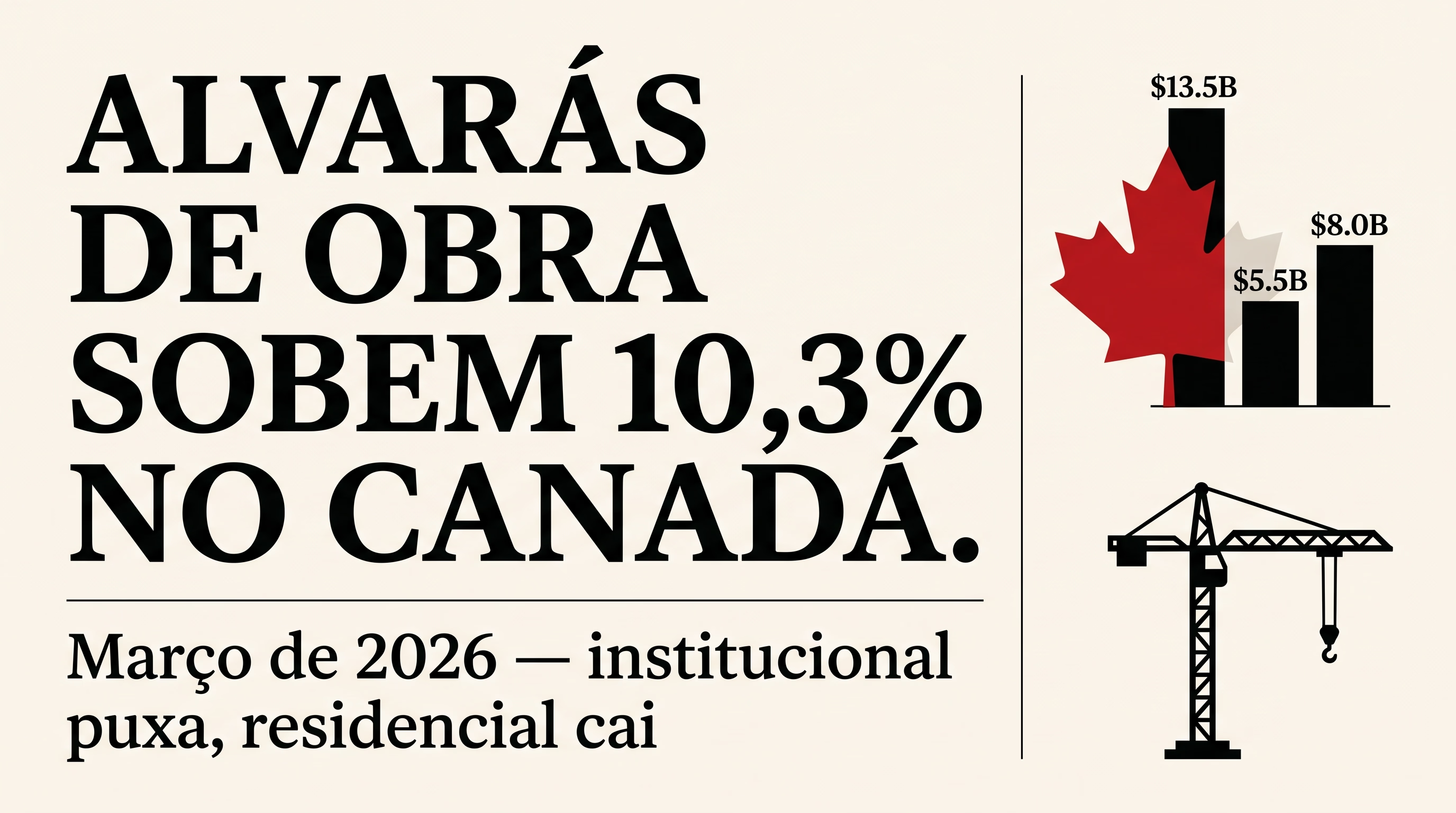
Canada building permits hit CAD 13.5 billion in March (+10.3%). Vancouver led institutional with a hospital; multi-family fell in ON/QC.
Look, this is data for people thinking long term: building permits are the thermometer of how much housing will be available 12 to 18 months from now in Canada. It’s not data you read in a headline and move on from. It’s data that tells you whether the rent you’re paying in Toronto or Vancouver is going to squeeze harder or start to breathe down the road.
Statistics Canada released the March 2026 report this week, and the headline number is striking: CAD 13.5 billion in permits issued, up 10.3% over February, a jump of CAD 1.3 billion in a single month. It looks like a sign of supply coming back strong. But when you open up the composition, the story changes completely, and anyone who rents in Canada needs to understand what’s underneath that number before making any housing plan.
Here’s what happened in March 2026: the non-residential sector (hospitals, schools, factories, offices) grew CAD 1.5 billion, while residential fell CAD 270.6 million. Translation: Canada is approving more construction, but most of it isn’t housing. And the part that fell most inside residential was exactly the segment that matters most to an immigrant who rents, the multi-family segment, which is apartments and condos.
How much did building permits rise in March 2026?
Building permits in Canada rose 10.3% in March 2026, totaling CAD 13.5 billion, a nominal gain of CAD 1.3 billion in a single month. In real terms, stripping out inflation on the 2023=100 base, the growth was 10.1% on the month and 4.8% over the past 12 months, which confirms the jump isn’t just a materials-price effect.
The important detail is where the growth happened. The non-residential sector surged CAD 1.5 billion and reached CAD 5.5 billion issued. Within it, three categories pulled the weight:
- Institutional (hospitals, schools, government buildings): +CAD 817.1 million, totaling CAD 1.8 billion
- Industrial (factories, warehouses): +CAD 473.2 million, totaling CAD 1.5 billion
- Commercial (stores, offices, restaurants): +CAD 238.0 million, totaling CAD 2.2 billion
Commercial rose in 7 provinces and 2 territories, a broad distribution. Industrial concentrated in Ontario (+CAD 510.8 million) and Quebec (+CAD 113.6 million). And institutional had a single dominant engine: British Columbia, with +CAD 665.5 million, basically all concentrated in the Vancouver CMA.
Why did residential fall if the total rose?
Residential fell because the drop in multi-family was big enough to drag the whole sector down, even with the overall total rising. In March 2026, residential permits totaled CAD 8.0 billion, down 3.3% on the month (CAD 270.6 million less). And practically all of that drop came from one place: multi-family, which lost CAD 270.9 million and closed at CAD 5.3 billion.
This matters a lot for a Brazilian who rents or is thinking about buying pre-construction. Multi-family is where most recently arrived immigrants live in big cities, apartments, condos, new rental buildings. When that segment slows down in permits, it means that 12 to 18 months from now those units won’t be ready to hit the market.
The geography of the drop is revealing too. Ontario lost CAD 393.1 million in multi-family and Quebec lost CAD 163.5 million, exactly the two provinces with the largest rental markets in Canada. Going the other way, British Columbia had +CAD 90.7 million and Nova Scotia added +CAD 83.8 million, but those gains were small next to the drop in ON and QC.
Single-family homes, meanwhile, were virtually flat at CAD 2.7 billion. No growth, no drop, just not enough to offset the multi-family collapse. For anyone renting in Toronto who thinks the market will open up in 2027, this March number says: probably not, at least not from the new-supply side.
What happened in Vancouver in March 2026?
Vancouver was the solo engine of the month’s institutional jump. British Columbia received CAD 665.5 million in additional institutional permits in March 2026, and Statistics Canada attributed the number to new permit approvals for a medical institution in the Vancouver CMA, basically newly approved hospital projects that landed in the month’s figures.
This explains why the national headline looks so positive while the reality for a Vancouver resident is more nuanced. A new hospital doesn’t become rental housing in 18 months. A new hospital becomes health capacity, important, but it doesn’t solve the housing problem of someone just arriving.
The good news for BC is that, within residential, the province was one of the few to grow in multi-family (+CAD 90.7 million), while Ontario and Quebec shrank. The Vancouver market remains under demand pressure, immigration plus supply restriction, but at least apartment permits aren’t falling there the way they fell in the Southeast.
For a Brazilian thinking about buying pre-construction in Vancouver, the mixed reading is this: new supply is still being approved, but the pace is far from solving the price equation. And institutional growth, however many construction jobs it creates in the short term, doesn’t ease the pressure on rent.
How does this affect rent 12 to 18 months from now?
A permit approved today becomes a delivered unit 12 to 24 months from now, depending on the type of construction. Multi-family takes longer (apartments, condos, whole buildings). Single-family delivers faster. That’s why building permits are the best leading indicator of housing supply that exists, more reliable than housing starts, which measure only what has already begun construction.
And the read for rent is harsh: multi-family falling CAD 270.9 million in March means the pipeline of new apartments for 2027 and 2028 is shrinking, not growing. For quarterly context, in the first quarter of 2026 (Q1) 68,500 housing units were authorized in Canada, below the 71,000 units in the same period of 2025. A drop of about 3.5% year over year in the creation of housing capacity.
This doesn’t mean rent will spike immediately. It means the hope of many recently arrived immigrants, that “in a couple of years supply opens up and rent deflates,” is propped up on a pipeline that is shrinking, not expanding. Anyone renting in Toronto, Vancouver, or Montreal and waiting for the market to loosen in 2027 needs to recalibrate that expectation.
For a Brazilian thinking about pre-construction, there’s an interesting signal in the Q1 cumulative: single-family grew CAD 349.8 million, the first quarter of growth after 4 consecutive quarters of decline. It’s an early sign of recovery in that segment. Commercial, on the other hand, fell CAD 813.7 million in Q1, the largest quarterly drop since Q4 2020 (the peak of the pandemic). It means the office, retail, and commercial-space side is practically stalled, which usually precedes lower pressure on construction jobs tied to commercial building.
Where to find the full data and the next release?
The full release is in Statistics Canada’s The Daily, identifier dq260519b, published on May 19, 2026. The official URL is https://www150.statcan.gc.ca/daily-quotidien/260519/dq260519b-eng.htm, and all the numbers in this post come straight from there, no middleman.
The next building permits release, covering April 2026, comes out on June 11, 2026. That’s the number worth marking on the calendar: if multi-family keeps falling in Ontario and Quebec for two straight months, the supply-squeeze signal in the two largest provinces becomes a confirmed trend, not an outlier.
To follow these series more consistently, Statistics Canada publishes them in Table 34-10-0285-01 (monthly permits by province and type) and Table 34-10-0066-01 (the version by metropolitan area). Anyone who wants to go deeper on the effect on a specific city, Toronto CMA, Vancouver CMA, Montreal CMA, should pull the second one.
And the point worth repeating: building permits don’t tell you what IS happening with rent today. They tell you what WILL happen with housing supply 12 to 18 months from now. For anyone living here and making a rental or buying plan, it’s the right number to look at before deciding city, neighbourhood, and timing.
Frequently asked questions
What happened to building permits in Canada in March 2026?
Why did residential fall if the total rose?
Why did Vancouver lead the institutional jump?
How do these numbers affect rent 12 to 18 months from now?
When does the next building permits report come out?
Sources
- Statistics Canada, Building permits, March 2026 (The Daily, dq260519b, 19/05/2026): https://www150.statcan.gc.ca/daily-quotidien/260519/dq260519b-eng.htm
- Statistics Canada, Table 34-10-0285-01 (Building permits, by province and type, monthly)
- Statistics Canada, Table 34-10-0066-01 (Building permits, by census metropolitan area)
- Next release: Building permits, April 2026, June 11, 2026
The Vancouver Letter
You made it this far. That tells me something.
The Vancouver Letter is the letter I wish someone had sent me the third time I tried for Canada, when I had no idea what I was doing wrong. Once a week, straight to your inbox. No products, no courses, just what actually works. I got your back.
Get immigration updates
Practical tips straight to your inbox.
Related articles
New home prices in Canada fall 0.4% in April 2026 (and what that tells you)
National NHPI fell 0.4% in April (monthly drop). Most provinces flat; the new-build market cooled. What it tells you if you want to buy.

Canada's GDP stalled in Q1 2026, and the direction is downhill
Canada's GDP was flat (0.0%) in Q1 2026 after falling 0.2%. Technically not a recession yet, but the economy is losing steam.
Commercial rent in Canada: StatCan's new CRSPI index is now available
StatCan released the CRSPI Q1 2026: commercial rent index for 13 CMAs plus the 4 largest provinces. What it means for a Brazilian who wants to start a business.