BUROCRACIA
7 Misrepresentation Mistakes That Can Destroy Your Canada Process
In this article
IRCC uses AI to cross-check your applications. Know the 7 most common mistakes that lead to a 5-year ban, and how to avoid them.
Como conseguimos morar no Canadá depois de 3 VISTOS NEGADOS?
O que mudou na imigração do Canadá? Veja minha experiência real!
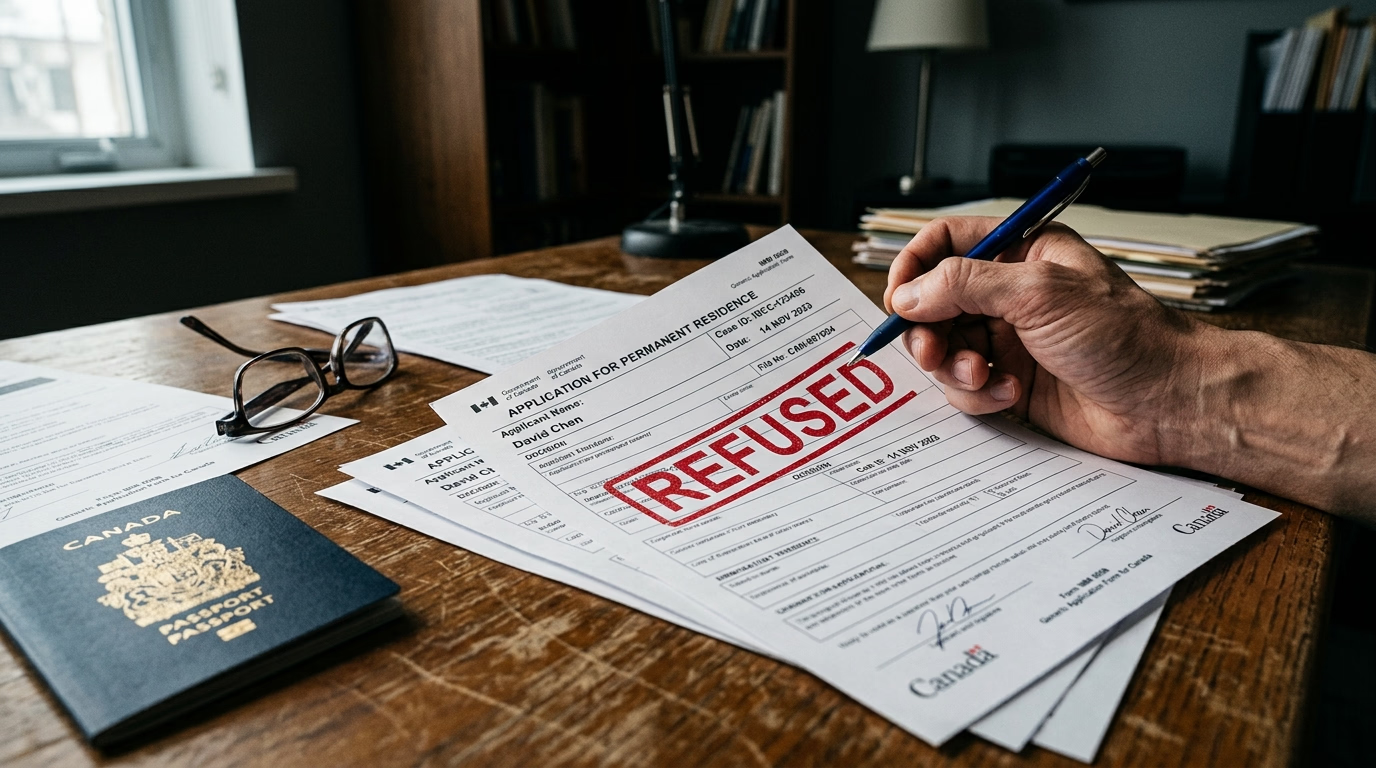
I’ll be honest with you: I’m afraid of making a mistake on my application. Genuinely afraid. The kind of fear that wakes you up at 3 a.m. and you lie there thinking “did I put the right date in that field?”, “did I forget to declare something that happened 6 years ago?”. Because in Canada, a mistake on your immigration process isn’t just an inconvenience. It can be the end of the line for 5 years.
And the worst part? Most people who get a misrepresentation determination weren’t trying to deceive anyone. They were honest mistakes. Things they forgot. Information that seemed irrelevant, so nobody thought to declare it. But to IRCC, it doesn’t matter whether it was intentional or not. What matters is that the information was wrong and could have affected an immigration decision.
So I’m writing this to you as someone who’s on your side, man. As someone who’s also in the middle of this process and knows the weight every form carries. If you don’t pay attention to the 7 mistakes I’m about to list here, you’re playing with fire.
What is misrepresentation, exactly?
Misrepresentation is when you provide false, incomplete, or misleading information on an immigration application, or when you fail to provide information that could have influenced the officer’s decision. And that second part is the one that catches most people. It’s not just actively lying. It’s omitting something relevant.
The penalty? A 5-year ban counted from the date of the determination. During those 5 years, you cannot submit any immigration application for Canada. Nothing. No tourist visa, no study permit, no Express Entry, no family reunification. Five years in the freezer.
And there’s an important detail: the ban applies even if the wrong information didn’t give you extra points or a direct advantage. If the information influenced a previous decision, like the approval of a study permit back then, IRCC can consider it misrepresentation in your current process. It doesn’t matter that you’re not using that experience to gain points in Express Entry. What matters is that the information helped get something approved in the past.
The AI factor: IRCC knows more than you think
This is where things get seriously real. IRCC is using artificial intelligence tools to cross-check all of your previous applications. All of them. That study permit you filed 5 or 6 years ago? That visitor visa from 2020? The PGWP? Your current Express Entry profile? Everything is compared automatically.
The system looks for inconsistencies. Discrepancies in job titles, start and end dates, role descriptions. If on your 2021 study permit you declared you worked as a “sales associate” from January to September, and on your Express Entry profile you put “retail manager” from March to December at the same job, you can be sure that’s going to get flagged.
And immigration officers have limited time to review each application. If the AI system raises a red flag, the officer isn’t going to sit there investigating whether it was an honest mistake or not. If they’re not satisfied with the explanation, the tendency is to refuse. Simple as that.
You know when you get a request for Schedule A (background declaration) after you’ve already submitted your Express Entry? That usually means the officer found discrepancies. They’re cross-checking your current profile against ALL previous applications: study permits, visitor visas, PGWPs, and even your spouse’s applications. If a Schedule A shows up, it’s time to pay very close attention.
Bill C-12 made everything worse
As if AI weren’t enough, Bill C-12 created something that completely changes the game: data sharing between government agencies. CRA, ESDC, IRCC, CBSA, they all now share information with each other.
What does that mean in practice? Your T4 slips (income statements), your Records of Employment, everything that passes through the Canadian tax and labour system is now cross-checked against your immigration declarations. That Uber gig you did and didn’t declare? That freelance work paid in cash? That side job that seemed irrelevant? Now it’s all detectable.
There’s no more hiding undeclared work. The agencies talk to each other. And if what you declared to IRCC doesn’t match what the CRA has on record, you’ve got a serious problem.
Now let’s get to the 7 mistakes. Each one has already destroyed the process of people who, just like you and me, only wanted to do the right thing.
Mistake #1: Inconsistent employment dates
This is the most common and the most treacherous. You filled out a study permit in 2021 and declared that you worked at company X from January to August 2021. Now, 5 years later, you’re filling out Express Entry and, from memory, you put that you worked from March to October. It’s only a few months’ difference, right? To you, it’s a detail. To IRCC’s AI, it’s an inconsistency.
Real scenario: imagine you worked part time at a restaurant during university. At the time of the study permit, you declared April to November. Now on Express Entry, reviewing your documents, you find a pay stub from March and think maybe you started earlier. You put March to December. Done, the dates don’t match what you declared before, and the system flags it.
The solution is simple but it takes work: before filling out any new form, review ALL of your previous applications. Pull the PDFs, compare the dates. If you no longer have access, request a copy of your records from IRCC. Yes, you can do that. And it’s infinitely better to spend that time than to receive a misrepresentation letter.
Mistake #2: Not declaring visa refusals, including childhood ones
This one catches a lot of people off guard. The question on the immigration form about previous visa refusals has no time limit. It’s not “in the last 10 years”. It’s your entire life. And it includes ANY kind of refusal: tourist visa, student visa, that school trip to Disney that got denied when you were 12, even being turned away at the U.S. border.
Real scenario: your parents tried to take you to the United States when you were 8. The visa was denied. You barely remember it, you were a kid. Your parents mentioned it once in a conversation and you didn’t think anything of it. But it happened. And if you don’t declare it, that’s the omission of relevant information.
And there’s more: if you were turned away at the U.S. land border, like you got there and the officer sent you back, that also counts as a refusal of entry that needs to be declared. It doesn’t matter if it was 15 years ago. It doesn’t matter if you were a minor.
What to do: call your parents, call whoever handled your documents when you were a child. Ask if there was any denied visa attempt, any trip that didn’t work out, any situation at a border. Better to declare something you maybe didn’t need to than to omit something you definitely needed to.
Mistake #3: Incomplete personal history
The form asks for your complete personal history for the last 10 years (or since you turned 18, whichever is longer). Every month needs to be accounted for. Work, study, unemployment, travel, all of it. There can’t be a gap.
Real scenario: you spent 4 months between one job and another in 2019. During that period, you stayed home job hunting and doing freelance work. When filling out the form, you simply skipped those 4 months because you didn’t know what to put. Result: a gap in your history. The system flags it, the officer asks, and now you’re explaining why you omitted information.
And there’s an exception few people know about: if you worked in government or in military organizations, there is no time limit. It’s not 10 years, it’s your whole life. If you served in the Brazilian army at 18, that needs to be there even if it was 20 years ago.
The rule is: if you’re in doubt about whether to include something, include it. Always. Nobody ever got misrepresentation for declaring too much information. But plenty of people got it for declaring too little.
Mistake #4: Work experience during full-time study
This is the CEC (Canadian Experience Class) trap. If you were studying full time in Canada, with an active study permit, and working part time, that work experience cannot be counted toward CEC eligibility. It doesn’t matter if it was the legal 20 hours a week with your study permit. It doesn’t matter how long your study program was.
Real scenario: you came to Canada on a study permit, did a 2-year program, and during that time you worked part time at a café. That’s 18 months of work. When applying for Express Entry via CEC, you include those 18 months as eligible Canadian experience. Mistake. That experience doesn’t count for CEC because you were a full-time student.
This doesn’t mean you can’t declare that work in your history. On the contrary, you MUST declare it. The point is not to use that period to claim Canadian experience points for CEC. The experience that counts for CEC is what you accumulated after the study permit, usually during the PGWP period.
Mixing the two is one of the most common mistakes I see, and it’s especially dangerous because it looks innocent. You worked, the work was legal, you have the proof, but for CEC, it doesn’t count.
Mistake #5: Multiple roles at the same employer without separation
A lot of people grow within a company. They start as a clerk, become a supervisor, then a manager. That’s great for your résumé, but on the immigration form, each role needs to be listed as a separate entry.
Real scenario: you worked 3 years at the same retail chain. You started as a “sales associate”, then became a “shift lead”, and ended as an “assistant manager”. When filling out the form, you put just one entry: “Sales Associate/Assistant Manager” with the total span of 3 years. Problem: IRCC wants to see each position separately, with its dates, its responsibilities, its NOC code.
Okay, but what about the reference letter? A letter from the employer covering all the roles is acceptable, but the entries on the form need to be distinct. One entry per role, with specific start and end dates, and the description of the duties for that period.
If you put it all together, the system might interpret that you had a single role for 3 years, which doesn’t match the reference letter describing progression. Inconsistency detected.
Mistake #6: Undeclared international travel
Here’s where someone thinks: “ah, it was only 3 days in Mexico, no need to declare it”. Yes, you do. Every international trip needs to be declared in your travel history. And I know it’s an absurd amount of work, especially if you’ve travelled a lot.
Real scenario: you’re Brazilian, you lived in Europe before coming to Canada, and during that time you took about 15 weekend trips to neighbouring countries. When filling out the form, you put only the “main” trips and forget that weekend in Prague or those 4 days in Morocco. But the stamps are in your passport. And if the officer asks for the passport and counts the stamps…
Good news: the IRCC system accepts up to 50 travel entries on the form. If you have more than 50, the surplus goes in a separate document that you attach to the application. So there’s no excuse to omit anything. If it doesn’t fit on the form, it fits in the attachment.
Practical tip: grab all your passports (including the expired ones), go stamp by stamp, and build a spreadsheet with country, entry date, and exit date. Yes, it takes hours. But it’s a one-time thing, and it saves you from a problem that could cost 5 years.
Mistake #7: Spouse inconsistencies
This is the one that catches people who think only their own form matters. If you’re applying with a spouse, even if he or she is only a dependant, your spouse’s personal history, work history, and travel history are verified too. And your spouse’s inconsistencies affect YOUR application.
Real scenario: you filled everything out perfectly. You reviewed it 3 times. But your wife filled out her personal history quickly, from memory, without checking the documents. The dates of one of her old jobs don’t match what she declared on a visitor visa 4 years ago. IRCC flags the inconsistency on her application, and now the problem belongs to both of you.
I know it’s annoying to stay on top of your spouse to review forms. Nobody wants to become the “bureaucracy nag” at home. But man, we’re talking about a 5-year ban. Sit down together, review together, check together. Both your documents need to tell the same story, because it is the same story.
What to do if you discover a mistake
Okay, now comes the most important part of this whole article. If you’ve read this far and you’ve got that pit in your stomach thinking “I think I made one of these mistakes”… breathe. Because there’s a HUGE difference between a mistake that YOU identify and correct proactively, and a mistake that IRCC finds on its own.
Here’s the step by step:
-
Identify exactly what the mistake is. Pull your previous applications, compare them with the current one, and find the specific discrepancy.
-
Take responsibility. Don’t make up an excuse, don’t try to justify it. “I made a mistake, I noticed it, and I’m correcting it” is infinitely more powerful than any elaborate explanation.
-
Write a letter of explanation. Be direct: what was wrong, why it was wrong (memory error, date confusion, spouse’s information), and what the correct information is.
-
Submit the correction through official channels. Use the IRCC web form to update your application. Attach the explanation letter and any document that proves the correct information.
-
Save screenshots of EVERYTHING. Of every form submitted, every correction sent, every confirmation received. If an officer ever questions you, you need the complete record.
A voluntary correction is treated completely differently from an omission discovered by IRCC. When you yourself call attention to the mistake, apologize, and provide the correct information, the officer understands there was no intent to deceive. When IRCC finds it on its own? The presumption works against you.
Honesty is the best (and only) strategy
I know it’s scary. I know the urge is to make everything “look nice” on the application, round off a few dates, omit that job that seems irrelevant, forget that visa refusal from 15 years ago. I get it. I feel that pressure too every time I fill out a form.
But man, the system has changed. IRCC’s AI cross-checks everything. Bill C-12 connected the agencies. Officers have tools that didn’t exist 3 years ago. The only strategy that works in 2026 is absolute honesty, even when the truth is inconvenient, even when it complicates the narrative, even when it gives you fewer points.
Five years is a long time. It’s a long time to be locked out. It’s a long time to sit in limbo. And I guarantee you that no shortcut, no omitted information, no date “adjustment” is worth the risk.
If you’re in the middle of your process, take this article as a checklist. Go mistake by mistake, check your application, check your spouse’s. If you find something, correct it now. Today. Not tomorrow, not next week, now. Because the best time to fix a mistake is before IRCC finds it for you.
I got your back. The process is long, it’s stressful, and it’s full of traps. But with attention, honesty, and a little healthy paranoia, we get there. 💪
Frequently asked questions
What counts as misrepresentation in IRCC's eyes?
How long does the misrepresentation ban last?
Does IRCC really cross-check my old applications?
Does work during a study permit count as Canadian experience for CEC?
What should I do if I discover a mistake on a previous application?
The Vancouver Letter
You made it this far. That tells me something.
The Vancouver Letter is the letter I wish someone had sent me the third time I tried for Canada, when I had no idea what I was doing wrong. Once a week, straight to your inbox. No products, no courses, just what actually works. I got your back.
Get immigration updates
Practical tips straight to your inbox.
Related articles
Canada's New PR Program: Answers to the Most Common Questions
When does the new PR arrive? Is Express Entry still worth it? What to do now? Direct answers about the 2026 reform of Canada immigration system.

Concurrent work experience in Express Entry: the loophole few people know about
Express Entry loophole confirmed by IRCC: simultaneous Canadian and foreign work can add 38 CRS points. But it might not last.
Documents to immigrate to Canada: complete guide
Immigration paperwork for Canada costs R$8,000-12,000+ (about CAD 2,000-3,000): apostilles (R$120-150), translations (R$200-500/page), ECA (CAD 200-300).