DADOS DO CANADÁ
Sectors That Hire (and Those That Lay Off) in Canada: April 2026
In this article
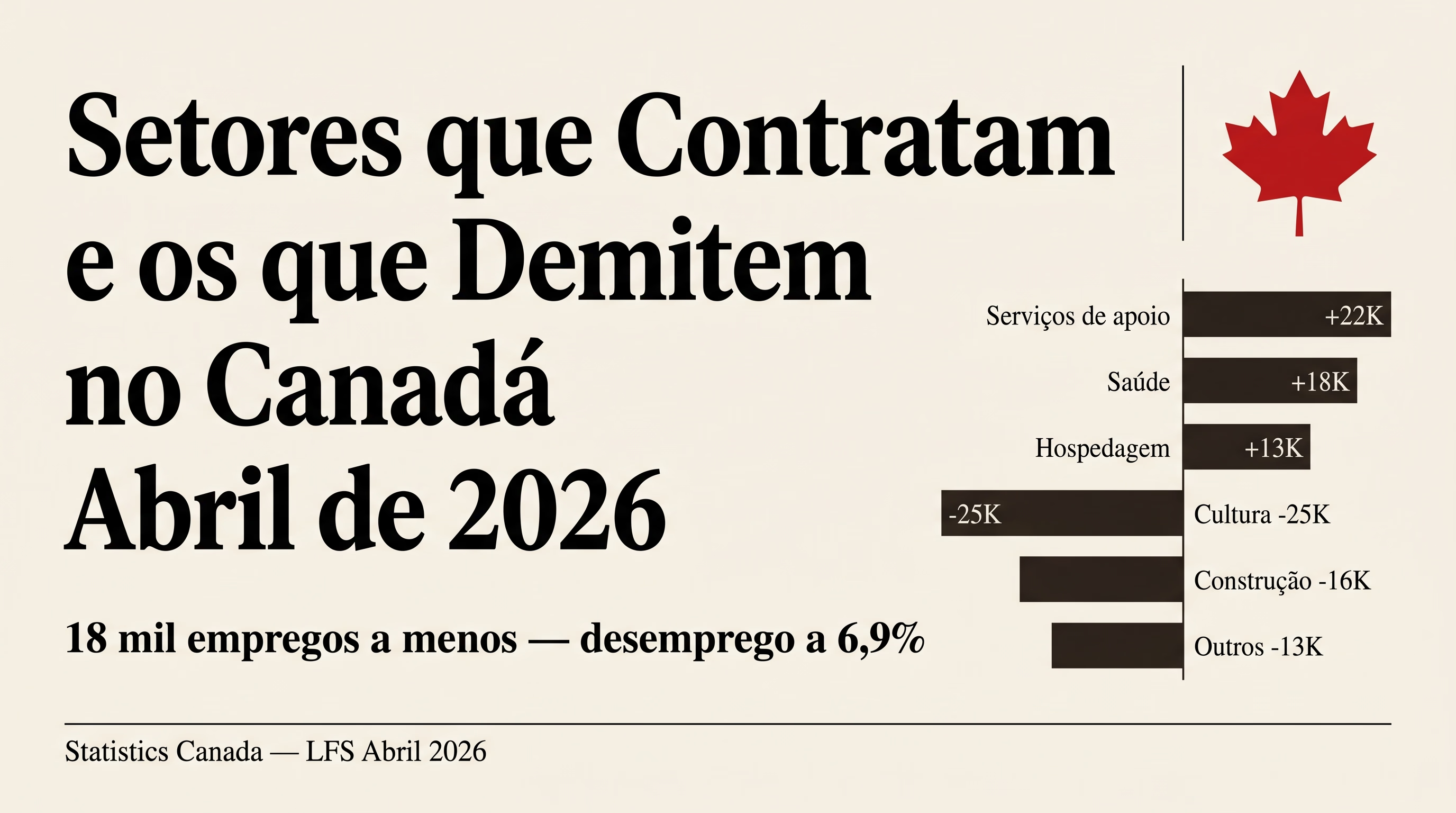
Canada lost 18,000 jobs in April 2026, unemployment at 6.9%. Health (+18,000) and hospitality are hiring; construction (-16,000) and culture are cutting.
REACT: Números CHOCANTES do Desemprego no Canadá Março 2025!
Desemprego subiu? Descubra o que mudou no mercado de trabalho canadense!
On Thursday, May 8, 2026, Statistics Canada released the April Labour Force Survey report. I read it immediately, and spent the next 20 minutes redoing a spreadsheet I had structured wrong.
The figure that stopped me: from January to April 2026, Canada racked up 112 mil Empregos destruídos no acumulado de 2026 StatCan
The market didn’t collapse, and I’ll show you the data that confirms it. But the 2026 picture is far more uneven than the generic headlines make it look. Some sectors are hiring aggressively at the same time as others are cutting. And your choice of sector and province matters more than the timing of your immigration.
How is Canada’s labour market doing in April 2026?
Canada lost 18 mil Empregos perdidos no Canadá em abril StatCan
StatCan
StatCan
StatCan
StatCan
What puts April in context is the year-to-date total: - 112 mil Empregos destruídos no acumulado de 2026 StatCan
Brendon Bernard, senior economist at the Indeed platform, described the picture precisely: the Canadian labour market is “static”. It isn’t crashing like in March 2020, when the pandemic destroyed 1 million jobs in 30 days. But it also isn’t growing like in 2022 and 2023, when Canada was adding 50,000 to 100,000 jobs a month.
The background noise is the trade war with the US. The 25% tariffs on steel and aluminum and the threats against the auto sector took effect in the first quarter of 2026 and rewrote employment projections for Ontario and for manufacturing as a whole. The effect wasn’t immediate or uniform, but it shows up clearly in the sector data.
Which sectors created the most jobs in April 2026?
Business support services led the month with + 22 mil Vagas criadas em serviços de apoio a negócios StatCan
The sector that consistently anchors employment in Canada in 2026, though, is health care and social assistance: + 18 mil Vagas criadas em saúde e assistência social em abril StatCan
StatCan
StatCan
Accommodation and food services added 13 mil Vagas criadas em alimentação e hospedagem StatCan
In total, the services sector added 9,100 jobs in April and 85,900 jobs over the last 12 months. The structural demand for services (health care, business support, food) is holding up better than the productive economy, and the trend should continue as long as demographic pressures persist.
Which sectors lost the most jobs in April 2026?
Information, culture and recreation posted the biggest cut of the month: - 25 mil Vagas perdidas em informação, cultura e recreação StatCan
Construction lost 16 mil Vagas perdidas na construção StatCan
Other services cut 13 mil Vagas perdidas em outros serviços StatCan
The most worrying number over a 12-month horizon is manufacturing: -51,800 jobs since April 2025. Most of the destruction is concentrated in Ontario, where auto-parts, steel, and aluminum plants were the first to absorb the impact of the American tariffs. Andrew DiCapua, chief economist at the Canadian Chamber of Commerce, summed it up in one sentence: “If companies can’t produce at high volume, they don’t need the workers.”
Why did youth unemployment reach 14.3% in Canada?
Young people aged 15 to 24 ended April with an unemployment rate of 14,3 % Taxa de desemprego de jovens (15 a 24 anos) StatCan
For comparison: men aged 25 to 54, the core-aged group that employers prioritize, ended April at 6,1 % Taxa de desemprego de homens de 25 a 54 anos StatCan
StatCan
The number of long-term unemployed, 27 weeks or more without a job, reached 22,5 % Desempregados de longa duração StatCan
The historical context matters: the federal public sector employed 950,000 additional people between 2015 and 2024. The Carney government has signaled cuts of 40,000 federal positions by 2029. That contraction, on top of the stagnation in the private sector, removes one of the traditional exits for people entering the labour market without a network of contacts.
Did the American tariffs destroy jobs in Canada in 2026?
The direct answer is: partly, and in a concentrated way. Manufacturing lost 51,800 jobs in 12 months, with the biggest impact in steel, aluminum, and auto components, the three sectors directly targeted by Trump’s tariffs. Ontario absorbed most of the geographic shock.
But the total collapse didn’t happen, and the following numbers explain why.
The 497,200 job openings in April represent a ratio of 3.1 unemployed people per opening. That’s high by recent standards (in 2022 it was 2.1) but far from a paralyzed market. Wages rose 4.5% to 4.8% a year, which means employed workers have growing purchasing power, even as the market cools. Kari Norman, economist at Desjardins, projected that manufacturing should “stabilize rather than keep falling” if the tariffs stay at their current level.
CIBC projects an unemployment rate around 6.7% on average in 2026, with improvement in 2027 if the trade negotiations between Canada and the US move forward. The interest rate should stay stable through the year. The Bank of Canada has little room to cut without reigniting inflation, but it also has no reason to raise rates with the labour market under pressure.
The read I take: Canada is processing a real external demand shock in manufacturing while the services sector holds up aggregate employment. It’s not an employment crisis, it’s a fork in the road. And for immigrants, that fork is the most relevant data point, because it defines which side of the equation you’ll enter on.
Which provinces have the hottest labour market in Canada right now?
Manitoba ended April with 5,0 % Taxa de desemprego em Manitoba StatCan
StatCan
At the other extreme: Ontario reached 7,5 % Taxa de desemprego em Ontário StatCan
StatCan
StatCan
StatCan
For people planning to immigrate who have geographic flexibility: Manitoba and Saskatchewan are structurally underrated destinations. Less competition, lower unemployment, and, for now, shorter lines in the provincial nomination programs like the MPNP and the SINP. The trade-off is a harsher winter and smaller cities. The question isn’t whether these markets are perfect, it’s whether they’re better than the 18-month wait for a job in Toronto.
I live in Vancouver. Even though I like it here a lot, I think I’d do much better somewhere more rural, maybe a Kelowna or even a Red Deer. But when I read a report showing Manitoba at 5,0 % Taxa de desemprego em Manitoba StatCan
The April 2026 labour market is not Canada closed to immigrants. It’s a market that demands more precision in your choice of sector and destination. The margin for error in choosing “anything in Toronto” has shrunk. The margin for those who arrive with clarity about their sector, health care, food services, business support, and a willingness to consider Manitoba or Saskatchewan is wider than it’s been in the last three years.
Frequently asked questions
How many jobs did Canada lose in April 2026?
Which sectors are hiring immigrants in Canada in 2026?
Is youth unemployment high in Canada in 2026?
Is it worth immigrating to Canada with the labour market falling?
The Vancouver Letter
You made it this far. That tells me something.
The Vancouver Letter is the letter I wish someone had sent me the third time I tried for Canada, when I had no idea what I was doing wrong. Once a week, straight to your inbox. No products, no courses, just what actually works. I got your back.
Get immigration updates
Practical tips straight to your inbox.
Related articles

Canada's job market: wages, unemployment and opportunities (2019-2024)
Canadian job market 2019-2024: unemployment from 5.7% to 13.7% at the COVID peak, now 6.7% (Mar 2026). Average wage CAD 32.50/h.

BRL/CAD exchange rate: the real's purchasing power in Canada (2019–2026)
BRL/CAD exchange rate: R$2.90 (2019) → R$3.63 (April 2026). Brazil's 38% cumulative inflation erodes the purchasing power of remittances. Full analysis.

Economy and Inflation in Canada: How the Country Weathered the Storm (2019-2024)
Canadian inflation: peak 8.1% in June 2022 (highest in 40 years) to 1.8% in February 2026. What changed in the budgets of Brazilians here.