
DADOS DO CANADÁ
Canada's job market: wages, unemployment and opportunities (2019-2024)
In this article
Canadian job market 2019-2024: unemployment from 5.7% to 13.7% at the COVID peak, now 6.7% (Mar 2026). Average wage CAD 32.50/h.
REACT: Números CHOCANTES do Desemprego no Canadá Março 2025!
Desemprego subiu? Descubra o que mudou no mercado de trabalho canadense!
💰 Quanto Ganham os Trabalhos Iniciais no Canadá? | Vida em Vancouver 🇨🇦
Your first job in Canada is an experience few Brazilians forget.
It isn’t necessarily the role itself. It can be the simplest job in the world. It’s what that job represents: the first paycheque with the CAD symbol, the first income tax return as a resident, the start of a Canadian work history that opens doors to everything that comes after.
I remember mine. I remember the first days thinking my English was good enough, until I discovered that good enough to survive is different from good enough to work. I remember calculating and recalculating how many months it would take to move from that entry-level job to something closer to what I had studied in Brazil.
The Canadian job market has nuances that the numbers help you understand, but that the numbers alone don’t capture. In this post, I’ll try to combine both.
What does the Labour Force Survey measure?
Statistics Canada runs the Labour Force Survey (LFS) every month, a survey of roughly 56,000 households that measures the state of the Canadian job market. It is the official source for the unemployment, employment, and wage data you’ll see throughout this post.
The unemployment rate measures the percentage of the labour force (people who are employed or actively looking for work) that is unemployed. It’s different from “percentage of adults without a job”, because people who stopped looking for work don’t count in the official rate.
Wages are measured as the average hourly figure across all employees (full-time and part-time), in every industry and province.
2019: the healthiest job market in decades
In 2019, the unemployment rate in Canada sat at 5.7%, the lowest level since the LFS began in the 1970s. It was what economists call “full employment” in practice: anyone who wanted work could get it, and employers were competing for workers.
The average hourly wage in 2019 was around CAD 29.00/hour for all employees. For immigrants in their settlement period, the reality was more complex. Many started in positions below their qualifications, with lower pay, and took one to three years to reach market level.
But the environment was favourable. The economy was growing. Opportunities existed.
2020: the unemployment shock
Unemployment rate in Canada (%)
Source: Statistics Canada, Labour Force Survey (LFS), Table 14-10-0287-01. Open Government Licence. Annual figures represent averages. The March 2026 value is the most recent available in the government data pipeline.
| Período | Taxa de desemprego (%) |
|---|---|
| 2019 | 5,7 |
| 2020 | 9,7 |
| 2021 | 7,5 |
| 2022 | 5,3 |
| 2023 | 5,5 |
| 2024 | 6,3 |
| mar 2026 | 6,7 |
Ver dados em formato de tabela
COVID-19 destroyed the Canadian job market in a matter of weeks.
The unemployment rate jumped from 5.7% in 2019 to an annual average of 9.7% in 2020, but the peak was far more dramatic: in May 2020, unemployment hit 13.7%, the highest in Canada’s recent history.
For scale: in May 2020, roughly 3 million Canadians were unemployed, plus another 2 million working drastically reduced hours. Almost the entire hospitality, tourism, non-essential retail, and entertainment industry came to a halt.
For recent immigrants, especially those in service jobs, which are often the first available to newcomers, the impact was devastating. Many lost the jobs they were using to build the Canadian experience they needed for the immigration process.
The Canadian government responded with CERB (Canada Emergency Response Benefit), paying CAD 2,000/month to affected workers. For many Brazilians in Canada, this was the first real contact with Canadian social protection, and it worked.
2021-2022: the extraordinary recovery
The job market recovery was remarkably fast. In 2021, the unemployment rate dropped to 7.5%. In 2022, to 5.3%, practically back to the pre-pandemic level.
The speed of the recovery surprised even the more optimistic economists. The reason was a combination of massive government stimulus, pent-up demand for services once restrictions lifted, and a booming housing and construction market that created jobs at scale.
In 2022, many sectors didn’t have enough workers, the famous “labour shortage” that dominated the headlines. Restaurants closing on weekends for lack of staff. Construction projects delayed for lack of workers. Hospitals urgently asking for qualified immigrants.
For immigrants arriving in 2021-2022, the market was favourable, especially for those with qualifications in health, technology, construction, and logistics.
Wages: did they keep up?
Average hourly wage, all employees (CAD)
Source: Statistics Canada, Labour Force Survey, Average Hourly Wages, Table 14-10-0063-01. Annual figures are approximate averages. The January 2026 value is the most recent in the government data pipeline. Open Government Licence.
| Período | Salário médio horário (CAD/h) |
|---|---|
| 2019 | 29 |
| 2020 | 28,8 |
| 2021 | 30,1 |
| 2022 | 31,2 |
| 2023 | 31,9 |
| 2024 | 32,5 |
| jan 2026 | 32,73 |
Ver dados em formato de tabela
Here’s the question every Brazilian immigrant asks, but rarely finds a direct answer to: did wages keep up with inflation?
2020: Wages fell slightly (CAD 28.80/h). With high unemployment, workers’ bargaining power dropped.
2021: Recovery to CAD 30.10/h, but inflation of 3.4% started to erode it.
2022: Wages rose to CAD 31.20/h (+3.6%), but inflation was 6.8%. Real result: purchasing power fell by roughly 3%.
2023: Wages: CAD 31.90/h (+2.2%), inflation: 3.9%. Still a real loss, but smaller.
2024: Wages: about CAD 32.50/h (+1.9%), inflation: 2.4%. Recovery: a small but positive real gain.
2026 (Jan): CAD 32.73/h, the highest nominal wage in the historical series.
The lesson here is subtle but important: in 2022, you got poorer on paper even while earning more. The wage in nominal dollars went up, but the purchasing power of that wage fell because prices rose faster.
This is a phenomenon that affects people in their first years the most, because those who are established tend to have the ability to negotiate raises, while people in entry-level jobs rarely get that conversation.
2023-2024: the new scenario, more workers, fewer jobs per person
In 2023, unemployment began to rise subtly, reaching 5.5%. In 2024, it went to 6.3%. In March 2026, the most recent data from the government data pipeline indicates 6.7%.
Why is it rising if the economy didn’t enter a recession?
The answer has two parts:
1. Immigration volume. Canada admitted almost 500,000 permanent residents in 2023, plus hundreds of thousands of temporary workers and international students. All that labour needs to find work. Job creation couldn’t absorb everyone at once.
2. Specific sectors weakening. The tech sector went through a wave of layoffs in 2022-2023 (the American big tech companies, which employ many Canadians remotely, cut staff massively). The financial sector too. That created skilled unemployment that took longer to relocate.
For Brazilian immigrants in technology, finance, and professional services, 2023-2024 was harder than the previous years. For those in health, construction, transport, and essential services, the market stayed favourable.
The job market for immigrants: the reality beneath the numbers
The aggregate data matters, but the immigrant’s experience is rarely the average experience. I need to be honest about some realities the numbers don’t capture directly:
Credential recognition is still a nightmare. Doctors, engineers, lawyers, psychologists, and pharmacists trained in Brazil face long and expensive processes to have their degrees recognized in Canada. It’s common for qualified professionals to work in roles well below their training for one to three years while they navigate that process.
English (or French) at a professional level takes time. You can have IELTS 7.0 and still feel you can’t communicate with the fluency the Canadian professional environment demands. That gap closes over time, but it creates frustration at the start.
Networks matter more than resumes. A large share of jobs in Canada are filled through networking and internal referrals, not through applications via LinkedIn or Indeed. Brazilians who arrive without a local network tend to take longer to find work in their field.
Minimum wage and living wage are different things. Minimum wage varies by province: in Ontario it’s CAD 17.20/hour (2025), in BC it’s CAD 17.40/hour. It’s a level that lets you survive, but it doesn’t let you pay rent in Vancouver or Toronto without sharing housing. The conversation about a living wage in Canada is moving forward but is still far from resolved.
Which sectors have the most opportunities for Brazilians?
Based on employment data and the patterns I observe in the Brazilian community, the sectors with the highest absorption of qualified immigrants include:
Technology: Software development, data analysis, cybersecurity, product management. Canada has a solid tech ecosystem, especially in Toronto (the largest concentration of AI jobs outside Silicon Valley), Vancouver, and Montreal. The downside: the sector went through a contraction in 2022-2023.
Health: Nursing, medicine (with the long revalidation process), physiotherapy, mental health. There is a severe shortage in practically every province. The revalidation process is bureaucratic, but the final destination is one of the most resilient and well-paid markets.
Construction and infrastructure: Civil engineers, technicians, electricians, plumbers. The construction boom to try to solve the housing deficit created enormous demand. Regulated trades have equivalency processes, but generally quicker than medicine or law.
Finance: Accountants (CPA), financial analysts, risk managers. Toronto is one of the main financial centres in the world. The CPA equivalency process for Brazilian accountants exists and has been followed by several professionals.
Education: Certified teachers, especially in the public elementary and secondary school system, have consistent demand, especially in French.
The Canadian resume: why your Brazilian resume doesn’t work here
I’ll tell you something I learned the hardest way possible.
In Brazil, I had a resume I considered good. It had experience, projects, results. A degree from a recognized university. Detailed descriptions of every role I’d held. Well-written professional objectives. The photo in the top right corner, as tradition demands.
Here in Canada, that resume was wrong in practically every aspect that matters.
The Canadian resume has completely different conventions:
No photo. Including a photo on a resume in Canada is not neutral. It’s frowned upon by recruiters trained to avoid unconscious bias. Some won’t even read the resume if it has a photo. Take the photo off.
No date of birth, marital status, or other personal information. The Canadian Human Rights Act prohibits discrimination based on age, marital status, race, and so on. Responsible recruiters don’t want that information, and including it creates discomfort.
One page for professionals with less than ten years of experience. In Brazil you fill the resume with information. In Canada, even ten years of work fits one to two pages at most. Brevity is a virtue.
ATS-friendly. Most large companies use Applicant Tracking Systems that read your resume before a human does. Simple formatting, no tables or text boxes, plain text the system can extract.
Quantified results, not responsibilities. Instead of “Responsible for managing the team”, write “Managed a team of 8 people, reducing project delivery time by 23%”. The Canadian market values evidence of impact, not a description of tasks.
Professional summary at the top, not an objective. Instead of “Objective: To work at a technology company where I can develop my skills”, write a 3 to 4 line paragraph describing who you are professionally and what you offer.
The process of adapting the resume is not cosmetic. It’s a complete revision of how you present your trajectory. And it’s worth every hour invested.
How do you write a Canadian cover letter?
In Brazil, few jobs ask for a cover letter. In Canada, it’s often required, and when it isn’t, sending one voluntarily is a differentiator.
A good Canadian cover letter:
- Is specific to the job and company (not generic)
- Shows you researched the company
- Connects your experience to the specific requirements of the position
- Is concise, one page at most
- Ends with a clear call to action
The most common mistake I see Brazilians make: copying and pasting the resume summary into the letter. A cover letter is not for repeating what’s on the resume. It’s for telling the story that connects you to the company and the role, the “why you, why here, why now”.
How do you negotiate salary in the Canadian market?
There’s a myth that needs to be dismantled: the idea that in Canada salaries are fixed, published, and you just accept or not.
It’s not like that. Salary negotiation exists here, it just works differently.
First: research the market. Sites like Glassdoor, Levels.fyi (for tech), LinkedIn Salary, and Statistics Canada itself (Wages and Salaries Survey) publish salary ranges by occupation, city, and experience level. Go into a negotiation knowing what the market pays. Don’t guess.
Second: ask, but with grounding. When a recruiter asks “what is your salary expectation?”, the answer is not a vague number. It’s something like: “Based on my research of the market for this role in [city], at my level of experience, I’m looking for between CAD X and CAD Y. Is that within the range you’re considering?”
Third: the total package matters. Salary is one line. The package includes: health plan (dental, vision, drug plan), RRSP contribution (the equivalent of FGTS/pension), vacation days (the legal minimum is 2 weeks, but many companies offer 3 weeks or more), work flexibility, bonus, stock options, parental leave, and so on.
A company that offers CAD 70,000 with a full health plan and 4% RRSP matching can be better than one that pays CAD 75,000 with no benefits, depending on your situation.
Fourth: for your first job in Canada, be strategic, not anxious. The mistake many newly arrived Brazilians make is to accept any offer in a hurry. I understand, there’s real financial pressure. But accepting an offer significantly below market creates a salary anchor that can take years to correct. If possible, have at least one alternative before negotiating.
Fifth: the 24-hour rule. If you get an offer you weren’t expecting or that’s better than you imagined, ask for 24 to 48 hours to consider it. This doesn’t offend anyone, it’s standard practice. Use that time to check whether there’s room to negotiate.
What benefits beyond salary in Canada?
When a Brazilian planning to immigrate sees a salary of CAD 60,000/year, the first thing they do is convert it to reais. What is rarely considered is the value of the benefits that come with it, which in many cases represent an additional 20% to 35% of the salary in real value.
Extended Health Benefits: The public health system (Medicare) covers medical appointments and hospitalization, but doesn’t cover dentist, glasses, contact lenses, physiotherapy, psychology, prescription drugs outside government programs, and so on. A corporate health plan that covers all of this is worth CAD 5,000 to CAD 12,000 per year for a family, in real quality of life.
RRSP matching: Many companies contribute a percentage of your salary to your RRSP (Registered Retirement Savings Plan, the Canadian retirement plan) if you also contribute. A match of 3-5% of salary is free money for your retirement. Never fail to take advantage of this benefit if it exists.
Vacation days: The Canadian minimum standard is 2 weeks (10 working days). More generous companies offer 3, 4, or even 5 weeks. Each extra week represents about 2% of the annual salary in time, or valuable rest to visit Brazil.
Remote/hybrid work: Since 2020, many Canadian companies have adopted permanent hybrid models. For Brazilians who value flexibility, this has real monetary value: less spending on transport, lower housing cost (you can live farther from the centre), and the possibility of working temporarily from Brazil.
Parental leave: Canada has one of the best parental leave policies in the world, up to 18 months of leave split between parents, with Employment Insurance benefits. For families thinking about having children in Canada, this is a significant factor.
How does employment insurance (EI) work in Canada?
One of the aspects of the Canadian job market that gets discussed the least in the Brazilian community is Employment Insurance (EI), the Canadian unemployment insurance.
If you worked and contributed to EI (the contributions are deducted automatically from your paycheque), and you lose your job without it being your own fault, you’re entitled to receive EI benefits. The rate is 55% of your average weekly wage over the last 52 weeks, up to a maximum of roughly CAD 668/week (in 2025).
To receive EI, you need a minimum number of hours worked, which varies from 420 to 700 hours depending on your region and the local unemployment rate. In the vast majority of cities, anyone with 6 to 7 months of full-time work already meets the requirement.
For newly arrived Brazilians building a financial life here, knowing this safety net exists makes a difference in planning. If you lose your job in the first year, it’s not a total financial collapse. It’s a difficult situation, but manageable if you’ve already paid enough in contributions.
The real table: what each sector pays in Canada
| Sector | Entry level | Mid level | Senior level | Notes |
|---|---|---|---|---|
| Technology (dev/eng) | CAD 55–70k | CAD 80–110k | CAD 120–180k+ | Concentrated in Toronto/Vancouver |
| Health (RN nursing) | CAD 60–70k | CAD 75–90k | CAD 90–120k | Severe shortage in all provinces |
| Construction (technician) | CAD 45–55k | CAD 60–75k | CAD 80–100k | Includes overtime; high demand |
| Finance/Accounting | CAD 50–65k | CAD 70–90k | CAD 100–150k | CPA needed for progression |
| Education (teacher) | CAD 45–60k | CAD 65–80k | CAD 85–100k | Varies a lot by province and union |
| Logistics/Transport | CAD 40–55k | CAD 55–70k | CAD 70–90k | Stable demand; no degree needed |
| Hospitality | CAD 32–45k | CAD 45–58k | CAD 60–80k | Minimum wage + tips + benefits |
Values in annual CAD (2024-2025). They vary by city, company, and specific experience. Sources: Statistics Canada LFS, Glassdoor Canada, LinkedIn Salary Insights.
How much would you earn in another city? The salary gap between cities is real. Compare salaries by sector in Vancouver, Toronto, Calgary and 20 more cities in our free tool. Compare now →
The gap between cities is real and significant. A software developer with 5 years of experience can earn CAD 80,000 in Winnipeg and CAD 120,000 in Vancouver or Toronto, for the same work, with the difference partly offset by the higher cost of living in the big cities.
How to build a network from scratch: real networking
Going back to a point I mentioned earlier, networks matter more than resumes, let me be more specific about how you actually build that here.
First, a figure that always surprises newcomers: between 70% and 80% of jobs in Canada are never posted. They’re filled through referral, internal network, or direct recruitment before they become open postings. This isn’t market perception, it’s data from the Chartered Professionals in Human Resources of Canada (CPHR).
That means the strategy of “sending a resume via LinkedIn to 200 companies” has a very low return.
What works better:
An active, well-set-up LinkedIn. Having a profile isn’t enough. You need a profile with a professional photo, a clear headline, and an “About” section that tells your story. Connect with people in your field. Comment on posts from industry leaders. Share relevant content. The goal is to show up as someone who exists in the Canadian professional ecosystem.
Informational interviews. Ask for 20 to 30 minutes by video call with professionals in your field, to learn, not to ask for a job. Most Canadians respond positively to polite, direct requests for an “informational interview”. It’s a way to build a network without the pressure of an active job search.
Industry events. Meetups, conferences, professional association events. At first they’ll feel strange. You don’t know anyone, English will feel hard in a crowded room. It gets easier over time, and the connections you make there are worth more than any online application.
The Brazilian community as a way in. Brazilians established in various cities and sectors are a network that MorarFora is precisely trying to connect. Someone already working at a company can refer you internally, and an internal referral multiplies your chances of at least one interview by ten.
How does credential recognition work in Canada?
I mentioned earlier that credential recognition is a long and complex process. I want to be more specific here, because the misinformation on this topic creates the wrong expectations.
Regulated vs. unregulated professions:
In Canada, there are two categories of professions:
Unregulated: Most professions, technology, business, marketing, design, data analysis, logistics, and so on. To work in these areas, you don’t need credential recognition. Your resume, experience, and demonstrated ability speak louder than any certificate. A software developer with a strong portfolio and proven experience can be hired tomorrow, with no bureaucracy.
Regulated: Medicine, nursing, dentistry, pharmacy, architecture, engineering (P.Eng.), accounting (CPA), law, psychology, and others. For these professions, there is a regulatory body per province that controls access to the profession. You can’t practise without a licence, and the licence generally requires degree equivalency, exams, and sometimes supplementary courses.
For regulated professions, the paths are:
Medicine: The longest process. Brazilian medical degrees are generally not recognized directly. Doctors trained abroad need to take the MCCQE (Medical Council of Canada Qualifying Examination) and go through a residency match. The process takes 2 to 5 years and is extremely competitive. Many Brazilian doctors work as nurses or in health-related roles while navigating this process.
Engineering: Professional Engineers Canada (PEC) coordinates recognition across provinces. The general process involves: academic assessment, a period as an EIT (Engineer in Training) of 4 years under the supervision of a licensed engineer, and technical and ethics exams. Total: 4 to 6 years.
Accounting: CPA Canada has an equivalency program for accountants trained abroad. If you have training equivalent to the Brazilian CPA (CFC/CRC), the process can be accelerated, but it still requires exams and a practical period in Canada.
Nursing: The process varies by province, but generally involves: assessment by the NNAS (National Nursing Assessment Service), an eventual NCLEX-RN (the licensing exam for nurses), and sometimes bridging courses. It’s a 1 to 2 year process, shorter than medicine.
For unregulated professions, the message is simpler: don’t expect formal recognition. Build evidence of competence, portfolio, projects, references, and measurable results. The market will assess you by what you do, not by the degree you hold.
Remote work for a Brazilian company while living in Canada: what you need to know
A question I get with growing frequency: “Can I keep working for my Brazilian company after I arrive in Canada?”
The short answer is: technically yes, but with legal and tax implications you need to understand before doing it.
The immigration status problem:
If you’re in Canada on a work permit, that permit is generally tied to a Canadian employer. Working for a Brazilian company remotely from Canada may or may not be allowed depending on the type of your permit:
- Open Work Permit: Allows you to work for any employer, including a foreign company.
- Closed Work Permit (tied): Specifies the Canadian employer. Working for another employer, even a Brazilian and remote one, technically violates the conditions of the permit.
- Permanent residence or citizenship: No employer restrictions. You can work for whoever you want, including a Brazilian company.
The tax implications:
If you live in Canada for more than 183 days in a year and establish significant ties (residence, family, bank account), you’re considered a “tax resident” of Canada, regardless of where your employer is.
This means the income you receive from a Brazilian company has to be declared in Canada and is subject to Canadian income tax. The double taxation treaty between Brazil and Canada can prevent you from paying tax in both countries on the same income, but you still need to declare on both sides.
The practical situation:
There are many Brazilians who work remotely for Brazilian companies while building a life in Canada. It works, but it works best when you:
- Have immigration status that allows it (PR or open work permit)
- Declare the income in Canada as a tax resident
- Check whether the Brazilian company needs to report any Canadian labour obligation (rare, but relevant for larger companies)
For specific cases, it’s worth consulting an accountant with experience in international taxation and immigration. This is not a question you solve with guesswork.
How do you navigate the first 90 days in a Canadian job?
You got the job. You went through the selection process. You signed the offer. The first week begins.
And then you realize the Canadian work environment has conventions you didn’t learn in any English course.
These are the things the job market numbers don’t teach, but that make all the difference in the first months:
Direct but polite communication. Canadians have a communication style that can confuse Brazilians: they’re direct about work problems, but extremely polite in form. “I have a concern about this approach” means “I think this is wrong”. “Maybe it’s worth exploring another option” can mean “this path won’t work”. Learning to read these signals takes time.
Punctuality is absolutely non-negotiable. Unlike many Brazilian contexts where 10-15 minutes late is acceptable, in the Canadian professional environment you arrive on time or a little early. In a meeting scheduled for 9 a.m., everyone is in the room at 8:58 a.m. Being late is understood as a lack of respect.
Meetings have an agenda and end on time. Meetings here rarely run past their scheduled time. If you have a 30-minute meeting, it ends in 30 minutes. There’s an expectation that everyone came prepared and that everyone’s time is respected.
Feedback is given and expected regularly. In professional Canada, there’s a culture of frequent, constructive feedback. Your manager will give you feedback. You can, and should, ask for feedback. This isn’t a sign of insecurity, it’s a sign of commitment to development.
The hierarchy is flatter than in Brazil. In many Canadian companies, you call your CEO by their first name. This doesn’t mean there’s no hierarchy, there is. But the hierarchy is generally exercised with less formality and more authority of competence than of title.
You can disagree with your boss. Politely and with grounding, of course. But the “the boss is always right” culture that exists in many Brazilian companies is less prevalent here. Your technical perspective has value, even if you’re the most junior in the room.
The first 90 days are for observing, learning, and asking questions. Brazilians tend to be proactive and engaged, which is generally well received. Just calibrate the intensity. Showing initiative is great. Coming across as anxious or impatient can be misinterpreted.
How does self-employment work in Canada?
Canada has a mature entrepreneurship ecosystem, and there’s a significant number of Brazilians who arrive here not to work for a company, but to set up their own business.
Incorporating a company in Canada is surprisingly simple. You can register a sole proprietorship for less than CAD 100 in practically any province, or incorporate a federal corporation for less than CAD 200. The process is bureaucratic at a far lower level than in Brazil.
The implications of self-employment:
If you work as a freelancer, consultant, or self-employed person in Canada, you’re responsible for:
- Declaring all income as self-employment income
- Paying CPP (Canada Pension Plan), both the employee and the employer part, totalling roughly 11.9% of income up to the annual maximum
- Paying EI (Employment Insurance) if you want coverage as a self-employed person, optional but recommended
- Charging and remitting GST/HST to Canadian clients if your annual income exceeds CAD 30,000
What you can deduct:
One of the advantages of self-employment in Canada is the ability to deduct legitimate business expenses from income tax:
- Home office space (a percentage of rent or mortgage)
- Work equipment (computer, software, peripherals)
- Communications (phone, internet, a percentage of professional use)
- Business-related transport
- Education and professional development
- Marketing and advertising expenses
It’s not advisable to navigate these deductions without an accountant. A good accountant pays their own fee in tax savings, especially in the first year when the rules are new to you.
For immigrants who want to start a business, it’s also worth researching the immigrant entrepreneurship support programs that exist in each province. Many chambers of commerce have specific programs, and organizations like the Business Development Bank (BDC) have resources specifically for small businesses founded by immigrants.
See the current job market data
To follow the latest unemployment rates and wage data, updated monthly by Statistics Canada, visit the Canada Data page.
Worker protection in Canada: what the law guarantees you
One of the things that most impresses Brazilians who start working in Canada is the solidity of the legal framework of worker protection. It’s not perfect, and there are sectors with more precarious conditions, but the law guarantees a minimum level that is significantly more robust than many expect.
What the Employment Standards Act (ESA), or its provincial equivalent, guarantees:
Hours of work: The standard work week is 40 hours in Ontario and BC (44 hours in some contexts). Hours beyond that limit are overtime, paid at at least 1.5x the regular rate. Workers in specific categories (professionals with a salary above certain thresholds, managers, and so on) may have different rules.
Vacation: A minimum of 2 paid weeks (equivalent to 4% of salary) in the first year, rising to 3 weeks (6%) after 5 years with the same company. Some provinces, like Saskatchewan, have even higher minimum standards (3 weeks from the start).
Sick leave: At the federal level, employers above a certain size are required to offer 10 days of sick leave per year (some paid, some unpaid, depending on the province’s legislation). This is different from what EI pays in case of long-term illness.
Dismissal without cause: You can’t be dismissed without an adequate notice period. The formula varies by length of service and method of hiring, but the general rule in Ontario is at least 1 week per year of service (up to 8 weeks) of notice, plus potentially additional “reasonable notice” depending on the contract. Dismissals motivated by discrimination or retaliation are illegal.
Employment Insurance (EI): As mentioned earlier, the EI contribution is automatic and guarantees access to unemployment insurance in case of dismissal without cause. EI also covers parental leave, sick leave, and care for a seriously ill family member.
A safe work environment: Canada has comprehensive occupational health and safety legislation (OHS, Occupational Health and Safety). You have the right to refuse work you believe is unsafe without retaliation.
What to do if your rights are violated:
If you believe your employer is violating labour law, unpaid overtime, vacation not respected, a hostile work environment, you can file a complaint with your province’s Ministry of Labour. The process is free. Legal representation is not necessary for ESA cases. There are also support organizations for immigrant workers in many cities.
Knowing your rights isn’t paranoia, it’s preparation. Most Canadian employers respect the law. But knowing what the law says puts you in a stronger position in any conversation about working conditions.
Conclusion: the market exists, you need to know where to look
The Canadian job market is not perfect for immigrants. It has credential barriers, language barriers, network barriers. It has the veiled prejudice of some employers who prefer “Canadian experience”, even when that’s absurd for someone who just arrived.
But it exists. It’s real. It’s big enough to absorb hundreds of thousands of immigrants per year, as the data shows.
The difference between someone who finds a job in their field in six months and someone who takes two years is rarely merit or luck. It’s preparation. It’s understanding how this market works before you arrive. It’s arriving with solid English (or French), with references adapted to the Canadian standard, and with strategic patience for the first months.
Canada won’t wait for you standing still. But it will respond to your effort, in a way few countries in the world do.
The inflation that eroded these wages is analyzed in Post 2 of the series. And the immigrants who entered through this market came in through the process described in Post 3.
I got your back.
Sources
-
Statistics Canada, Labour Force Survey (LFS), Unemployment Rate, Table 14-10-0287-01. Available at: https://www150.statcan.gc.ca/t1/tbl1/en/dtbl!/14/14-10-0287-01. Open Government Licence.
-
Statistics Canada, Average Hourly Wages, All Employees, Table 14-10-0063-01. Available at: https://www150.statcan.gc.ca/t1/tbl1/en/dtbl!/14/14-10-0063-01. Open Government Licence.
-
Statistics Canada, Employment by industry and province. Table 14-10-0023-01. Open Government Licence.
-
Government of Canada, Employment Insurance (EI) program data. Available at: https://www.canada.ca/en/employment-social-development/.
Frequently asked questions
What is the Labour Force Survey?
What was the peak of unemployment in Canada during COVID?
How much did CERB pay?
Why are 70% of jobs in Canada not posted?
How much does it cost to start a company in Canada?
The Vancouver Letter
You made it this far. That tells me something.
The Vancouver Letter is the letter I wish someone had sent me the third time I tried for Canada, when I had no idea what I was doing wrong. Once a week, straight to your inbox. No products, no courses, just what actually works. I got your back.
Get immigration updates
Practical tips straight to your inbox.
Related articles
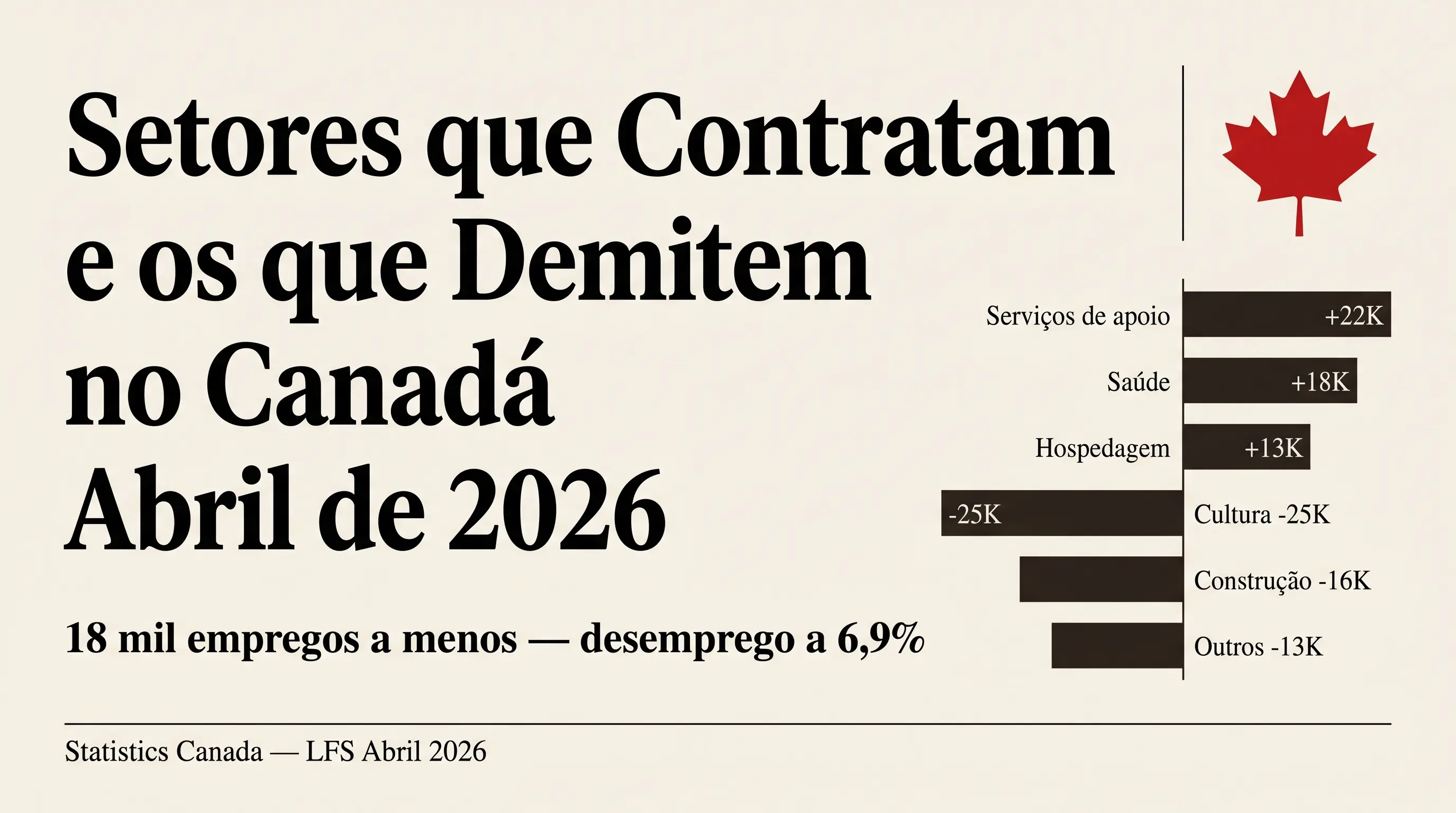
Sectors That Hire (and Those That Lay Off) in Canada: April 2026
Canada lost 18,000 jobs in April 2026, unemployment at 6.9%. Health (+18,000) and hospitality are hiring; construction (-16,000) and culture are cutting.

BRL/CAD exchange rate: the real's purchasing power in Canada (2019–2026)
BRL/CAD exchange rate: R$2.90 (2019) → R$3.63 (April 2026). Brazil's 38% cumulative inflation erodes the purchasing power of remittances. Full analysis.

Economy and Inflation in Canada: How the Country Weathered the Storm (2019-2024)
Canadian inflation: peak 8.1% in June 2022 (highest in 40 years) to 1.8% in February 2026. What changed in the budgets of Brazilians here.