PROGRAMAS DE IMIGRAÇÃO
Canada plan 2025-2026: the shortcut that could disappear
In this article
There is a path to immigrate spending 80-90% less than the traditional route. But it could end in 2026 or 2025. If you do not act now, you will regret it.
PLANO CANADÁ 2025 E 2026: A HORA É AGORA (SUA ÚLTIMA CHANCE)
Man, immigrating to Canada is about to change, and if you do not do it now, you will regret it badly. There is a way to move here spending 80%, in some cases up to 90% less than the traditional path. And that shortcut could disappear in 2026 or even in 2025, depending on how the political game turns in the next cycle. I am not saying this to sell a course. Clara and I are starting to study French right now ourselves because this could be our last chance to close our process. I’ll explain exactly what changed, what the shortcut is, how much it costs, and how much time you have.
What changed in the elections (and why it matters to you)
The recent Canadian elections were not only about politics. They defined who gets to immigrate from here on. The race was tight, nobody knew who would win until the end. If the Conservative Party had won, we would have had drastic changes in immigration programs: the target dropping from 413,000 to maybe 100,000 a year, francophone programs probably being cut, priorities shifting completely. But since the Liberals won, and they have been in power for a while now, they are going to double down on the programs they created themselves.
That means we have more certainty about where the next 1 to 2 years are headed. It is not a guess, it is continuity of the same party with the same agenda. And I say this while planning my own immigration in the flesh, applying through Express Entry, watching the federal tech program shrink down to cyber security, watching the provincial tech program run dry (5,500 invitations for 4,000 spots, it ate next year’s quota too). I am living the system, not commenting from the outside.
And if you ignore what is happening in Canadian politics, you end up planning your immigration based on programs that are either already gone or have become much stricter. That means losing years in planning, thousands of dollars, and the real chance to immigrate while there are still viable paths. The window is finite.
The old recipe (still sold as the standard)
Years ago, about 6, 7, 8 years back, the Canadian pitch was clear: come study in Canada, specialize here, gain Canadian experience, become a permanent resident, then a citizen. That was the famous TR to PR to citizenship path. You came as a student (temporary resident), finished college, gained 2 to 3 years of experience, applied through Express Entry, became PR, and after 3 more years, became a citizen. Neat.
That is the path I walked myself. I landed in Vancouver in September 2024 on a study permit, paid for my college, started the marathon. And I am stuck in the mud twice over because of provincial changes: the tech program shrank, the provincial program ran dry before my turn. People who got in before me may have managed to close it. People who get in now, like me, will depend on a lot of luck and a lot of extra points.
This college to work to PR model is still sold as the standard, as the rule. But it has become a funnel. It did not end, it became selective, expensive, and risky. People who get in without understanding this often do not realize how hard it will be to get out. And the problem is not the model itself, it is the cost of it in 2026.
The numbers that weigh on you
Run the traditional path math with me:
- Private college: about CAD 16,000 to CAD 20,000 (mine was CAD 16,000, Clara’s was CAD 8,000 because we went as a family)
- Private master’s: CAD 40,000 to CAD 60,000+ (and easy to go higher)
- Rent + food + transit + health during 2 to 4 years of study: about CAD 1,500 to CAD 2,500 a month in rent, about CAD 400 a month in food, about CAD 100 to 150 a month in transit
- Final result: about CAD 60,000+ spent over 2 to 4 years
- And in the end: you might not hit the CRS needed for Express Entry, especially in competitive fields like tech (cut-off around 580+)
Time lost that does not come back. Money burned that is hard to recover on starting Canadian income (entry-level pays CAD 20 to 25 an hour). A real risk of reaching the end and not getting PR. I am living this in the flesh, and it is worth stepping back and asking: is there another way?
The shortcut: the French program
There is. And it is absurdly good. There is a federal and provincial immigration program that prioritizes French speakers, and it lets you arrive here already as a permanent resident, with no need for college, no need to become a TR first. You do not even need to change professions. You just need to speak French with a good score.
Why does this program exist? Think with me. Canada is officially bilingual, but only one region really speaks French, Quebec. Quebec absorbs French speakers, but Quebec does not let go, those who arrive there stay there. So the federal government wants to spread francophony across the rest of the country through immigration. Immigrants who speak French get priority in the other provinces precisely because Ottawa wants to increase the language’s presence outside Quebec. That is the engine of the program.
What changes in Express Entry with French CLB5+:
- A significant point boost. Good French scores are worth more in points than a master’s. I know it sounds like an exaggeration, but that is literally how it works.
- From CLB7 on, you enter the “French speaker” qualification. The entry cut-off for the francophone category drops from 580+ (tech) to the 300 to 400 range. In some rounds it dropped to nearly 200. I am still shocked when I look at it.
Man, it is just studying English and French. There is no catch. That is it. You get a good French score, get a reasonable English score, have a degree, plus a little something extra, and you have enough points to be invited through Express Entry. People who understand this and act now stand out. People who do not understand spend CAD 60,000+ over 4 years to maybe fall short of the finish.
Brutally honest comparison
Put the two side by side:
Traditional path (college to PR):
- Cost: CAD 20,000 to CAD 60,000+
- Time: 2 to 4+ years
- Risk: high (policies change during the course, the provincial program can run dry)
- Express Entry score needed: 580+ for tech
French path:
- Cost: about CAD 0 to CAD 3,000 (online French course + TEF/TCF tests)
- Time: 1 to 2 years of prep in Brazil
- Risk: the program may be discontinued in 2025-2026 if the political scenario shifts
- Express Entry score needed: 300 to 400 range via the francophone category
The cost difference: 20 to 30 times cheaper. The time difference: half or less. And you can do all of it from Brazil, without having to come here to study first. I keep full transparency: the program could disappear. That is why the urgency is real, not manufactured.
How Express Entry works (no jargon version)
To make it all clear, let me explain how Express Entry works without the legalese. To become a Canadian citizen, you first need to be a PR (permanent resident). To be a PR, you need to hit a score set by Canadian immigration itself. That score varies by your profile: field of work, professional experience, languages, age, education, marital status.
The federal government runs draws by category. Like: “now I want engineers”, a specific cut-off comes out for that category. “Now I want healthcare professionals”, a different cut-off comes out. Tech hovers around 580 points. Healthcare can be 500. Education can be 480. Francophones? 300 to 400 in many draws. That difference is what flips the whole strategy.
How to raise your points:
- Degree: raises it
- Master’s: raises it more
- Under 30 years old: raises it (and you lose points progressively after 30)
- English with a good score: raises it
- French with a good score: raises it A LOT. If I am not mistaken, mid-to-high French scores are worth more points than a master’s.
- French CLB7+: turns you into a “French speaker” and the entry cut-off drops to the 200 to 400 range.
It is like the wild card in the deck. If you get a good French score, instead of needing 580 to get in, you need 300 to 400. Did you do French? You are set for life. Got a degree, took the English test, took the French test? You already have enough points. It cost a few thousand dollars and 1 to 2 years. Versus CAD 60,000+ and 4 years on the traditional path.
”I hate French too, but I’m going to study it”
Being honest: I hate French. I do not like speaking it, I cannot understand it well when I hear it, horrible phonetics, plural, masculine, feminine, it all sounds the same. The words all sound identical when you hear them at real speed. To me it makes no sense as a language. I am from the “if I am going to learn another language, I would rather learn German or Japanese” school. But French, man, French is torture.
So what am I going to do? I am going to have to study it. Why? Because it is the way to immigrate right now. Clara and I are going to start studying French, not because we love the language, but because the system offers this shortcut and we would be fools to ignore it. The sooner you accept this, the better for you. It is not about love for the language, it is about strategy inside a system that is offering you a shorter path. Use the path.
And if you don’t act now?
If you do not act now, what is the alternative? Come, do college, spend CAD 20,000 to CAD 60,000, become a TR, wait 2 to 4 years to apply for PR in an increasingly tight system. I already gave you the number: the tech cut-off hovers around 580, and it is climbing as more people do college and French. You compete with people doing the same thing, and the baseline rises with every cycle.
And an important warning: Canadian colleges are not as good as Brazilian ones for actually learning. I can say that because I am doing my college here right now. There are people with undergrad and graduate degrees who came to study here and got frustrated because it was not what they expected. If your goal is to learn, stay in Brazil or go to the US. A Brazilian public university is often better than a private Canadian college. College here is an immigration path, not a learning path. And even as an immigration path, it is becoming a bad funnel. I am learning a little bit, yes, but for the CAD 16,000 I paid, it is not worth it for the content.
How do you build a lean action plan to immigrate through French?
To make it mechanical:
Month 1-2, diagnosis: Calculate your current CRS on the Canadian immigration simulator. Validate your diploma (WES). Decide whether French fits your strategy (target CLB5 minimum, CLB7 ideal). Decide the path, French + Express Entry or another.
Month 3-12, hard prep: English for the test (IELTS or CELPIP, target CLB7+). French for the test (TEF or TCF, target CLB5 minimum, CLB7 ideal). Study daily. Block fixed hours in your week, without that, it slips away.
Month 12-18, execution: Official tests booked and done. Express Entry profile built and submitted. Plan A submitted, plans B and C structured.
Month 18+, decision: If the francophone program still holds, apply. If the political scenario shifted and the program got cut, plans B/C/D already structured (rural program, Atlantic province, trades).
A reminder I will repeat until the end: the francophone program could end in 2025-2026 if the political scenario shifts. The window is now. Whoever sleeps through this window wakes up on the traditional path, and the traditional path costs CAD 60,000+ and 4 years.
Final creator honesty
I do not know if the francophone program will last until 2027. I bet it will, because the Liberal government stayed and they were the ones who created it. But it is a bet, not a certainty. If the political scenario shifts in 1.5 or 2 years, the program could be cut, or the criteria could be hardened drastically, or the quota could collapse. I do not have a crystal ball. I am giving you the best scenario with the best information I have, living the process in the flesh.
If you are in a position to start now, start. Those who started in 2024 already took advantage of the program under very favourable conditions. Those who start now still catch a good window. Those who start in 2026 maybe will not make it, and I do not want that “maybe” to be you.
I got your back
Immigrating to Canada is not luck. It is strategy. Speaking French is like having a superpower inside the Canadian immigration system. People who understand this will manage to stand out and immigrate in the next 12 to 18 months. People who do not will spend 4 years and CAD 60,000 to maybe stall halfway. Clara and I are starting to study French now, in 2026, because this is our last chance within our current plan. Share this post with whoever is coming with you: a partner, friends, siblings. Nobody immigrates well alone. I got your back.
Frequently asked questions
How much do I save by immigrating through the francophone program instead of college?
What CRS score do I need to enter through francophone Express Entry?
Why does the Canadian government prioritize French speakers outside Quebec?
How much is French worth in points on Express Entry vs. a master's?
Can the francophone program be cut? When is the window?
The Vancouver Letter
You made it this far. That tells me something.
The Vancouver Letter is the letter I wish someone had sent me the third time I tried for Canada, when I had no idea what I was doing wrong. Once a week, straight to your inbox. No products, no courses, just what actually works. I got your back.
Get immigration updates
Practical tips straight to your inbox.
Related articles

Paula in Canada: where I agree, where I disagree (and what changed in immigration)
Honest take on the Paula no Canadá video: I agree the cookie-cutter recipe is dead, I disagree with 'stay in Brazil'. The 1.5 to 2 year window is real.
Canada's New PR Program: Answers to the Most Common Questions
When does the new PR arrive? Is Express Entry still worth it? What to do now? Direct answers about the 2026 reform of Canada immigration system.
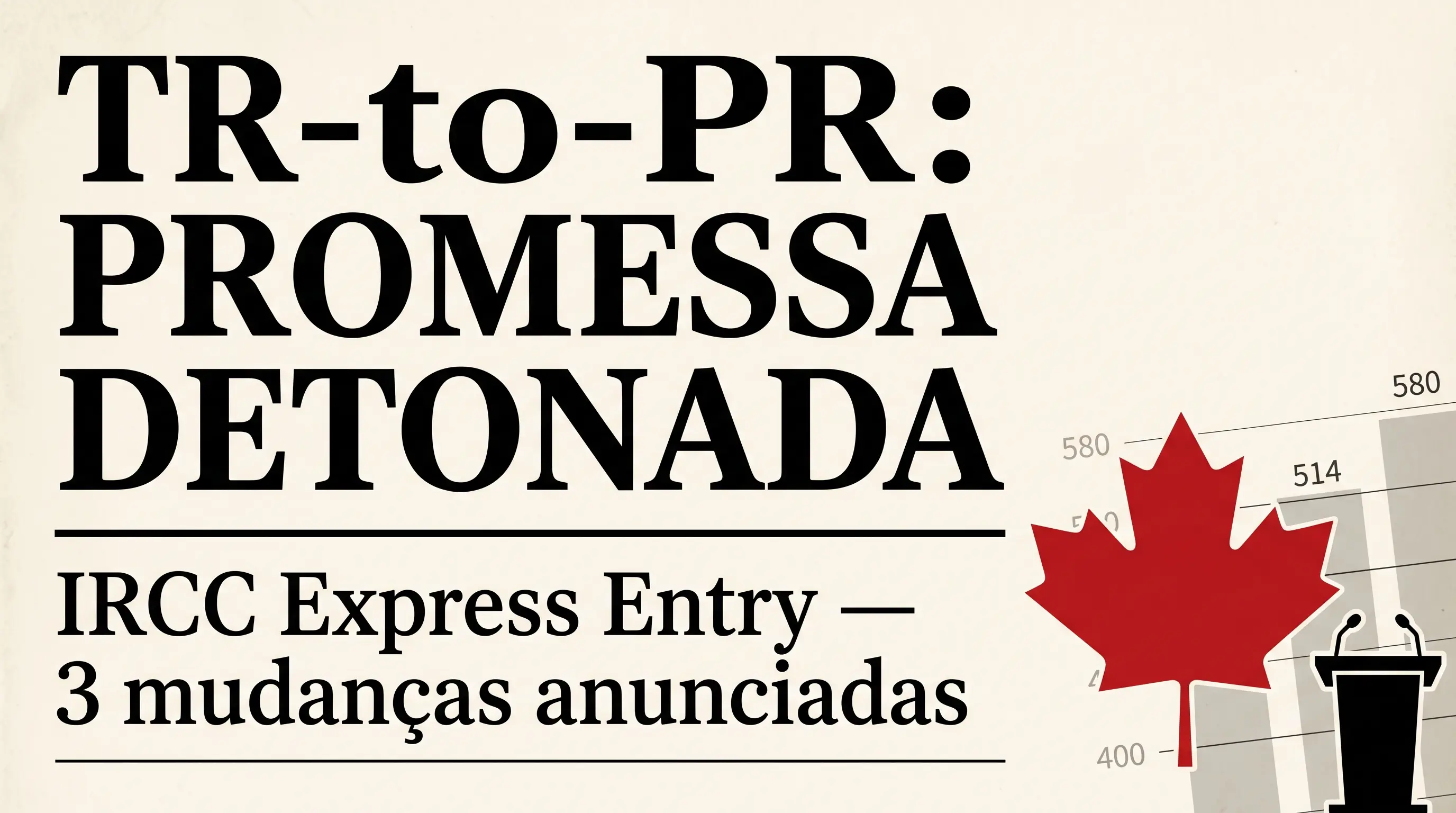
Ep 509: TR-to-PR, Express Entry and LMIA in 2026 [Canadian Immigration Institute]
Episode 509 of the Canadian Immigration Institute channel: minister Diab TR-to-PR communication torn apart and the 3 Express Entry changes detailed.