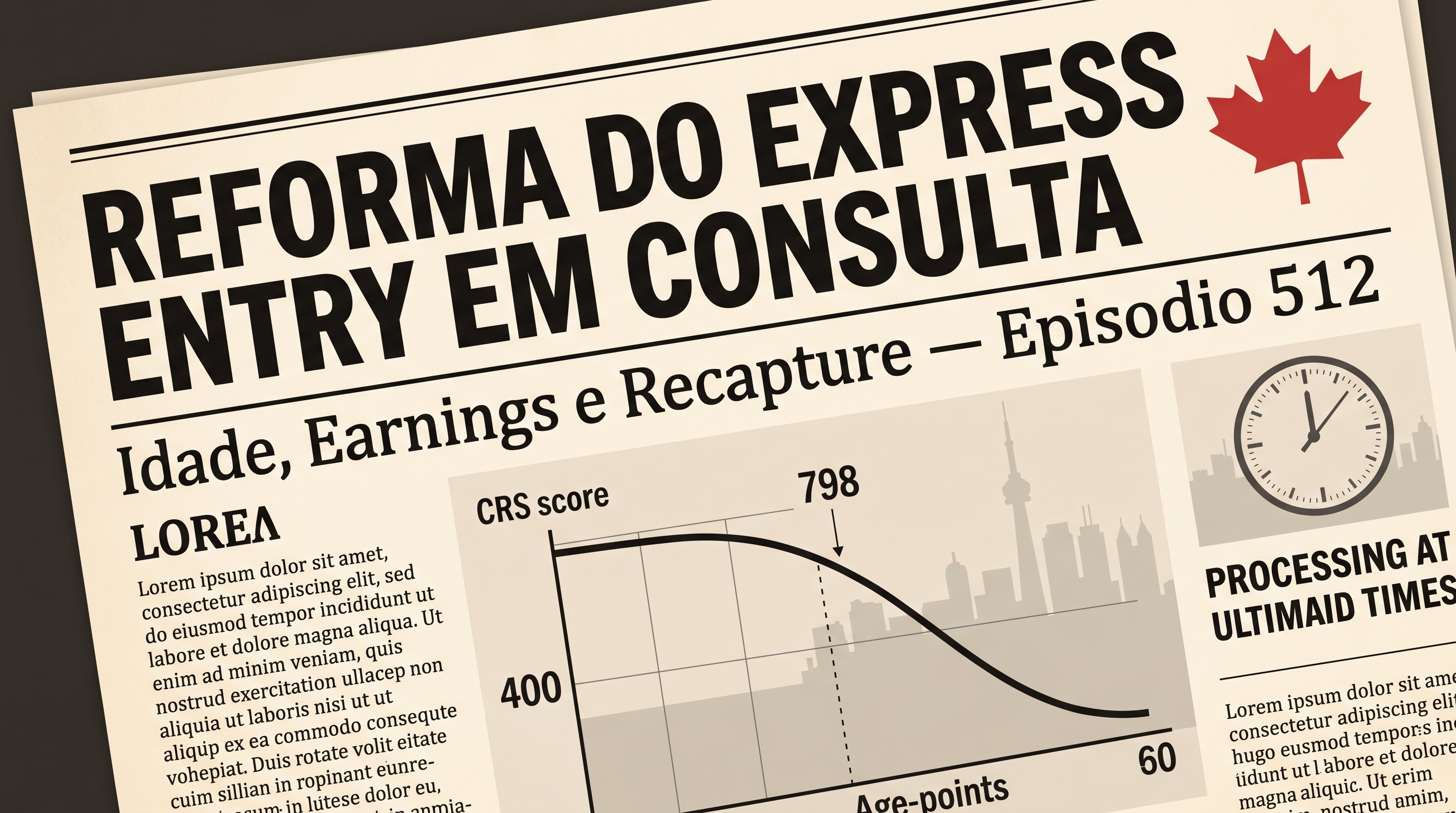
NOTÍCIAS
Ep 512: Express Entry under consultation, age in CRS and recapture [Canadian Immigration Institute]
In this article
Episode 512 of the Canadian Immigration Institute (May 14, 2026): Express Entry reform is in public consultation, age in the CRS, and work permit recapture.
Episode 512 of Canada Immigration LIVE Q&A opened with Mark and Alicia admitting, in minute one, that they were “sleep deprived and overworked”, and it was this tired live that made me stop and reopen my Express Entry profile. The point that grabbed me was not a new draw: it was the line that Express Entry reform is no longer a rumour, it is in open public consultation, and that anyone, including me, a Brazilian in Vancouver since 2024, can send feedback to the government.
This post is my Brazilian read of what Wednesday’s stream discussed. I cross-checked every number, every date and every program name against the official IRCC source before writing, because the transcript is auto-captioned and gets immigration jargon wrong, and because immigration is too expensive a decision to trust to automatic captions.
Is Express Entry reform really in open public consultation?
Yes. Express Entry reform is no longer speculation. IRCC opened a formal public consultation from April 23 to May 24, 2026, and anyone can submit feedback, including people living outside Canada. In Ep 512, Alicia said verbatim that “the status is still open for consultations and feedback from stakeholders” and that “heck, even you could submit your own thoughts to the government”. This matches the official IRCC consultation page.
Mark said in the episode that he and the team will dissect the proposal in a new podcast series over the summer and fall, even referencing his own history, a 2014 blog post called “top 10 things to prepare for Express Entry” from when the current system was created. The verifiable fact is what matters: the consultation window closes May 24, 2026. After that the government reviews the feedback, drafts the regulations and publishes them in the Canada Gazette before they become law, a process that has historically taken 12 to 18 months.
The heart of the proposal, according to the material IRCC put up for consultation: replace the three current programs, Canadian Experience Class (CEC), Federal Skilled Worker (FSW) and Federal Skilled Trades (FST), with a single federal high-skill class, and recalibrate the CRS. The consultation document says the strongest economic predictors are language ability (English and/or French) and high “earnings” as a temporary resident, while spousal points, a sibling in Canada, Canadian education and the 50-point French bonus appear as weak factors that IRCC may reduce or eliminate.
What this means for Brazilians
Mark showed a slide from the reform material on screen and said: “never before as a strongest predictor have they put earnings”, meaning the indexed salary of your occupation now weighs more than Canadian experience or a job offer. The proposal includes a “high-wage occupation” factor: extra points for those with Canadian experience or an offer in an occupation that pays above the national median wage. For a Brazilian coming for trades or mid-wage sectors, not senior tech, this could count against you. For a more experienced, well-paid profile, it could open a door.
Mark raised an honest caveat in the episode that is worth repeating: indexing an “ideal” salary without looking at region is a recipe for error. He cited Moose Jaw, Saskatchewan, against Toronto, someone earns less in a small city without being economically less successful. It is a proposal, not law. If you are thinking about starting the process, I already broke down what is at stake in the post on what changed in Express Entry in 2026, and the practical message is: apply with your current reality instead of waiting for the new rule, because no one yet knows how “earnings” will be calculated.
Why does Express Entry penalize people who are 30 or older?
Because the CRS only awards maximum age points between ages 20 and 29 and starts deducting from 30, hitting zero at 45. In Ep 512, Mark ran a live poll asking why the system “punishes you if you’re 40 years old or older”, and the answer he validated on the spot was a viewer’s: taxes. Canada wants more years of tax contribution per immigrant.
Mark, who said he is 53, was direct: an immigrant aged 40+ is at their career peak and pays a lot of tax, but has few contribution years left ahead. The government plays “the long game”, someone who enters at 29 has decades of tax to collect to fund health care, retirement and the other social programs of a country he called socialist. This matches the CRS age grid published by IRCC: the points peak is the 20 to 29 band, and every birthday after 29 costs points.
The interesting part: Mark observed that the “earnings” in the reform proposal could soften this. Today, a 30+ candidate is penalized for age with nothing to offset the high income they actually generate. If “earnings” becomes a strong criterion, a well-paid senior profile wins back part of what they lose on age, one of the few optimistic reads the episode offered for Brazilians over 30.
What this means for Brazilians
I arrived in Vancouver in 2024 and I am in my own Express Entry, so this age math is not abstract to me, it is the spreadsheet I reopen every week. The mechanical message of the episode is the most obvious and the most ignored: age is the only CRS factor that only gets worse. English you can improve, education you can improve, experience you accumulate, age only goes down. If you have a competitive profile today and you are delaying your application waiting for “the right moment”, every month of waiting is a lost point. I already wrote about how work experience weighs in the CRS; add that to age and the math is clear: the best day to apply was yesterday.
What was the April Francophone draw cut-off, and why are PNP draws so low?
The Francophone draw of April 29, 2026 closed at CRS 400, with 4,000 invitations, one of the most accessible category cut-offs in years. In Ep 512, Mark pulled up that number and commented that the Provincial Nominee Program (PNP) draws are “moving very, very slow”. The cross-check against IRCC’s Express Entry Rounds of Invitations confirms the Francophone draw (round #414, 4,000 ITAs, CRS 400) and the small PNP draws of April and May.
Here I need to be honest about the auto-caption noise. The transcript records Mark saying “380 PNPs” and “473 on April the 27th”, “356, 324, 473, and 380 points”, and that is easy to misread. The PNP draws do not close at 300-something CRS points. Every provincial nominee gets an automatic 600-point bonus on entering the pool, so a PNP draw typically closes above 700. What those smaller numbers represent is the size of the round (number of invitations), not the CRS. I verified: the first round of May (May 11, 2026) was a PNP draw of 380 invitations, with a CRS cut-off of 798. That is why I do not cite “324 CRS” as a fact, it would be reproducing a caption error.
What is fact and matters: PNP rounds shrank because the federal allocations to PNPs were cut in 2026, and many provinces are nominating through their own streams that are more occupation-focused. The contrast with French, 4,000 invitations at CRS 400, is glaring. Mark raised the same rhetorical question as always: “Where’s the education draw? Where’s STEM? Where’s trades?”, and he offered the honest read himself: studies show that not speaking the dominant language of the region is a weak economic indicator, and IRCC itself signalled this by putting the French bonus on the list of factors it may reduce.
What this means for Brazilians
Mark was explicit: for those betting on learning French to enter a French draw, “the possibility is still there”, but it is a window. The 50-point French bonus is nominally at risk in the reform consultation. I am studying French aiming for the TCF Canada, with a goal of B2 (NCLC 7), for exactly this reason: CRS 400 in a French draw is objectively easier than breaking the 500+ of a general draw. If your French is not yet at NCLC 7, the episode is an alert to hurry, not to give up. I wrote out the full reasoning in the post on French as the secret weapon of Express Entry. The sober read: the French draw category should survive the reform; the extra 50 bonus points, maybe not.
How does recapturing work permit time (H-1B and PGWP) work?
A work permit like the H-1B open work permit or the PGWP does not “extend” in the common sense, but you can recapture time that was not issued in the original grant. In Ep 512, viewer Shabbam asked about H-1B holders with three-year permits expiring, and Mark explained: the only possible extension is for those who did not get the full three years when the permit was issued.
The scenario Mark described: sometimes the border officer looked at the H-1B open work permit introduction letter and, because it was valid for three years but already issued a year and a half ago, gave only a one-and-a-half-year permit. That “lost” time can be recaptured. Cross-checked against IRCC’s official instructions for H-1B open work permit holders: the permit can be extended if it was issued with a validity shorter than three years, the request must be made from inside Canada, and the new permit covers the remainder of the three-year maximum (or the passport validity, whichever comes first). The deadline to request the extension is December 15, 2026, the H-1B program itself has been closed to new applicants since 2023.
Alicia added that the PGWP logic is the same: you do not extend a PGWP, but you can recapture time if you did not get the full period you were entitled to. The detail Mark stressed and that stings: those who, after the H-1B open work permit program was created, rushed to grab the permit and went back to the US to keep working, are burning that time, “burned up, burned up, burned up”, in his words.
What this means for Brazilians
Most of the Brazilians I know did not arrive in Canada through H-1B, they arrived through a student permit and PGWP, which was my most common read. But the recapture concept matters for everyone holding a PGWP: if the border gave you fewer months than your authorized period, that time is not necessarily lost. Alicia was practical: the focus for someone with an expiring permit should be strategic, where you are losing CRS points, and how to recover them (language, French, provable foreign experience, or an employer willing to do a closed work permit). Recapture buys months; it does not replace a PR plan.
When does the processing clock start counting?
The processing-time clock starts on the AOR (Acknowledgement of Receipt) / EAPR date, not on the ITA date. In Ep 512, a viewer named Sarah listed every stalled step of her application and Mark answered bluntly: stop following online crowdsourcing and look only at the official published time. Alicia reinforced it: “the processing times do not start from your ITA, they start from whatever day you actually submitted your EAPR”.
The practical rule Mark hammered: IRCC publishes a service standard, the Express Entry standard is 6 months from the completeness check to the decision, for 80% of applications. As long as your application is within that time, opening a web form, calling, and comparing yourself to a queue of strangers online only generates anxiety. The time to request the GCMS notes (the officer’s internal records) is after you exceed the official time. Cross-checked against IRCC: the 6-month clock counts from when the application passes the completeness check, not from the automatic AOR nor from the ITA.
Mark and Alicia contrasted this with the Federal Skilled Worker era of the 2000s, when the same process took at least 24 months and any document request added two months. The point is not nostalgia, it is to calibrate expectations. Mark admitted he is “fully engaged in the world of social” and that is why he feels the FOMO; Alicia, who according to him avoids that world, “lives a much more peaceful life”. The lesson he drew is honest: comparing yourself to other people’s queues is human nature fed by social media, and it does not bring you any closer to the decision.
What this means for Brazilians
I work with data, so this part got me: cross-referencing your queue with strangers’ in a tracker is exactly the kind of data that looks informative and is not. Every application has its own background check, security and nuances. The mechanical message of the episode: write down your AOR/EAPR date, take the official processing time from the IRCC site, and only act if you exceed it. If you exceed it, then request the GCMS notes. Before that, anxiety is the only product crowdsourcing delivers.
How does the AAIP Francophone allocation work?
The Francophone allocation of the Alberta Advantage Immigration Program (AAIP) is not a separate category, it is a federal layer on top of normal eligibility. In Ep 512, viewer Khan asked whether working outside your field of study, with NCLC 5 in French, gave access to its own route, and Alicia was categorical: “this is not a separate category… there is no new category of processing stream under AAIP”.
The mechanics Alicia explained, which match the official AAIP processing page: Alberta’s nomination allocation for 2026 is 6,403. On top of that, the federal government reserved additional spaces for Francophones, and those nominations do not count against Alberta’s provincial allocation. To use this path, the Francophone candidate can work in any AAIP-eligible NOC, but needs to have NCLC 5 in French across all four abilities. The detail that confuses, and that Alicia broke down: you still need to be eligible through the regular track, AOS (Alberta Opportunity Stream) or Alberta Express Entry-linked. If your studies do not match the occupation, you fall out of the AOS and need to qualify through the Express Entry-linked track.
Alicia also flagged a numbers trap: in the AAIP worker expression of interest grid, you get 3 points for bilingual proficiency at NCLC 4, a different level from the NCLC 5 required by the federal Francophone allocation. Same word “French”, two tiers: NCLC 4 gives you points on the grid; NCLC 5 across all four abilities puts you in the federal allocation queue.
What this means for Brazilians
For a Brazilian aiming at Alberta, and Alberta pays well in trades and construction, as I already covered in the post on the Canadian job market for Brazilians, the lesson is not to confuse the two NCLCs. Studying French up to NCLC 4 improves your grid; studying up to NCLC 5 across all four abilities opens the door of the federal Francophone allocation, which does not compete with Alberta’s 6,403 regular nominations. It is one more concrete argument, added to the federal French draws, to treat French as a PR investment and not a hobby.
What comes out of this for Brazilians?
In one sentence: Episode 512 of the Canadian Immigration Institute channel (May 14, 2026) confirmed that Express Entry reform is in open public consultation until May 24, 2026, with “earnings” proposed as a strong predictor, that the CRS only awards maximum age points up to age 29, that the April 29 Francophone draw closed at CRS 400 with 4,000 invitations, that you can recapture H-1B open work permit time until December 15, 2026, and that the processing clock counts from the AOR and not from the ITA.
For Brazilians, three practical decisions come out of this episode:
- Apply with your reality today. The reform does not arrive in 2026, but age deducts CRS every year and the “earnings” rule is still unknown. Waiting for the new rule is betting against the only factor that only gets worse.
- Treat French as a PR route, not a bonus. CRS 400 in a French draw, plus the AAIP federal Francophone allocation with NCLC 5, is a shorter path than breaking 500+ in a general draw, even with the 50 bonus points at risk.
- Stop comparing your queue to other people’s. Write down the AOR, take the official IRCC time, and only request GCMS notes if you exceed it. Crowdsourcing only delivers anxiety.
I am doing all three: running my Express Entry without waiting for anything to improve, studying French for the TCF Canada B2, and looking at the official time instead of a stranger’s tracker.
Frequently asked questions
Is the Express Entry reform already in effect in 2026?
Why does Express Entry give fewer points to people over 30?
What was the cut-off CRS of the most recent Francophone draw?
Can I extend my H-1B open work permit in Canada?
When does the processing time of my PR application start counting?
Sources:
- Canadian Immigration Institute, Canada Immigration LIVE Q&A, Episode 512 (May 14, 2026, official YouTube channel)
- IRCC, 2026 consultations on potential Express Entry reforms (canada.ca, official, consultation open April 23 to May 24, 2026)
- IRCC, Express Entry: Rounds of invitations (canada.ca, official, April 29 Francophone draw, CRS 400)
- IRCC, Express Entry: Comprehensive Ranking System (CRS) criteria (canada.ca, official, age grid)
- IRCC, H-1B visa holder work permit: open work permit extensions (canada.ca, official, December 15, 2026 deadline)
- IRCC, Check current IRCC processing times (canada.ca, official)
- Government of Alberta, Alberta Advantage Immigration Program, Processing information (alberta.ca, official, allocation 6,403 plus federal Francophone spaces)
- IRCC, Supplementary Information for the 2025-2027 Immigration Levels Plan (canada.ca, official)
Last verification of this page: May 16, 2026. Episode 512 covered more questions than fit in one post, to hear the full episode (in English), the video is free on the Canadian Immigration Institute channel. I am not affiliated with the channel, I just watch it and cross-check what they say against the official source.
This post is not legal or contractual advice. I am a Brazilian in Vancouver, commenting publicly on a public broadcast. For immigration decisions specific to your case, hire a lawyer licensed in Canada or an RCIC (Regulated Canadian Immigration Consultant).
The Vancouver Letter
You made it this far. That tells me something.
The Vancouver Letter is the letter I wish someone had sent me the third time I tried for Canada, when I had no idea what I was doing wrong. Once a week, straight to your inbox. No products, no courses, just what actually works. I got your back.
Get immigration updates
Practical tips straight to your inbox.
Related articles
Ep 511: The new 2027 economic PR and the "1 year" mistake [Canadian Immigration Institute]
Ep 511 of the Canadian Immigration Institute (May 7, 2026): the new 2027 economic PR and the trap of accepting an ITA before completing 1 year.
Ep 509: TR-to-PR, Express Entry and LMIA in 2026 [Canadian Immigration Institute]
Episode 509 of the Canadian Immigration Institute channel: minister Diab TR-to-PR communication torn apart and the 3 Express Entry changes detailed.

Ep 510: Express Entry, rural TR-to-PR and CRS 514 [Canadian Immigration Institute]
Ep 510 of the Canadian Immigration Institute (April 30, 2026): rural TR-to-PR for 33,000, CEC at CRS 514, French draw at 400, Express Entry reform.