NOTÍCIAS
Ep 510: Express Entry, rural TR-to-PR and CRS 514 [Canadian Immigration Institute]
In this article
Ep 510 of the Canadian Immigration Institute (April 30, 2026): rural TR-to-PR for 33,000, CEC at CRS 514, French draw at 400, Express Entry reform.
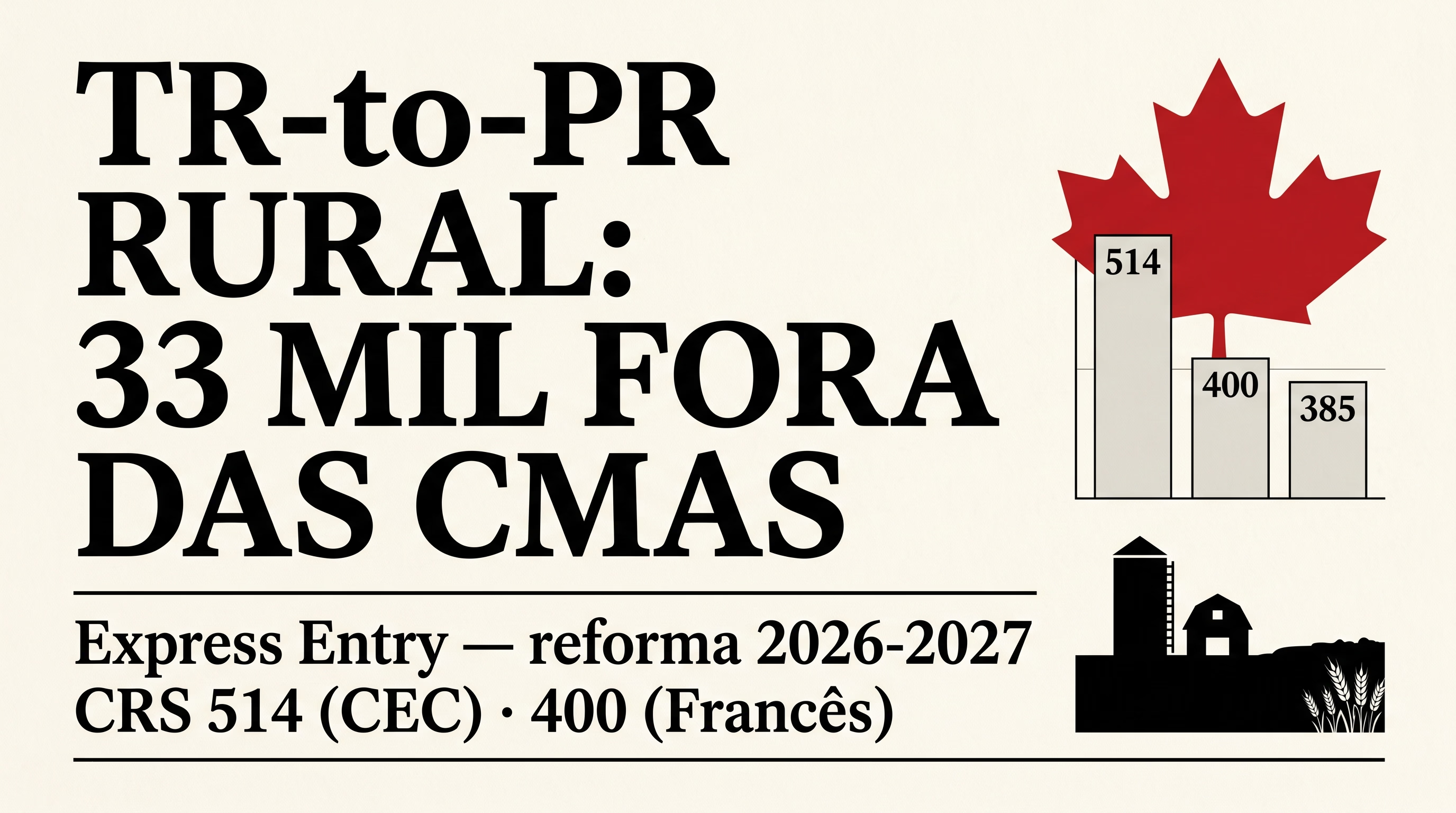
The piece of news from Episode 510 that made me stop and redo my spreadsheet was the rural TR-to-PR: Canada is going to open a pathway for 33,000 people who live in communities outside the CMAs (Census Metropolitan Areas) and have paid Canadian taxes. Vancouver, Toronto, Montreal: all CMA. A Brazilian like me, who chose a big city to work in, is left out.
This post is the no-frills version of what happened in the episode: what’s confirmed, what’s still official speculation, and why some of these things directly affect any Brazilian thinking about starting (or already in the middle of) their Canadian immigration process in 2026.
Why does the rural TR-to-PR for 33,000 people change the game?
The team opened the episode straight on this point, and they’re right: the biggest still-unannounced Canadian news of 2026 is this pathway. What’s officially known so far, from what IRCC has already put in the 2025-2027 Immigration Plan and what Minister Diab has let slip in interviews, is this:
- The pathway will have 33,000 spots total (not per year, total).
- The applicant needs to live in a community outside the CMA (Census Metropolitan Area).
- The applicant needs to have paid Canadian taxes, meaning proof of income high enough above the tax threshold for at least one fiscal year.
- IRCC promised details in April 2026, and the window is closing. The channel had been waiting weeks for the formal announcement.
If you don’t know what a CMA is, here’s the deal: Statistics Canada uses the concept of Census Metropolitan Area to group a core city with its suburbs. Toronto CMA includes Mississauga, Brampton, Markham; Vancouver CMA includes Burnaby, Richmond, Surrey, North Vancouver; Calgary CMA covers Airdrie and Cochrane. People in a CMA won’t get this route. Someone in Grande Prairie (Alberta), Lethbridge (Alberta), Kamloops (BC), Sherbrooke (Quebec), Moncton (NB), Charlottetown (PEI), smaller communities, qualifies.
What this means for Brazilians
This is where it gets uncomfortable. Most of the Brazilians I know here in Canada went to Vancouver, Toronto, Calgary, Ottawa, Montreal. Big cities. Because that’s where the Brazilian community is, where there are tech/data jobs, where rent is still reasonable (relatively), where the English is more cosmopolitan. I chose Vancouver myself in September 2024 for those reasons. And all of those cities are inside a CMA.
For someone still in Brazil thinking about coming to Canada for the first time, this is a clear signal: if you don’t have an “easy” Express Entry profile (high score, French, young age), considering a small city as your destination drastically increases your chance of PR via this pathway. The channel mentioned Grande Prairie in the episode. It’s in northern Alberta, near the BC border, daylight until 9:30 p.m. in summer, a hot labour market in oil/gas/agriculture. It’s not Toronto, but there’s PR at the end.
How far will CRS drop in the next CEC draw?
The team pulled this number straight from the Express Entry page: the Tuesday, April 29, 2026 draw was for Canadian Experience Class (CEC), with 2,000 spots and a CRS cutoff of 514. The previous draw closed at 515. The tiebreak rule on that last one pulled profiles created before September 24, 2025, meaning the pool at 514 wasn’t fully emptied; people were left over.
For context:
- January 2026, CEC draw: 8,000 people, cutoff at 511.
- April 2026, CEC draw: 2,000 people, cutoff at 514.
The round size was cut by 4x and CRS rose only 3 points. That means the pool of candidates with high CRS is still huge. The channel repeated what everyone working with Express Entry repeats in 2026: aim for 520 if you want an ITA in a CEC draw. Aiming at 514 is walking a tightrope: new profiles don’t get in, older profiles do, and you can sit waiting for 6 months.
How a Brazilian reaches CRS 520
The truth, no frills: for a Brazilian aged 28-32, married, with a bachelor degree, reaching 520 without French is practically impossible. The math:
- Age 29, married, bachelor: ~440 base points.
- English CLB 9 (IELTS 7.0/7.5/7.0/7.0): +124 points.
- 1 year of skilled Canadian experience: +35 points.
- 3 years of skilled foreign experience: +25-50 points (depends on the combination).
- Realistic total: 520-540 if you can get CLB 10 across all English bands.
Without CLB 10 or without Canadian experience, you land at 460-490. Then it depends on category-based draws: STEM, healthcare, trades, education, French, which historically close at much lower CRS. More on that in a moment.
Why are there so many French draws?
This was the moment the channel dropped a comment that made me laugh out loud: they said the firm’s founding partner would be “furious, foaming at the mouth” at the pace of French draws in 2026. Look at the numbers the episode pulled:
- January 2026, French draw: ~8,500 people invited (record).
- February 2026, French draw: ~4,000 people.
- March 2026, French draw: ~4,000 people.
- April 30, 2026 (the day of the live): new French draw coming out, 4,000 people, CRS cutoff at 400.
Compare that to CEC’s 514. The team asked rhetorically: “Where’s the education draw? Where’s STEM? Where’s trades? Why only French?” And they have a point on the argument. Minister Diab said the focus is closing gaps in health and trades. But Canadian public policy has another factor cutting across this conversation: the federal promise to increase the francophone presence outside Quebec. It’s not an economic priority, it’s a linguistic-cultural-federal priority.
What this means if you speak French
If you’re Brazilian and speak French at NCLC level 7 or higher (equivalent to CLB 7 but in French, TEF Canada/TCF Canada), 2026 is the year to apply. I’m studying French for exactly that reason. I’m at high B2 studying toward C1, and the goal is to enter a French draw with CRS 420-450 instead of trying to break 520 in a CEC draw.
The team tried to hold back the alarmed tone and said the French “heyday” still lasts some time, but it’s a window. The 50 bonus points of French CRS are at risk. IRCC has already sent a consultation to stakeholders saying it’s considering removing those 50 points. Not the French draw category, just the 50 extra points in the base CRS calc. Implementation? The channel estimates between late 2026 and 2 years out. If your French isn’t at NCLC 7 yet, hurry.
What will change in Express Entry in 2026-2027?
The team broke down what IRCC has already sent in an official document to lawyers. This isn’t YouTube speculation, it’s what’s in formal consultation. The 4 proposed changes:
- Collapse 3 categories into 1. Today Express Entry has CEC (Canadian Experience Class), FSW (Federal Skilled Worker) and FST (Federal Skilled Trades). It will become a single category.
- Drop the FSW 67-point pass mark. That selection test that ran before the CRS to qualify FSW will disappear.
- Reduce the work experience window from 10 years to 3 years. This is big. Today you can count work experience from the last 10 years. If it becomes 3, a Brazilian with 10 years of career will only be able to count the last 3.
- Remove the 50 French bonus points in the base CRS. As I said above.
And when does this happen? The channel’s analysis was: “late 2026 or 2027 via ministerial instruction; new legislation maybe 2027”. The more conservative read was 2 years from now, because the Canadian government is slow. They compared it to Calgary’s green line, which has been under discussion for 15 years.
The takeaway for Brazilians
If you’re thinking about starting the process now:
- Experience window 10→3 years: applying with your current experience before the change is worth gold. If you have 8 years of a solid data analyst career in Brazil, 5 of those years could stop counting.
- Collapsed categories: it should simplify things, but the sub-category of category-based draws (French, trades, healthcare, STEM, education) stays. The team was emphatic: the category-based draws aren’t going away.
- 67-point FSW removed: good for anyone applying FSW straight from Brazil, one less barrier.
In short: the system gets simpler, but it may get harder for profiles without French or without recent Canadian experience.
When does my PR “lock-in date” start counting?
This question came up in the episode and the answer was direct: the date you submit the application is the lock-in date for everything, language test, dependent child’s age, ECA. It’s not the AOR (Acknowledgement of Receipt) date, it’s not the date IRCC opens the file, it’s the submission date.
But here’s a detail the channel added that’s worth gold for Brazilians who apply through the PR Portal (not Express Entry directly): the AOR is the confirmation that your application is complete, not just that IRCC received it. And through the PR Portal, AOR can take 4 to 5 months to come out, even with Express Entry showing AOR the same day.
And worse: the channel said it has seen cases where IRCC returned applications after issuing AOR, claiming they were incomplete. When that happens, the lock-in date is lost. If you’re applying for spousal sponsorship with a dependent child who could pass 22 years old during the process, that’s catastrophic.
What to do to avoid this trap
- Before submitting, check the A11.2 (Completeness Check) checklist item by item.
- The PR Portal is stricter than Express Entry-linked. If something isn’t on the checklist, they send it back.
- Document everything in the moment: screenshots of every screen as you submit, receipt of every payment, hash of every file upload.
- If the application comes through the PR Portal and the AOR takes 3+ months, get a copy of the complete application via an ATIP request (Access to Information Act, NOT Privacy Act, the channel was specific) so you have proof of what was submitted.
What’s the difference between Spouse Common-Law Partner Class and Family Class?
This part made me stop and pay the most attention, because I know married Brazilians here who will need it. The channel explained the difference between the two classes for spousal sponsorship:
| Spouse Common-Law Partner Class (SCLP) | Family Class | |
|---|---|---|
| Where you apply | From inside Canada | From outside Canada |
| Spousal Open Work Permit | Yes (already was) | Yes (via 2026 temporary public policy) |
| Current processing time | ~24 months | ~12 months |
| Appeal if IRCC denies genuineness | Federal Court only (judicial review) | IRB (tribunal, can add new evidence) |
The critical difference is the appeal path. If IRCC denies your spousal sponsorship because it doesn’t believe the relationship is genuine:
- SCLP: you only go to Federal Court and have to prove the officer’s decision was unreasonable. You can’t add new evidence.
- Family Class: you go to the IRB (Immigration and Refugee Board), a tribunal, you can add new evidence: travel photos, messages, testimony.
For a Brazilian marrying a Canadian (or a Canadian PR), the choice of class matters a lot. Family Class today, in 2026, processes in half the time of SCLP because of a temporary public policy. But if you already live in Canada, SCLP makes more logistical sense (you keep working while it processes).
Genuineness vs primary purpose: two different things
The channel explained a legal concept I’d never thought to separate: Regulation 4 establishes that IRCC can deny a sponsorship if (A) the relationship is not genuine OR (B) the relationship was entered into primarily to obtain an immigration benefit. They’re two disjunctive tests.
Translation: you can have a relationship that’s genuine today but that began primarily to get PR, and IRCC can deny it anyway. And worse: if you reapply 10 years later, with children, still married to the same person, IRCC can deny again, arguing that at the time the relationship started the purpose was immigration. There’s no statute of limitations.
The practical rule: apply strong the first time. Show how you met, how the relationship evolved, photos, messages, trips, shared life. Don’t trust that “we’re still married after 5 years” will solve it.
What about people living in Quebec who want to apply for federal Express Entry?
This question also came up in the episode and the answer was categorical: if you live in Quebec, studied in Quebec, or are physically in Quebec when you receive the federal Express Entry ITA, alarms go off for IRCC. The Quebec process is separate (CSQ, then federal), and federal Express Entry requires intention to reside outside Quebec.
The practical solution the channel gave (and that has been used with a real client): move before submitting the EAPR. Not on paper, physically. Lease in another province, job in another province, driver’s licence in another province, health plan in another province. Everything. IRCC doesn’t buy “I’ll move after they approve it”.
For a Brazilian who chose Montreal because it’s cheaper and French helps with PR via French: double the caution. The French draw category is federal. If you win the ITA via a French draw while living in Montreal, you need robust proof of intent to leave Quebec. Otherwise, IRCC denies it.
What the channel did NOT discuss (and I think matters)
A one-hour live doesn’t cover everything. What was left out or discussed only superficially:
- The real financial cost of the process. They talked about processing times but never about how much it costs in lived CAD. For a Brazilian: a CEC application on its own today is about CAD 1,590 federal + about CAD 2,000 in prerequisites (ECA, IELTS, biometrics, medical exam). That’s a heavy weight on a middle-class financial plan.
- PNP as a parallel route. The channel mentioned only in passing that PNP exists. For a Brazilian with CRS below 480, a specific province’s PNP (Saskatchewan, Manitoba, Atlantic provinces) is often a better path than waiting on general Express Entry.
- Provincial nominee + intent to reside. The conversation about Quebec was rich, but the same logic applies to Saskatchewan SINP, Ontario OINP, BC PNP, Atlantic AIP. Each one requires intent to reside in that province. If you live in Toronto and apply for SINP, proof of intent to reside in Saskatchewan is required all the same.
If you want to understand any of these topics in more depth, I’ve already written about how the 2025-2026 Canadian Immigration Plan works and about the Canadian job market for Brazilians.
What’s the takeaway for Brazilians?
In one sentence: Episode 510 of the Canadian Immigration Institute channel (April 30, 2026) confirmed that the rural TR-to-PR for 33,000 people is close, that CEC closed at CRS 514 (aim for 520), that French draws keep pulling 4,000 people at CRS 400, and that the Express Entry reform should come between late 2026 and 2027, collapsing 3 categories into 1, shrinking the experience window from 10 to 3 years, and potentially removing 50 French bonus points.
For Brazilians, three practical decisions come out of this episode:
- If your relevant work experience is all within the last 3 years, apply now, before the 10 → 3 year window change strips you of points.
- If you have room to choose your Canadian city, consider outside a CMA. Rural TR-to-PR could be your route.
- If you’re starting French now, stick with it until NCLC 7. The 50 bonus points may disappear, but the French draw category should continue, and CRS 400 in a French draw is easier than 520 in a CEC draw.
I’m doing all three. Applying with my Express Entry now (not waiting for anything to improve), living in Vancouver but considering relocating to the BC interior if rural TR-to-PR calls for it, and studying French toward C1 while there’s a window.
Frequently asked questions
What is a CMA and why does it matter for rural TR-to-PR?
What was the CRS cutoff of the last CEC draw in 2026?
Will the French draw category end when Express Entry is reformed?
I already submitted my application. When does the lock-in date start?
Can I apply for federal Express Entry while living in Quebec?
Sources:
- Canadian Immigration Institute, Canadian Immigration Live Q&A, Episode 510 (April 30, 2026, official YouTube channel)
- IRCC, Express Entry Rounds of Invitations (canada.ca, official)
- IRCC, Levels Plan 2025-2027
- Statistics Canada, Census Metropolitan Area definition
- IRCC, Comprehensive Ranking System (CRS)
- IRCC, Regulation 4, Bad faith relationships
Last check on this page: May 4, 2026. Episode 510 covered more questions than fit in a post. To hear the full episode (in English), the video is free on the Canadian Immigration Institute channel. If you want a consultation with a Canadian immigration lawyer, the channel serves clients through an associated firm (I’m not affiliated, I just watch and have for a while).
This post is not legal or contractual advice. I’m a Brazilian in Vancouver, commenting publicly on a public broadcast. For immigration decisions specific to your case, hire a lawyer licensed in Canada or an RCIC (Regulated Canadian Immigration Consultant).
The Vancouver Letter
You made it this far. That tells me something.
The Vancouver Letter is the letter I wish someone had sent me the third time I tried for Canada, when I had no idea what I was doing wrong. Once a week, straight to your inbox. No products, no courses, just what actually works. I got your back.
Get immigration updates
Practical tips straight to your inbox.
Related articles
Ep 509: TR-to-PR, Express Entry and LMIA in 2026 [Canadian Immigration Institute]
Episode 509 of the Canadian Immigration Institute channel: minister Diab TR-to-PR communication torn apart and the 3 Express Entry changes detailed.
Ep 511: The new 2027 economic PR and the "1 year" mistake [Canadian Immigration Institute]
Ep 511 of the Canadian Immigration Institute (May 7, 2026): the new 2027 economic PR and the trap of accepting an ITA before completing 1 year.
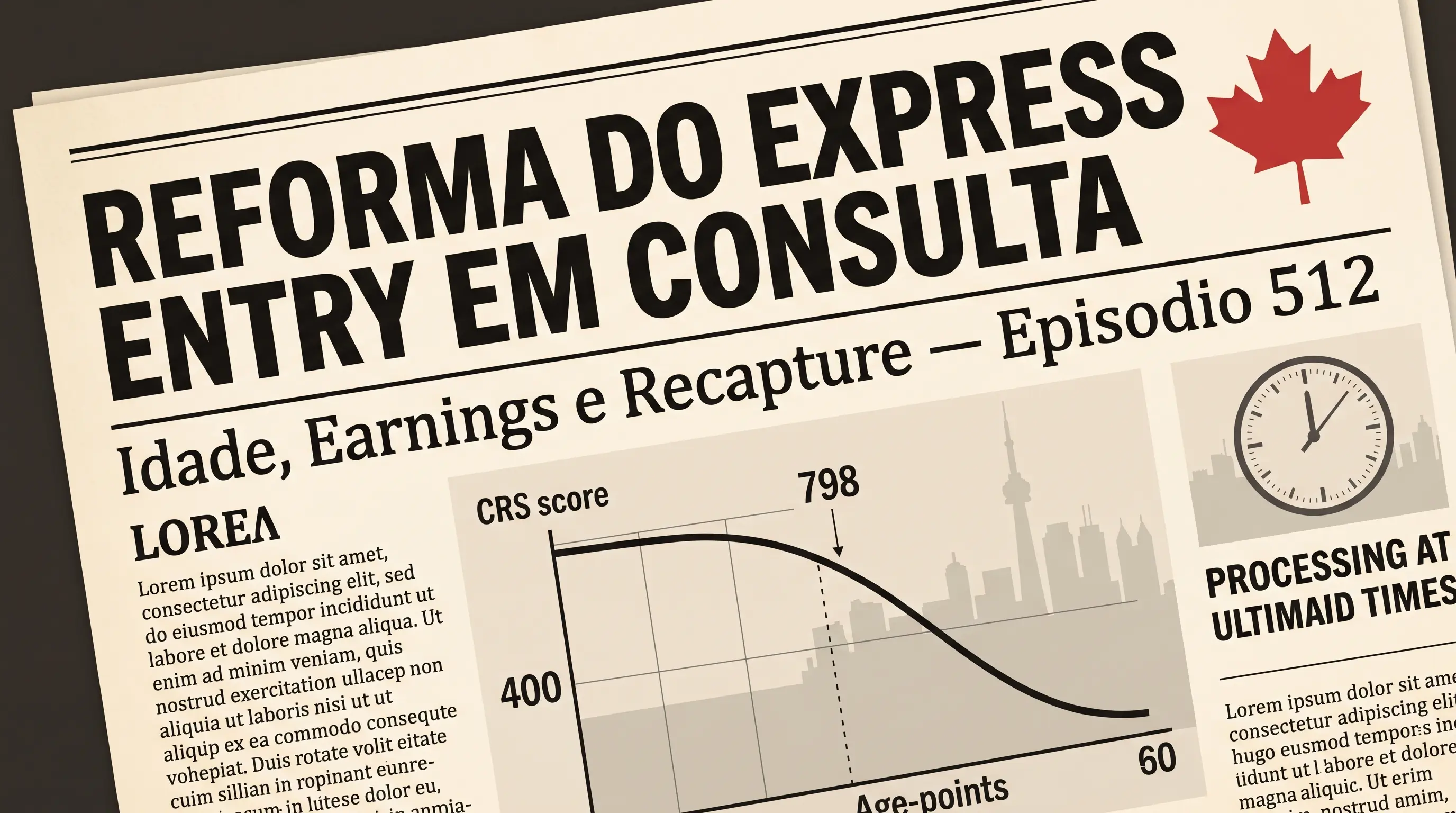
Ep 512: Express Entry under consultation, age in CRS and recapture [Canadian Immigration Institute]
Episode 512 of the Canadian Immigration Institute (May 14, 2026): Express Entry reform is in public consultation, age in the CRS, and work permit recapture.