NOTÍCIAS
Ep 509: TR-to-PR, Express Entry and LMIA in 2026 [Canadian Immigration Institute]
In this article
Episode 509 of the Canadian Immigration Institute channel: minister Diab TR-to-PR communication torn apart and the 3 Express Entry changes detailed.
In episode 509 of the Canadian Immigration Live Q&A, the team spent almost 50 minutes answering questions, and there were two moments that made me pause the video and open my own Express Entry profile to look again: the venting about minister Diab’s silence on the TR-to-PR program, and the 4,000-invitation Francophone draw with a 419 cut-off. This post is my Brazilian reading of what this week’s stream said, for anyone in Brazil planning the move, and for anyone already in Canada trying to navigate it.
How the channel reads this TR-to-PR Pathway
This is the point that most matches the Brazilian community WhatsApp here in Vancouver. Everyone is talking about “TR-to-PR”, the program that minister Lena Metlege Diab has been mentioning in interviews with content creators over the past few months, promising to regularize 33,000 temporary workers in 2026 and 2027 according to the 2025-2027 Immigration Levels Plan announced on November 5, 2025.
The channel’s reading was surgical and tough: there is no launched program. The minister says the program was “soft launched”, she drops details in Instagram and YouTube interviews with content creators, but IRCC has not published a single operational instruction, an eligibility criterion, or the application form. For an immigration lawyer advising paying clients, that is no data at all, it is speculation.
And here I have to lean hard into vulnerability-first: I myself, someone who cross-checks official source against official source every day at work, fell for the TR-to-PR expectation for about 2 months. I got that reading wrong. When the channel said that giving money to any consultant who claims to know the criteria of this program today is literally dangerous, I agreed with every comma.
Why IRCC’s official silence matters for Brazilians
If you are in Brazil, or you have a work permit about to expire and you are considering “waiting for TR-to-PR”, pay attention:
- The channel made it clear that even if the program does exist, 33,000 people is few compared to the stock of temporary workers in the country. That number will favour very specific profiles, and the minister already dropped an important hint that it will exclude metropolitan areas (CMAs) like Toronto, Vancouver, Calgary, and Edmonton. If you live in those cities, this program may literally not be for you.
- Without official criteria, nobody can tell you whether you qualify. Anyone charging you to prepare an application for this program today is selling you smoke, the form does not even exist yet.
- The channel’s technical analysis was direct: what matters for any PR application is having your documents ready, language test, Educational Credential Assessment (ECA), proof of work experience. You prepare those today regardless of which program opens.
For Brazilians in Brazil planning the move: keep working on the standard Express Entry prerequisites. Do not delay your application waiting for a phantom program.
What are the 3 proposed changes to Express Entry?
The channel team takes part in the Canadian Bar Association working group that is commenting on these changes with the government. They explained in detail what is being proposed, and it is worth gold for anyone in the funnel:
1. End of the 3 separate categories (FSW, FST, CEC)
Today Express Entry has three streams with different requirements:
- Federal Skilled Worker (FSW), for those in Brazil, with no Canadian experience.
- Federal Skilled Trades (FST), for certified trades.
- Canadian Experience Class (CEC), for those who already have work experience in Canada.
The proposal is to unify everything into a single stream, with homogeneous criteria. For Brazilians in Brazil, the next point changes the most.
2. End of the FSW “67-point grid”
Today, to enter the FSW pool coming from Brazil, you need to pass an eligibility test called the 67-point grid, a combination of points for age, education, language, experience, adaptability, and so on. Those without Canadian experience sit close to the threshold and can be barred before even entering the pool.
The channel’s analysis pointed out that the government is considering eliminating this barrier and widening the pool. This is GIGANTIC for middle-class Brazilians who have never worked in Canada: you enter the pool, and what differentiates you is your CRS (Comprehensive Ranking System), not an obscure initial filter.
3. Work experience window drops from 10 to 3 years
Today, Express Entry counts professional experience from the last 10 years. The new proposal is to cut that window to 3 years, only counting what you did recently.
This hits people doing a PhD or master’s hard. The team commented that this hurts candidates like PhD students who spent 7 years only studying. For younger Brazilians or those in a career transition, this change can help: you compete with people who have equally recent experience, not with someone who worked 10 years ago.
The worrying side nobody mentioned in the Brazilian interviews
The channel brought up a detail I had not seen anywhere: the government is considering including employment incidence and wage level as new criteria. In other words, they will look at how much the immigrant can earn and whether they actually find work. The analysis was direct: the government does NOT need only white-collar workers, and trying to predict ideal wages is a recipe for error.
For Brazilians coming for trades or sectors with average wages (not tech), this change could play against you. Worth watching.
How does losing your job on a closed work permit work?
This question came from viewer Jimmy and was answered by the channel with surgical clarity. I’ll list the facts as they were laid out (which I confirmed with IRCC):
- You do NOT have to leave Canada immediately if you lose your job on a closed work permit.
- You CANNOT work for another employer during the period of your current work permit.
- If you find another employer willing to take on an LMIA or open an employer portal offer, you submit a change of conditions on the work permit.
- There is a temporary public policy that lets you work for the new employer BEFORE the new work permit is approved: you send a web form with the code “PP change conditions” and IRCC responds within 2 weeks (yes or no).
The channel made an important reminder: LMIA is now seriously brutal. They cited a recent client case where a low-wage LMIA was practically impossible because of the refusal to process and the 10% cap that limits the number of foreign workers at some employers. Those two rules combined turned what was a viable option into a marginal one.
What this means for Brazilians with a work permit
If you are here on a closed work permit and the scenario tightens:
- Do not panic. You have the right to stay physically in the country while you look for another solution.
- Look at Francophone Mobility if you speak French. The channel mentioned this 3 times in this episode, and not by chance: the French draws are still big (4,000 ITAs in a single recent draw, with a CRS cut-off of 419, below the general draw sitting at 580+).
- Renew early. If you have an extension option, send the request right away, before the deadline.
I am in the middle of my own Express Entry with intermediate French. When the channel mentioned that 4,000-invitation draw with a 419 cut-off, I literally opened my spreadsheet to calculate the gap between my current CRS and the points I gain with the TCF Canada B2. It is worth every hour of study. There is even a course here on the blog for you to learn French (it’s free, for now).
What the channel said about certificate of qualification that nobody tells you
For me, this part was the most technical and the most useful. A viewer named Nav asked whether a pesticide applicator certificate from Manitoba gave the 50 points for certificate of qualification in Express Entry. The answer came in layers:
Step 1, who issued the certificate matters MORE than its content
Having a professional certificate is not enough. It has to have been issued by a competent Canadian authority: a crown agency, corporation, recognized union organization, or entity legally delegated by federal, provincial, or territorial legislation. The valid examples: Alberta Apprenticeship and Industry Training (AIT), Skilled Trades Ontario, Technical Standards and Safety Authority, Transport Canada.
What does not count: self-regulated certifications, professional associations without a legal mandate, commercial training.
Step 2, the occupation has to be on the list
Even if the issuer is valid, the occupation has to be on the official list of eligible NOC codes. The channel confirmed that pest controllers and fumigators are on the list, but stressed: having the right NOC code does not mean you automatically get the points. You need to meet all the conditions in step 1.
Why this matters for Brazilians
If you are an electrician, plumber, mechanic, or another technical occupation in Brazil and you are considering coming as skilled trades, do NOT assume your Brazilian certificate will give you automatic extra points in Express Entry. The path is:
- Validate the equivalent NOC code for your occupation (look it up on the IRCC portal).
- Check whether the NOC is on the list of eligible certificate of qualification occupations.
- After arriving as PR or on a work permit, get the Canadian certification through one of the recognized authorities.
- ONLY THEN do the extra points show up in your profile.
This is a detail many immigration influencers oversimplify, and oversimplifying here can cost you 50 CRS points.
Where I disagree with (or add to) what was said in the episode
There are things the channel did not cover because their audience is mostly people already in Canada. For Brazilians coming from Brazil, some points deserve a different reading:
- On IRCC’s silence about TR-to-PR: the channel framed it as a problem of poor communication by the minister. To me, it is deeper: it is a symptom that the program may not materialize as sold. The minister is grabbing headlines while IRCC internally works on real programs (like the Express Entry reform the channel described). If you are Brazilian, trust the Express Entry reform, not TR-to-PR.
- On LMIA: the channel talked about “low wage” LMIA as difficult. For Brazilians just starting out, I would add: LMIA is NOT the natural route to a first job in Canada. Most Brazilians I know (myself included) came in via study permit + PGWP, because applying for an LMIA before setting foot in Canada is practically a lottery. Those who have an LMIA job offer from Brazil are usually people who already have a network or a very specific senior tech profile.
- On Francophone Mobility: they mentioned it in passing. I underline it in red pen: if you have ANY level of French, it is worth the investment to get a B2 through the TCF Canada. The 4,000-invitation draw with a 419 cut-off that the channel cited is objectively the shortest route today for a middle-class Brazilian to come in as PR.
If you want to read my practical experience getting a job here, I wrote about it in detail in the 2026 job market post.
What to do this week if you are planning to immigrate
A lean action plan, based on what episode 509 confirmed:
- Forget TR-to-PR as your main route. Take it out of your plan A. If it shows up as a bonus later, great. But do not build strategy on top of an unannounced program.
- Work on the 5 Express Entry prerequisites TODAY: language test (IELTS General or CELPIP), Educational Credential Assessment (WES or equivalent), passport valid for 5+ years, proof of work experience formatted per IRCC requirements, and proof of funds.
- If you speak ANY French, book the TCF Canada as soon as possible and study for B2. The French draws are the most real shortcut for 2026.
- Follow the MorarFora blog for updates on the latest IRCC news: I post whenever a change comes out that affects Brazilians. To cross-check with the official source:
canada.ca/en/immigration-refugees-citizenship.html. - If you have a specific process question, do NOT trust a generic Brazilian consultant. Book a paid consultation with a licensed Canadian immigration lawyer.
I got your back
I am not an immigration lawyer. I am a Brazilian who has lived in Vancouver since September 2024, a data analyst, in the middle of my own Express Entry. The Canadian Immigration Institute channel does the technical work of reading regulations I don’t even know exist, and I try to translate that into the Brazilian reality they don’t even need to consider. If this post helped you calibrate your expectations, send it to someone who is waiting on TR-to-PR to start planning, that someone needs to read this this week, not in June.
And if you are in Canada and want to watch the whole episode, here’s the direct link. It is worth 50 minutes of your Saturday morning. I got your back.
Frequently asked questions, Episode 509 of the Canadian Immigration Institute channel
Is the TR-to-PR Pathway already open for Brazilians to apply?
What are the 3 main proposed changes to Express Entry in 2026?
I lost my job on a closed work permit. Do I have to leave Canada immediately?
Why does the Canadian Immigration Institute channel say LMIA is hard in 2026?
Are the French Express Entry draws still strong in 2026?
The Vancouver Letter
You made it this far. That tells me something.
The Vancouver Letter is the letter I wish someone had sent me the third time I tried for Canada, when I had no idea what I was doing wrong. Once a week, straight to your inbox. No products, no courses, just what actually works. I got your back.
Get immigration updates
Practical tips straight to your inbox.
Related articles

Ep 510: Express Entry, rural TR-to-PR and CRS 514 [Canadian Immigration Institute]
Ep 510 of the Canadian Immigration Institute (April 30, 2026): rural TR-to-PR for 33,000, CEC at CRS 514, French draw at 400, Express Entry reform.
Ep 511: The new 2027 economic PR and the "1 year" mistake [Canadian Immigration Institute]
Ep 511 of the Canadian Immigration Institute (May 7, 2026): the new 2027 economic PR and the trap of accepting an ITA before completing 1 year.
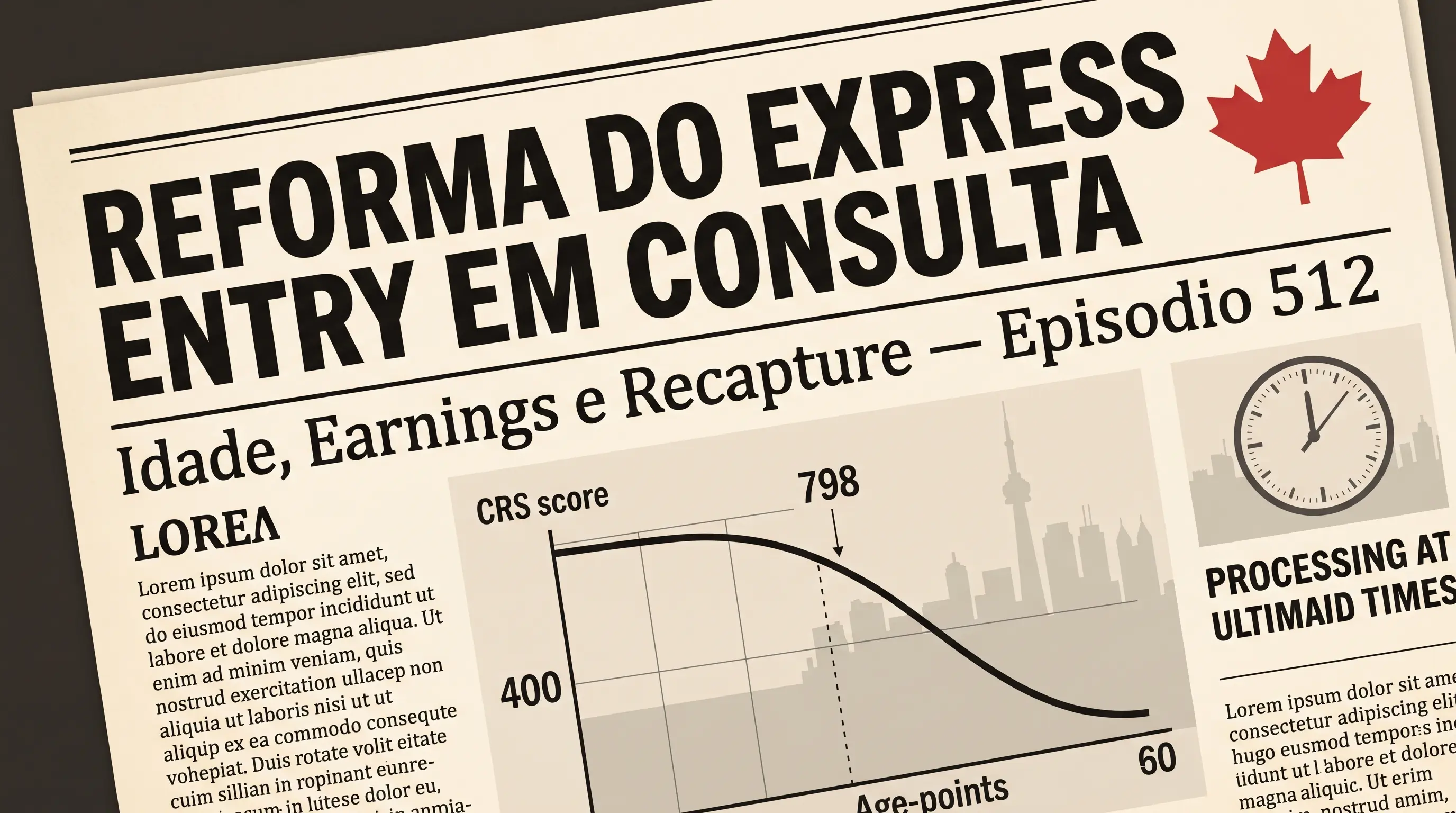
Ep 512: Express Entry under consultation, age in CRS and recapture [Canadian Immigration Institute]
Episode 512 of the Canadian Immigration Institute (May 14, 2026): Express Entry reform is in public consultation, age in the CRS, and work permit recapture.