NOTÍCIAS
What gets your Canadian PR refused [Canadian Immigration Institute]
In this article
Why IRCC refuses PR over inconsistencies between old applications, how to avoid a PFL, and the 15 days to challenge it, Canadian Immigration Institute.
Look, I’ll be honest: this week I was here in Vancouver wrapping up some dashboards for a client, and I opened YouTube at lunch to watch the weekly Q&A from the Canadian Immigration Institute channel. I’ve been following them since 2024 because they are literally the channel that explains PR refusals best in plain English. And Igor (the associate on the team that runs the Friday streams, while the senior team runs the Wednesday one) pulled up on screen a real refusal letter, dated April 2026, from a client he had handled that week.
534 points in Express Entry. 50 of them came from work experience abroad. Refused. The reason? The guy declared that work experience in the Express Entry application, but on a study permit he had submitted in December 2018, while studying full-time, he had not mentioned any employment in that period. The IRCC officer put the two applications side by side, saw the overlap, and cancelled the 50 points. Then the score dropped below the cut-off and the refusal letter came.
And here is where my paranoid data-analyst side screams: the officer went back FIVE applications to find the inconsistency. Five. Clara and I keep a spreadsheet with every form, every date, every NOC code, every employer since 2024, and even so I reread everything 3 or 4 times before hitting Submit. After hearing that letter, I’ll reread it one more time. This post is the no-frills version of everything Igor covered about refusals in the live on May 2, 2026, and what it changes for any Brazilian putting an application together right now.
What are the main reasons a PR gets refused in 2026?
Igor’s Q&A was not a theoretical list of 10 reasons. It was an autopsy of a real letter, plus 6 to 7 viewer questions that touched on other refusal mechanisms. Consolidating everything that came up in the live, you can extract 6 categories that IRCC is using right now to deny PR:
- Inconsistency between applications (the most dangerous, and the star of the live)
- Weak documentation of work experience (especially remote / overseas work)
- Police certificate out of validity
- Security check delays that turn into administrative hell
- Biometrics not submitted when IRCC asked for them
- Change of marital status or NOC between profile and EAPR without explanation
The first is the one that most often sinks PR for Brazilians who came through study permit to PGWP to Express Entry, because each step on that route generates ONE application, and IRCC compares ALL of them at the final PR stage. Let me take them one by one.
How do you avoid inconsistency between old applications?
This is the case from the letter Igor showed. The typical flow for someone who arrived as a student looks more or less like this:
- Initial study permit (form, experience declarations, dates)
- Study permit extension (more forms)
- Post-Graduation Work Permit (PGWP) (more forms)
- PGWP extension (because the passport expired, or because you entered the 18-month public policy)
- Express Entry profile + EAPR (the final PR application)
That is 5 applications at minimum. Each one asks for work history, personal history, entry/exit dates from Canada, status declarations. And the officer assessing the final PR reads all of them looking for contradictions. If you declared remote work experience for a Brazilian company from January 2018 to December 2019 in Express Entry, but on the study permit submitted in October 2018 you marked “full-time student, no employment”, the officer catches that overlap, calculates that you were in class 35h+ a week, and questions whether the experience you are now claiming is real.
The solution isn’t magic. It is manual cross-reference before submitting. Personally, I do the following (and I’ve been obsessive ever since I arrived in Vancouver on September 3, 2024):
- I keep a master spreadsheet with EVERY application I have ever sent to any government (Brazil, the US back when I had a B1/B2 visa, Canada), with dates, form, decisions, and justifications.
- Before each new application, I open the previous one and copy the dates, NOC codes, addresses, and employers LITERALLY. No rewriting from memory.
- Wherever something changed between applications (I changed jobs, changed addresses, found out I had some informal work I’d forgotten), I write a letter of explanation and attach it, explaining the reason for the difference BEFORE the officer asks.
Igor said one line in the live that stuck with me: IRCC officers don’t have a heart and soul to assess good faith. Their job is to process volume. If the contradiction is there and you didn’t explain it, they refuse.
How does a Procedural Fairness Letter (PFL) work, and why is it your only chance?
Before a refusal, in many cases IRCC is required to send a Procedural Fairness Letter, a letter saying “look, I found this in your application, you have X days to explain”. This letter is your real chance to save the PR.
What Igor stressed in the live: if you get a PFL, don’t reply on your own with a “sorry, I forgot” email. Prepare a detailed response with:
- Documents that prove whatever is being questioned (bank statements, contracts, employer letters, screenshots of emails from the time)
- A clear chronological explanation of what happened, no rambling, no vague excuses
- Reference letters from colleagues or supervisors from the time, if possible
- If it’s serious, an immigration consultant or lawyer reviewing the response before you submit
There is also the scenario where the officer does not send a PFL and refuses outright, which Igor called a breach of procedural fairness. There you have a deadline to challenge:
- 15 days if you are inside Canada
- 60 days if you are outside Canada
That challenge goes through Federal Court (judicial review). It is not emailing IRCC asking for “reconsideration”, because that route rarely works. Igor was explicit: reconsideration only works if there is a blatant factual error. For inconsistencies detected by an officer’s analysis, you go to Federal Court.
Why does remote work documentation get refused more often?
Another refusal reason that came up in the live: weak documentation of professional experience, especially remote or overseas work. For Brazilians this hits hard. A lot of people worked remotely for a Brazilian or European startup while living in Brazil or Portugal before coming over.
The mandatory document is the employer’s reference letter. But Igor made it clear that a reference letter alone is no longer enough. IRCC is asking for “an abundance of evidence”:
- Bank statements showing deposits from the employer (with the employer’s name on the statement, ideally)
- Pay stubs if you had them
- Tax documents from the country where you lived (in Brazil, payslips, declared income tax)
- Tax filings where applicable
- Screenshots / printouts of the company website, your LinkedIn from the time, corporate emails
- Business card of the supervisor who signed the reference letter
- Projects signed by you if you are a freelancer or consultant
And here comes a point Igor covered in detail: if you worked full-time in Canada while also working full-time remotely for a Brazilian company, the officer is going to question basic math. 24 hours in a day, and you are claiming 80 hours a week of work? If there is no detailed explanation of the schedule (8am to 5pm Canada + 7pm to 1am Brazil because of the time zone, for example), the officer refuses the overseas experience.
For Brazilians this is particularly critical because plenty of people keep working remotely for a Brazilian employer during their first months after arriving. Document the time zone, document the hours, document the days, before the officer asks.
When does a police certificate become invalid?
A question that came up in the live: “I got my police clearance certificate when I left Brazil in 2022, never went back. Is it still valid?”
IRCC’s official rule, as Igor showed on screen:
- For the country where you live today: a recently issued police certificate (generally within the last 6 months)
- For any other country where you lived since age 18 for 6 consecutive months or more: a certificate issued after the last time you were there for 6 consecutive months
In practice, for a Brazilian who left Brazil in 2022 and never went back: the certificate obtained in 2022 still holds. But pay attention to the detail Igor raised: law firms treat this more strictly than the official rule. If you went back to Brazil even for a single day (to visit family, a wedding, a funeral), they recommend getting a new certificate. Because IRCC officers can question it, and that delays the application by months.
Practical recommendation: before submitting EAPR, get a new certificate from every country where you lived 6+ months, dated within the last 6 months. It costs R$40 to 80 (about CAD 10 to 20) each, and it saves you a future PFL.
What turns a security check into a bureaucratic nightmare?
Igor mentioned a case that has been with him since 2021, almost 5 years stuck in security screening. The client is physically in Canada, work permit pending, no TRV to leave, basically trapped in limbo.
This is rare but it happens, and the factors that raise the risk:
- Mandatory military service in a country with geopolitical tension (Ukraine, Israel, some Eastern European countries)
- Background in a sensitive sector (defence, nuclear energy, communications)
- Travel history to countries on a watch list
- For Brazilians, this is extremely rare, but if you held a job in a Brazilian public body, especially in security, it is worth mentioning proactively in the application
If your application is stuck in pending security for more than 12 to 18 months with no update, the path is:
- Request GCMS notes (via ATIP request) to see what the officer noted in your file
- If the file is literally frozen (no one has touched it in over a year), a lawyer can send a letter of demand arguing “unreasonable delay”
- In extreme cases, mandamus, a court order to force IRCC to make a decision
The ATIP request, by the way, was another important part of the live: processing time ranges from 2 weeks to 7 months with no pattern. You can’t predict it. But it is the only way to see what is written in your own file.
Why can biometrics sink you even at the end of the process?
A recent change: since roughly October 2024, IRCC started requiring fresh biometrics for each new PR application, even if you already gave biometrics within the last 10 years for a study permit or work permit.
It used to be valid for 10 years for any application. Not anymore. For PR it is new. Details:
- Children under 14 remain exempt
- A non-accompanying spouse generally does not receive a biometric instruction letter (it makes sense, they are not coming along, they won’t become PR with you)
- IRCC sends the biometric instruction letter automatically, but it can be slow and land in spam
- If 60 to 90 days have passed since EAPR and you haven’t received it, send a web form asking for confirmation AND file an ATIP request to see if it has already been issued
Not submitting biometrics on time (generally 30 days after the instruction letter) closes the file, and the application is refused.
For Brazilians specifically, what are the extra things to watch?
This is where I put on the lens of someone who has lived in Vancouver since 2024 and is in the middle of Express Entry alongside Clara. For Brazilians there are 3 extra traps that aren’t obvious to anyone who has never applied:
1. Brazilian sworn translation vs certified translation. In Brazil, sworn translation (tradução juramentada) is the gold standard. In Canada, IRCC wants a certified translation, done by a translator certified by ATIO or OTTIAQ (Canadian associations), or at least with a notarized affidavit. A Brazilian sworn translation is sometimes accepted, but at a risk. My recommendation: translate in Canada after you arrive, with a recognized translator. It costs more but it’s safe.
2. Hague Apostille on Brazilian documents. Birth certificate, marriage certificate, diploma, all of them need an apostille done at a Brazilian notary office (cartório) before you leave, or via the consulate afterward. The apostille has no expiry, but the original document has to be recent (a birth certificate issued within the last 6 months, for example). Submitting a document without an apostille is a guaranteed PFL.
3. US visa history. If you held a US B1/B2 visa and overstayed (stayed beyond what was allowed), it shows up in the information-sharing systems between Canada and the US. Declare it on the IRCC form. Hiding it is misrepresentation, and that is the most serious refusal possible, with a 5-year ban from any application to Canada.
And if the refusal happens anyway, what’s the path?
Igor covered this clearly:
- If you got a PFL: prepare a documented response, ideally with a lawyer, and reply within the deadline (generally 7 to 30 days)
- If they already refused with no PFL: 15 days inside Canada or 60 days outside to file a judicial review at the Federal Court arguing a breach of procedural fairness
- Reapply from scratch: possible, but it can trigger a misrepresentation flag if the previous refusal was for a serious inconsistency; here a lawyer is almost mandatory
- Reconsideration request: Igor explicitly said it rarely works, it only helps if there was a blatant factual error by the officer
And the most important point: before the refusal, hire a practitioner if you suspect you have an inconsistency or weak documentation. Igor gave a number that stuck with me: his firm charges the same fee whether you come in before or after the ITA, because they do the cross-reference work on ALL previous applications in both cases. Meaning: the hard work is the same. Get help before the refusal.
I got your back
I’m a Brazilian in Vancouver, in the middle of my own Express Entry. I’m not an immigration lawyer. But I’m someone who stares at spreadsheets and understands risk. And what became clear after this live is that PR refusal risk doesn’t come from you “doing something wrong” today, it comes from you doing something right TODAY that contradicts something you did right 5 YEARS AGO, without realizing it.
The solution isn’t to stop applying. It is to map, document, cross-reference, and explain before they ask. Clara and I have been doing this for almost 2 years. It isn’t fun. But it’s what separates the people who reach PR from the people who lose 18 months and CAD 5,000 in a judicial review.
If you’re putting an application together right now, or you know someone who is, send them this post. And if you have an inconsistency that’s keeping you up at night, don’t submit without talking to a Canadian RCIC or immigration lawyer first. I got your back.
Frequently asked questions, PR refusal and inconsistencies at IRCC
Can I be refused over an inconsistency in an application from 5 years ago that I don't even remember?
What is a Procedural Fairness Letter and how long do I have to respond?
Is a Brazilian police certificate I got when I left Brazil still valid?
I worked full-time in Canada and remotely for a Brazilian company at the same time. How do I document that?
I have 15 days to challenge a refusal. What do I do in that window?
The Vancouver Letter
You made it this far. That tells me something.
The Vancouver Letter is the letter I wish someone had sent me the third time I tried for Canada, when I had no idea what I was doing wrong. Once a week, straight to your inbox. No products, no courses, just what actually works. I got your back.
Get immigration updates
Practical tips straight to your inbox.
Related articles
Ep 511: The new 2027 economic PR and the "1 year" mistake [Canadian Immigration Institute]
Ep 511 of the Canadian Immigration Institute (May 7, 2026): the new 2027 economic PR and the trap of accepting an ITA before completing 1 year.
Ep 509: TR-to-PR, Express Entry and LMIA in 2026 [Canadian Immigration Institute]
Episode 509 of the Canadian Immigration Institute channel: minister Diab TR-to-PR communication torn apart and the 3 Express Entry changes detailed.
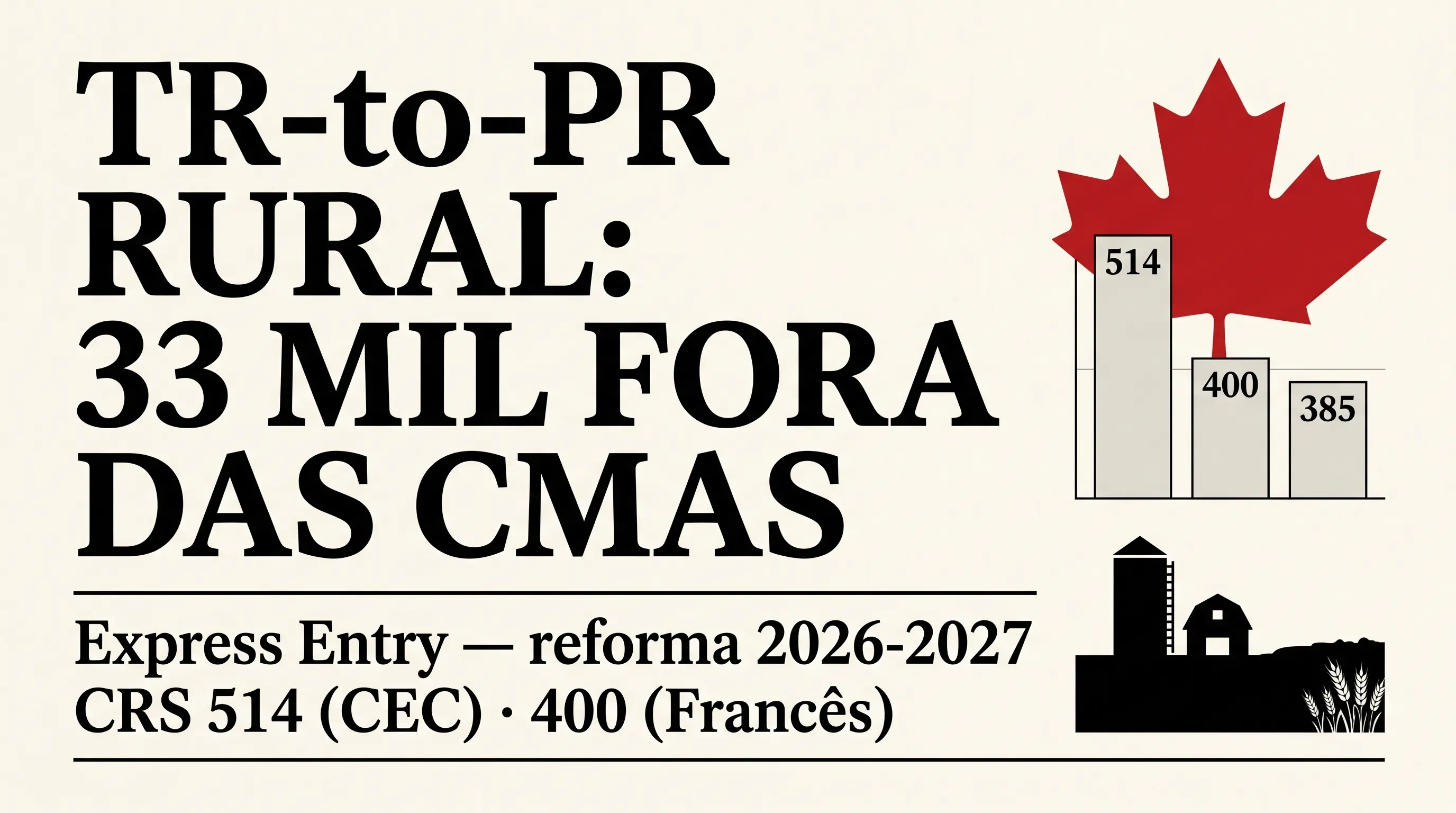
Ep 510: Express Entry, rural TR-to-PR and CRS 514 [Canadian Immigration Institute]
Ep 510 of the Canadian Immigration Institute (April 30, 2026): rural TR-to-PR for 33,000, CEC at CRS 514, French draw at 400, Express Entry reform.