NOTÍCIAS
How Canada's new PR program will work: what we already know
In this article
What will replace Express Entry in Canada: a unified new federal class, the likely criteria, and what the 2026 consultations have revealed so far.
This is Part 2 of the series. Read Part 1 first: Part 1: The investigation, what the Forward Regulatory Plan says.
The IRCC Forward Regulatory Plan confirms that a new federal immigration class will replace Express Entry as we know it. What will this new class look like in practice?
Here is what we can already tell from the public documents and the consultations that took place in April and May 2026.
The problem IRCC is trying to solve
Today’s Express Entry has three separate streams: Federal Skilled Worker (FSW), Canadian Experience Class (CEC), and Federal Skilled Trades (FST). Each has different eligibility criteria, different minimum scores, and serves a different profile.
This fragmentation has created distortions over the years:
- Candidates with similar profiles qualify under one stream but not the other
- The introduction of category-based draws fragmented the system even further, creating parallel logics that do not always talk to the three base streams
- The selection logic is not immediately transparent to someone building a profile for the first time
IRCC’s proposal is to consolidate the three into a single class with simplified requirements and a more direct selection logic.
What changes in selection: the signals from the 2026 consultations
The public consultations of April and May 2026 revealed the direction IRCC wants to take. These are not final criteria. They are signals of what is being designed.
More weight on earning potential
Canada is signalling that the new class will give more weight to candidates’ earning potential and employment outcomes, not just the CRS score accumulated through certificates and diplomas.
In practical terms: someone with a job in a high-demand sector and a competitive salary may have a relative advantage over someone with a master’s degree in a low-demand field, even if both have the same level of English. The system wants to select those with the highest probability of economic success in Canada, not just those with the most years of formal study.
A single class instead of three streams
Instead of choosing between FSW, CEC, and FST, each with its own criteria, different minimum scores, and distinct CLB requirements, the candidate will fit into a single class. Eligibility will be defined by the new regulation in the IRPR, with consolidated criteria.
For Brazilians who are in Brazil today, this change may simplify entry: instead of having to figure out which of the three streams applies to your profile, there is a single point of entry.
Will the CRS still exist?
Probably yes, but possibly reworked. The consultations did not indicate the elimination of the Comprehensive Ranking System, but the weight of each factor may change significantly. The clearest signals point to:
- More weight: the salary of the job offer, Canadian experience in high-demand sectors
- Less relative weight: years of formal study disconnected from the labour market
None of this is confirmed. When the draft regulation is published in Canada Gazette Part I, the exact criteria will appear there first.
The role of the EMPP: the second program under discussion
The Forward Regulatory Plan has a second relevant entry: the proposal to make the Economic Mobility Pathways Pilot (EMPP) a permanent federal program.
The EMPP was created to ease access to PR for skilled refugees and people in vulnerable situations who have economic qualifications. It was a pilot, and the proposal was to create a new economic class in the IRPR with its own selection criteria, making it permanent.
What actually happened: IRCC paused the EMPP at the end of 2025. Applications submitted by December 31, 2025 continue to be processed, but there have been no new intakes since then. The proposal to make it permanent still appears in the Forward Regulatory Plan, but the current status is an indefinite pause.
For most Brazilians, the EMPP was never a relevant route. It was designed for a very specific profile. But it shows up in this story because the logic of creating a new economic class in the IRPR with its own criteria is exactly the same architecture being proposed for the replacement of Express Entry.
Expected timeline
Based on the standard Canadian regulatory process:
- Public consultations happened in April and May 2026 (completed)
- Publication in Canada Gazette, Part I draft regulation open for additional comments (date not announced)
- Canada Gazette, Part II final regulations published
- Program launch applications open with confirmed criteria
In Canadian immigration, the path between public consultations and launch usually takes 6 to 18 months, depending on political and operational complexity. The new program will probably not be available in 2026.
Who tends to win and who may be affected
Based on the signals available today, not on confirmed criteria:
Profiles that tend to benefit from the new logic:
- Candidates with a job offer in a high-demand sector and a competitive salary
- Candidates with Canadian experience directly relevant to the local labour market
- Candidates with strong English and a projected salary above the sector average
Profiles that may need to adjust strategy:
- Candidates who qualify today via FST (Federal Skilled Trades), since that stream has specific criteria for trades workers that may not have a direct equivalent in the new class
- Candidates who use FSW purely for the years-of-study score, without work experience in a high-demand sector in Canada
These are readings of the available signals, not guarantees. The final criteria may be different.
Continue with Part 3: Questions and answers, what to do now, whether it is worth staying in Express Entry, and when to expect the new program.
The Vancouver Letter
You made it this far. That tells me something.
The Vancouver Letter is the letter I wish someone had sent me the third time I tried for Canada, when I had no idea what I was doing wrong. Once a week, straight to your inbox. No products, no courses, just what actually works. I got your back.
Get immigration updates
Practical tips straight to your inbox.
Related articles
Canada Is Creating a New PR Program, and the Government Already Published the Template
A Canadian immigration lawyer revealed that a new PR program is being created. I dug into it and found the source in IRCC documents.
Canada's New PR Program: Answers to the Most Common Questions
When does the new PR arrive? Is Express Entry still worth it? What to do now? Direct answers about the 2026 reform of Canada immigration system.
Ep 510: Express Entry, rural TR-to-PR and CRS 514 [Canadian Immigration Institute]
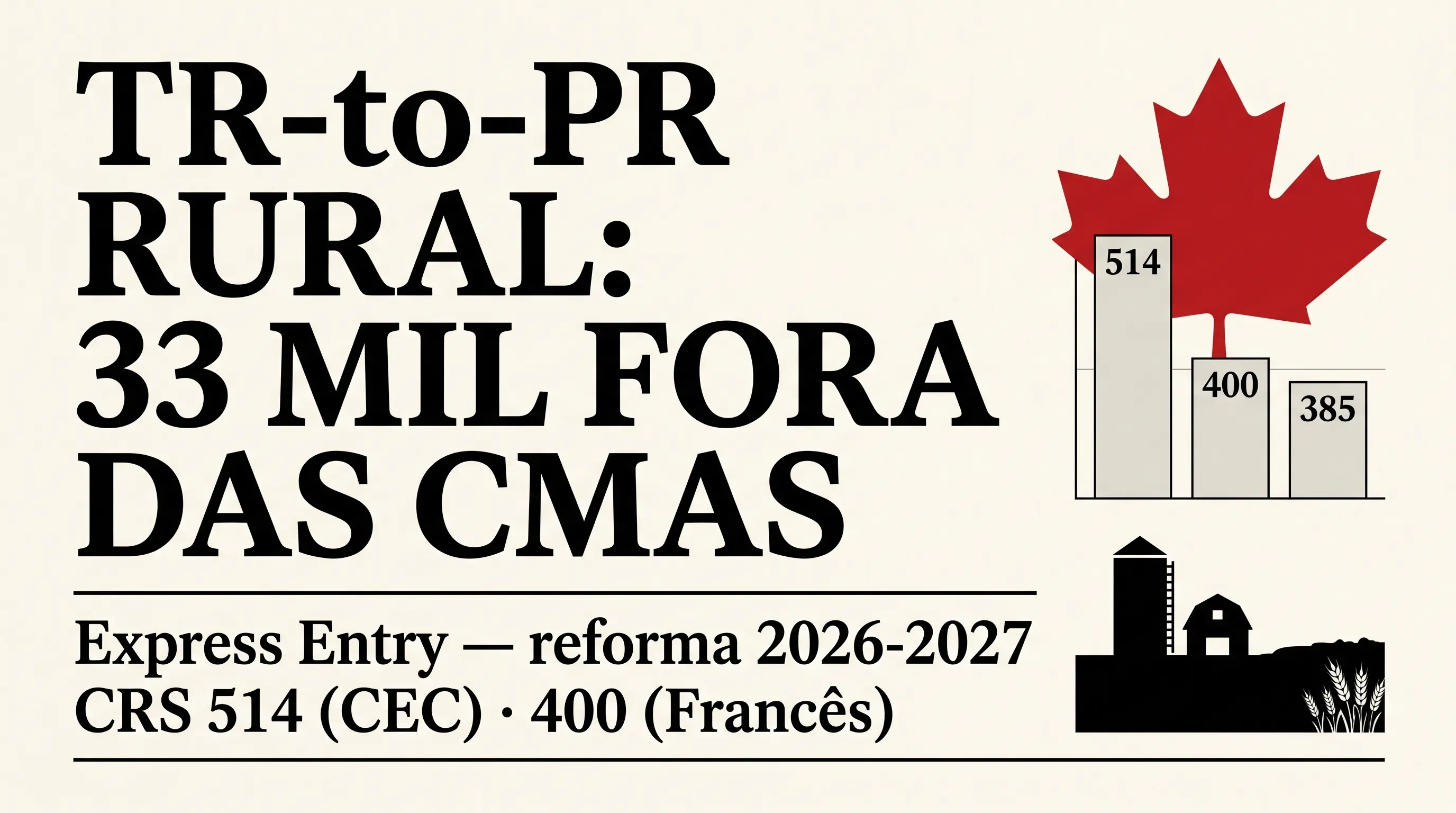
Ep 510 of the Canadian Immigration Institute (April 30, 2026): rural TR-to-PR for 33,000, CEC at CRS 514, French draw at 400, Express Entry reform.