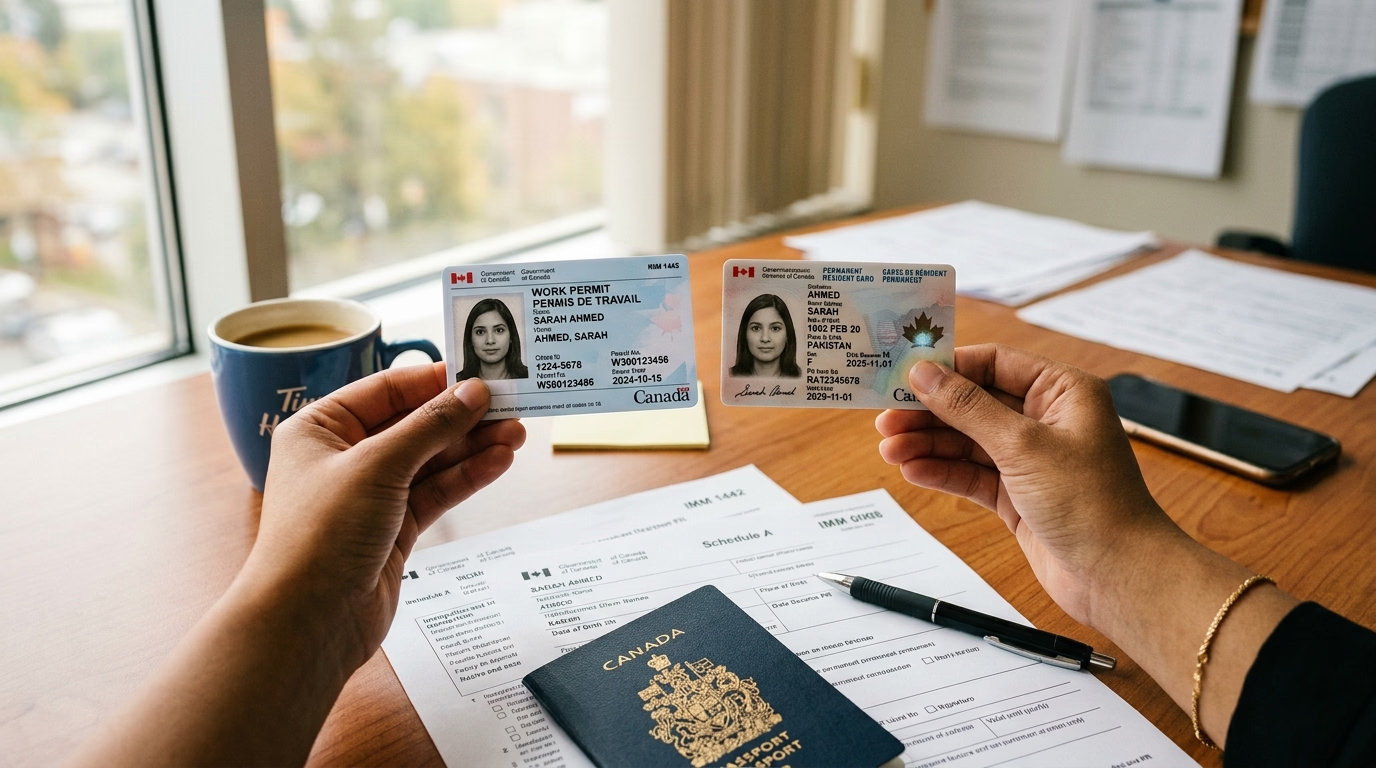
NOTÍCIAS
TR to PR: 33,000 spots in 2026, what we know and what we DON'T know
In this article
TR to PR 33,000 spots: 12 unanswered questions, no portal, no criteria. A data analyst's cold take. How to prepare right now.
IMMIGRATION 2025 and 2026: What will REALLY change in 2026 | Pt 03, EP 27
Como conseguir a residência permanente no Canada
Trabalhe no Canadá SEM LMIA (legalmente)
Over the last few days, my WhatsApp blew up. The Brazilians-in-Canada group, the people-planning-to-move group, the church group, the tech group, everyone saying the same thing: “Caio, did you see it? 33,000 spots to get PR! When does it open?” And there I was, phone in hand, thinking: easy, everyone. Because I’ve seen this movie before.
When the news dropped that Canada announced a TR to PR pathway with 33,000 spots for temporary workers in in-demand sectors, I did what any data analyst would do, I went after the numbers. And man, what I found was… confusing. Very confusing. And that’s exactly why I’m writing this article.
Because there are a lot of people out there celebrating like they already have PR in their pocket, and a lot of people paying consultants to “secure a spot” in a program that doesn’t even have an application portal. I need to tell you what’s fact and what’s speculation. No hype, no fear. Just data.
What was announced, just the facts
Let’s get to what we actually know, without dressing it up:
- The Canadian government announced a TR to PR pathway with 33,000 spots to convert skilled temporary workers into permanent residents
- The program covers two years (2026-2027)
- The immigration minister described it as a “soft launch”, in his words, “we have launched it already”
- The focus is on temporary workers in high-demand sectors
- More clarity was promised for April 2026
So far, fine. Sounds exciting, right? Now here’s the part nobody’s talking about.
What was NOT announced, the 12 unanswered questions
I listed everything we don’t know. And look, it’s a lot:
- There is no application portal. No link, no form, no guide on the IRCC site. Nothing.
- There is no program page on the IRCC site. Literally zero. Go look. You won’t find it.
- We don’t know if it’s a new program or embedded in Express Entry. The 33,000 spots don’t appear as a separate line in the Levels Plan 2026.
- We don’t know who is eligible. Students? Visitors with a work permit? Only workers with LMIA? Francophones? Nobody confirmed.
- We don’t know the work experience requirements. How long? Which NOC? Does full-time or part-time count?
- We don’t know if it will be race-to-file (first to submit wins) or merit-based selection (Express Entry style, with ranking).
- We don’t know which sectors count as “in-demand” in this specific context.
- We don’t know the language requirement. CLB 4? CLB 5? CLB 7? English only, or French too?
- We don’t know if co-op counts as work experience.
- We don’t know if there’s a cap per province.
- We don’t know if dependents are included in the 33,000 spots (which would drastically reduce the real number of principal applicants).
- We don’t know the opening date.
That’s TWELVE fundamental questions with no answer. And when someone tells you they know the answers, be suspicious. Because the government itself hasn’t published anything official yet.
I’m a data analyst. My job is to separate signal from noise. And right now, man, there’s a lot of noise and very little signal.
The 2021 precedent, what history teaches us
This isn’t the first time Canada has done something like this. In 2021, there was a TR to PR program that’s the closest benchmark we have. And it’s worth a careful look, because what happened there can give clues about what’s coming now.
The 2021 numbers:
| Aspect | TR to PR 2021 | TR to PR 2026 |
|---|---|---|
| Spots announced | 90,000 | 33,000 |
| Format | Standalone program | Unknown |
| Mechanics | Race-to-file | Unknown |
| Streams | Students, essential workers, francophones | Unknown |
| Speed | Filled in hours/days | N/A |
The 2021 program was standalone, separate from Express Entry, with its own forms and portal. It had multiple streams: one for international students, another for essential workers, another for francophones. And it was race-to-file, literally whoever submitted the complete application first got the spot.
And what happened? Chaos. The system filled up so fast that around 7,000 to 8,000 extra applications were accepted because they were submitted simultaneously. Processing? Some got PR in 2 weeks. Others submitted in 2021 and only got PR in 2024. Three years apart in the same program.
Oh, and one detail: in February 2021, there was a historic CEC draw, 27,332 invitations with a minimum CRS of 75 points. Seventy-five. Basically everyone in the pool got invited. Nothing like that ever happened again. It was a complete anomaly.
My lesson from 2021: when the government opens a door like this, you have to be ready before the door opens. The people who had their documents organized made it. The people scrambling for a medical exam and police certificate at the last minute lost out.
My theory, the data analyst’s view
Ok, now I’ll put on my analyst hat and give you my honest read. This is opinion, not fact, and I want to make that clear.
When I look at the Levels Plan 2026, the numbers are:
- 380,000 total planned admissions
- 239,800 through the economic immigration stream
- 395,000 reduced PR target (it used to be a pace of 500,000/year)
Now, the 33,000 TR to PR spots… where are they in this plan? Because I looked and I couldn’t find them as a separate line. And that makes me think something: these spots might not be a new program. They might be a reinterpretation of things that already exist.
There’s a real possibility that the 33,000 spots refer to:
- 10,000 extra PNP allocations for francophones and physicians that some provinces received
- New categorized Express Entry draws focused on physicians, researchers, senior managers, and military personnel
- A combination of existing programs repackaged under a new narrative
I’m not saying that’s what it is. I’m saying it’s possible. And the fact that IRCC hasn’t corrected or clarified the minister’s statements makes me even more cautious. If it were a new, robust program, it would already have at least an info page, right? Like it did in 2021.
Another thing that bothers me: Canada has a target to reduce its temporary resident population to under 5% by 2027. In 2025, 2.1 million temporary statuses expired. In 2026, the expectation is 1.9 million. Converting 33,000 to PR, even if it’s a real, standalone program, is a drop in the ocean. It doesn’t solve the structural problem.
So my theory? I think the government made a political announcement before having an operational program. And now it’s deciding how to implement it, or whether it’ll just point to categorized draws and PNPs and say “there you go, those are the 33,000 spots.”
I could be wrong. I actually hope I’m wrong, because a standalone program would benefit a lot of people I know. But as an analyst, I have to follow the data, not the hope.
The prep checklist, what to do NOW
No matter how this program ends up working, whether it’s standalone, repackaged Express Entry, or turbocharged PNP, one thing is certain: whoever is prepared will benefit. And whoever isn’t will be left behind again, just like 2021.
Here’s the complete list of documents and prep. It’s not a suggestion, it’s a requirement if you want a shot:
1. Passport with significant validity left. If it’s close to expiring, renew now. Don’t wait.
2. Immigration medical exam (IME). Valid for 1 year. Book it with an IRCC-designated panel physician. This takes time and there’s a queue, so if you leave it for when the portal opens, you’re done.
3. Police clearance certificates from EVERY country you’ve lived in. Brazil, Canada, anywhere else. The FBI one if it’s the US. Each country has its own process and timeline. Start yesterday.
4. Canadian education documents (if applicable). Diplomas, transcripts, letters from the institution.
5. Educational Credential Assessment (ECA). If your degree is from outside Canada, you need the equivalency through WES, IQAS, or another recognized body. This takes weeks, sometimes months.
6. Work experience reference letters. From Canada and abroad. With details: job title, dates, weekly hours, responsibilities, NOC. Ask your employer now, not the day the portal opens.
7. Language test, THE MOST CRITICAL BOTTLENECK. Man, if you haven’t done IELTS, CELPIP, TEF, or TCF, book it NOW. Test centres fill up when new-program news drops. In 2021, people couldn’t get a language test slot for months. And without a test, your application is worth nothing. Zero. It doesn’t matter if you have 10 years of experience, without a language test you don’t apply.
8. Passport photos less than 6 months old.
9. Birth certificates for dependents (children, partner).
10. Marriage certificate or proof of common-law relationship.
11. Proof of name change (if applicable).
12. Proof of entry and status in Canada. Work permit, study permit, visitor record, all organized.
I learned this the hard way. When Clara and I came to Canada in September 2024, after 3 visa refusals, we had a folder with EVERYTHING organized. Every document, every translation, every apostille. And that made all the difference. You can’t improvise immigration, man. You can’t.
WATCH OUT, what NOT to do right now
This section is the most important in the whole article. Read it carefully.
Do NOT pay anyone who says they can “secure your spot.” Nobody can. The program doesn’t even have an open portal. Anyone charging to “sign you up” is selling something that doesn’t exist yet. Period.
Do NOT sign a contract with a consultant based on this announcement. There are consultants out there already enrolling clients, charging entry fees, promising a “priority queue.” Priority queue for what, man? There’s no queue. There’s no system. There’s nothing published.
If you ALREADY have an immigration representative, ask one simple, direct question: “Where exactly am I in your application queue?” If the person can’t answer clearly, if they stall, if they say “we’ll see when it opens”, that’s a red flag.
Do NOT make big financial decisions based on this announcement. Don’t quit your job, don’t cancel plans, don’t go into debt thinking “PR is guaranteed.” The program might open tomorrow. It might take 6 months. It might not exist as a standalone program at all.
Do NOT panic if you don’t qualify. We don’t even know the criteria yet. You might qualify and not know it. You might not qualify for this program but qualify for another. Breathe.
I’ve lost money on a rushed immigration decision before. I’ve paid for a service I didn’t need. I’ve fallen into despair thinking the door was about to close. And you know what I learned? That the door never closes completely, it moves. And whoever is prepared finds the new door faster.
Who probably will NOT qualify
Based on all the previous TR to PR programs, I can say with reasonable confidence who probably will not qualify:
- People outside Canada. Every TR to PR program requires presence in the country. If you’re not in Canada, this isn’t your pathway. Focus on regular Express Entry or PNPs.
- People without valid work authorization. A visitor visa on its own probably doesn’t count. You need an active work permit.
- People without Canadian work experience. Every previous program required at least 1 year. There’s no reason to think this one will be different.
- Co-op alone probably doesn’t count. In 2021, co-op counted in some circumstances, but that’s the exception, not the rule. Don’t count on it.
So what do we do?
I know this article isn’t what a lot of people want to hear. People want certainty. They want “do this, then that, and in 6 months you have your PR.” I wanted that too.
But honesty is more useful than empty hope. And the honest truth is: we don’t know enough yet.
What we do know is that Canada needs immigrants. The economy needs them, the demographics need them. The targets of 380,000 annual admissions won’t fill themselves. The country wants to convert skilled temporary residents into permanent ones, that’s official policy, not speculation.
So the strategy is simple: prepare as if the program opens tomorrow, but don’t panic as if it closes today.
Take the language test. Organize your documents. Ask for reference letters. Do the medical. Put it all in a folder and wait. When, and if, the portal opens, you’ll be at the front of the line. And if it doesn’t open as a standalone program, all of this works for Express Entry, for PNP, for CEC.
No immigration document gets thrown away. Every bit of prep counts toward something.
And man, if you’re not studying French yet, I’ll say it for the thousandth time, start now. Canada has categorized draws for francophones with CRS way down low. Francophone Mobility is the pathway I’m using. And no matter what happens with the 33,000 spots, French opens doors that English alone doesn’t. Check out the 2026-2028 immigration plan to understand the full context.
I got your back
I know immigration is exhausting. I know the uncertainty hurts. I know you wanted to open this article and find a link to sign up and a date to mark on the calendar. I wanted to give you that too.
But I’d rather be the guy who tells you the truth than the guy who sells you an illusion. When there’s concrete news, an open portal, published requirements, confirmed dates, I’ll be the first to write about it. I’m monitoring this every day, because it affects my life too.
In the meantime: documents, language, preparation. That’s the game. It always was.
And if someone comes to sell you certainty about this program, remember me saying: nobody knows yet. Not me, not a consultant, not the guy in the WhatsApp group. The only one who knows is IRCC, and even they seem to be deciding as they go.
I got your back on this journey. Any news, I’ll update it here. Trust me.
Frequently asked questions
What do we know about the 33,000 TR to PR spots in 2026?
Which questions are still unanswered about the TR to PR program?
What happened with the 2021 TR to PR program (the precedent)?
Who probably will NOT qualify for the TR to PR program?
Which documents should I prepare now for TR to PR (and other programs)?
This article will be updated as soon as IRCC publishes official information about the program. Follow MorarFora so you don’t miss any news.
The Vancouver Letter
You made it this far. That tells me something.
The Vancouver Letter is the letter I wish someone had sent me the third time I tried for Canada, when I had no idea what I was doing wrong. Once a week, straight to your inbox. No products, no courses, just what actually works. I got your back.
Get immigration updates
Practical tips straight to your inbox.
Related articles
Ep 509: TR-to-PR, Express Entry and LMIA in 2026 [Canadian Immigration Institute]
Episode 509 of the Canadian Immigration Institute channel: minister Diab TR-to-PR communication torn apart and the 3 Express Entry changes detailed.

Ep 510: Express Entry, rural TR-to-PR and CRS 514 [Canadian Immigration Institute]
Ep 510 of the Canadian Immigration Institute (April 30, 2026): rural TR-to-PR for 33,000, CEC at CRS 514, French draw at 400, Express Entry reform.
How Canada's new PR program will work: what we already know
What will replace Express Entry in Canada: a unified new federal class, the likely criteria, and what the 2026 consultations have revealed so far.