NOTÍCIAS
Canada added 88,000 jobs in May 2026: did the market turn?
In this article
Canada added 88,000 jobs in May 2026, the biggest gain in six months, and unemployment fell to 6.6%. What that changes for Brazilians job hunting.
The sector that created the most jobs in Canada in May was construction, +27,000 positions in a single month, and I know firsthand what that number means. My first job here was demolition on a construction site, CAD 23 an hour, a week after I landed in Vancouver. So when Statistics Canada releases a number like this, I don’t read it as an economist: I read it as someone who once depended on exactly that kind of job to pay the first month’s rent.
And the May number came in strong. Canada added 88,000 jobs, the biggest monthly gain since December 2024, after four straight months of losses. But one good month is not a trend, so let me show you what the number hides and, above all, what it changes for anyone sending out résumés right now.
How many jobs did Canada add in May 2026?
Canada added 88,000 jobs in May 2026 (+0.4%), the biggest monthly gain since December 2024, according to Statistics Canada. The market expected only 10,000, so the number came in almost nine times higher. And more important than the size: this gain reversed much of the 112,000 jobs lost in the first four months of the year. The unemployment rate fell from 6.9% to 6.6%.
There’s one detail that makes the number look even better: the gain was in full-time work. There were +154,000 full-time jobs against −66,000 part-time, which means Canada didn’t just add jobs, it traded gig work for steady employment. For anyone watching Express Entry, this matters directly: full-time skilled work experience is what scores points on the CRS and what qualifies you for the Canadian Experience Class. A strong full-time month is a good month for anyone building eligibility.
Which sectors hired the most in May?
Construction led, with +27,000 jobs (+1.7%), followed by information, culture and recreation (+19,000), transportation and warehousing (+19,000), accommodation and food services (+17,000) and manufacturing (+15,000). These are largely the same sectors that employ the most newly arrived Brazilians, construction, restaurants, logistics, before a person manages to move into their trained field.
That was roughly my path. I started in demolition, paid by the hour, and today I work with data at an artificial intelligence startup. Your first job in Canada is rarely the one matching your training: it’s the one that pays the rent while you build a Canadian résumé, earn certifications, and do the networking that opens the next door. When these entry sectors are hiring, and in May they were, the door is easier to push for someone who just arrived.
Unemployment fell, but did it fall for everyone?
Not equally. Overall unemployment fell to 6.6%, but for young people aged 15 to 24 it stayed at 13.4%, double the average, even after dropping 0.9 points in the month. Among adults aged 25 to 54, women closed May with 5.5% unemployment and men with 5.7%. If you’re an international student competing for a part-time job, it’s that 13.4% that describes your reality, not the 6.6% headline.
And here’s an honest warning, because it protects you from falling for misinformation: Statistics Canada does not publish, in this monthly report, an unemployment rate broken out by immigrant or recent arrival. So any post you see out there stating “immigrant unemployment in May was X%” is very likely making the number up. What you can say with the data in hand is the general picture, and the general picture improved in May.
Did wages rise? Can they keep up with inflation?
They rose, and above inflation. The average hourly wage rose 3.0% over 12 months, reaching CAD 37.24, an increase of CAD 1.10. Since March inflation (CPI) was 2.4%, the real gain was positive: on average, the Canadian wage bought a little more in May than a year earlier. The key phrase is “on average”, because a newcomer almost never starts at the average.
When I was earning CAD 23 an hour on the site, I was well below that CAD 37.24 national average. And that’s fine: the entry wage is not your ceiling, it’s your first step. The number that matters for your planning isn’t today’s average, it’s the distance between your first wage and that average, and how fast you close that distance with Canadian experience, language, and recognized credentials. Wages rising in the aggregate means the next step is a little higher when you reach it.
What does this change for Brazilians looking for work in Canada?
It changes how you read the moment, on three concrete fronts. First: the market turned, but it turned cautious. One month of +88,000 after four negative months is relief, not a party. The year is still close to break-even when you add everything up. Don’t arrive thinking it got easy; arrive knowing it stopped getting worse.
Second: the entry sectors are open. Construction, accommodation and food services, transportation and logistics drove the gain. That’s exactly where a newcomer lands the first “yes”. Don’t dismiss the entry job for being below your training, it’s the one that generates the Canadian experience the rest of the process demands.
Third: a full-time job is immigration ammunition. The May gain was full-time. If you’re building points for Express Entry or work time for the Canadian Experience Class, a qualified full-time job is worth far more than two gigs combined. When you have to choose, weigh that.
What would I do in your place?
I’d celebrate the number with one foot on the brake. May was the best month in six, and that’s real, but one swallow doesn’t make a summer, and four straight bad months don’t become a good trend because of one month. I’d look at the May data as a door that opened, not as a market that changed its nature. In practice: if you’re looking, apply now, while the entry sectors are hiring, without waiting for the June data to “confirm” it. If the window is open, you go through it today. In immigration, the job you take in the hot month is the one that gives you room to choose better in the cold month.
Frequently asked questions
How many jobs did Canada add in May 2026?
What was Canada's unemployment rate in May 2026?
Which sectors hired the most in Canada in May 2026?
Are wages in Canada keeping up with inflation in 2026?
Is Canada's labour market improving for immigrants?
Sources
- Statistics Canada, Labour Force Survey, May 2026 (The Daily, 05/06/2026): employment +88,000, unemployment 6.6%, full-time +154,000, construction +27,000, average wage CAD 37.24 (+3.0% over 12 months): https://www150.statcan.gc.ca/n1/daily-quotidien/260605/dq260605a-eng.htm
Canadian labour market data comes out every month, free, in Statistics Canada’s The Daily, and it feeds directly into the Bank of Canada’s next rate decision. The next jobs report covers June and lands in early July.
The Vancouver Letter
You made it this far. That tells me something.
The Vancouver Letter is the letter I wish someone had sent me the third time I tried for Canada, when I had no idea what I was doing wrong. Once a week, straight to your inbox. No products, no courses, just what actually works. I got your back.
Get immigration updates
Practical tips straight to your inbox.
Related articles
The Canadian dollar just hit a 14-month low. Your reais barely felt it
The Canadian dollar fell to a 14-month low (1.4146 per USD) after the Fed's June 17 hawkish turn. But BRL/CAD held near R$3.63, so your reais barely moved.
Oil and gas in Canada: production at a record, investment down 12.6%
Canada's oil and gas companies cut capital spending 12.6% in Q1 2026, even with oil production and exports at record highs. What it changes.
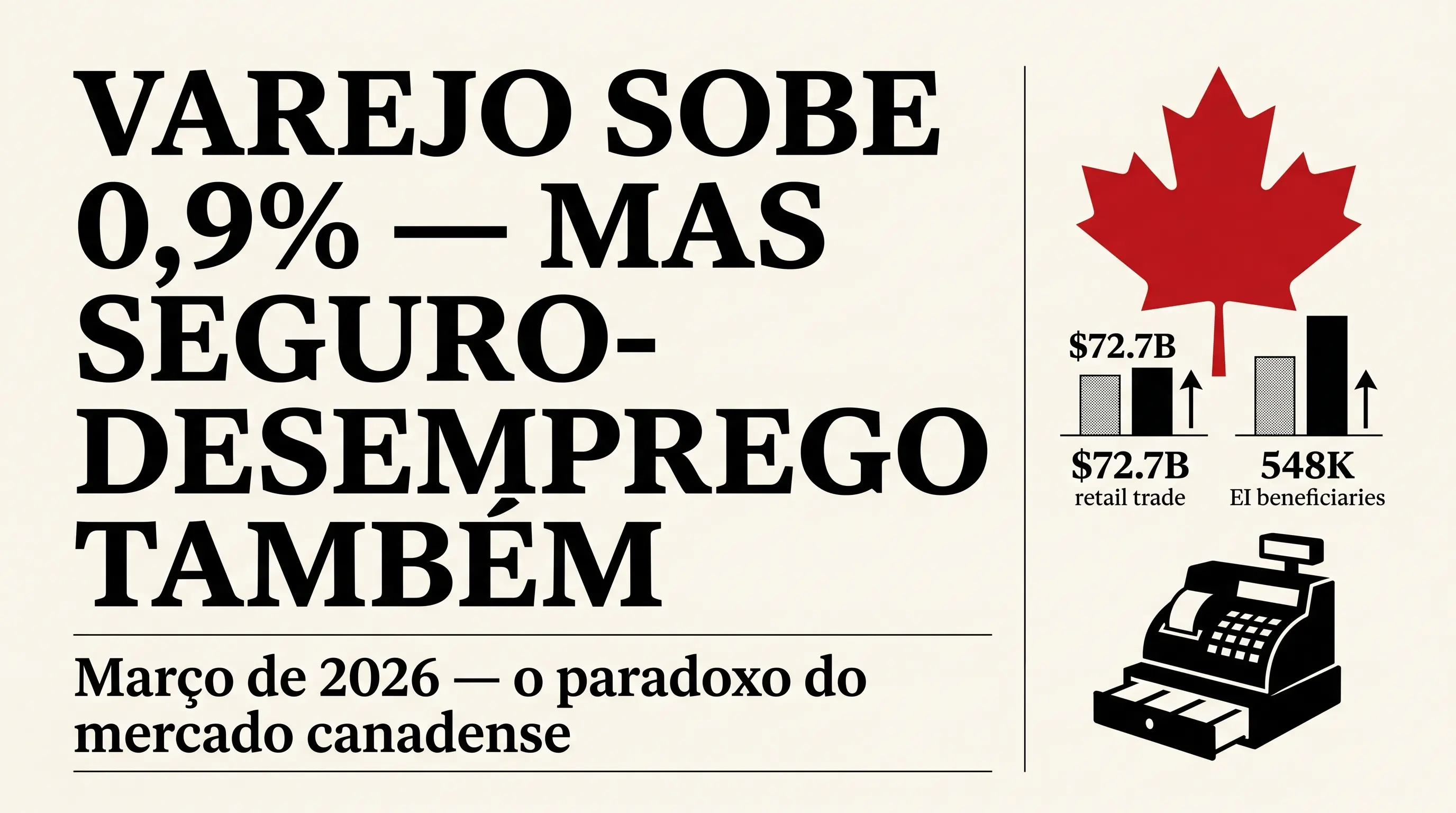
Retail and employment insurance in Canada in March 2026: the paradox
Canadian retail rose 0.9% in March (CAD 72.7B) but excluding gas it fell 0.1%. EI rose 8.7% over 12 months; Ontario leads at +22.2% YoY.